

Related

Behavioral Finance
Thinking about the various ways the future could play out can help you prepare for unfavorable outcomes and avoid irrational decisions.
Charles Rotblut leads a class in AAII's new Essential Investing Video Course. Go to https://www.aaii.com/ves for more information and to subscribe.
Article Highlights
Annie Duke is an author, corporate speaker and consultant on the behavior of decision-making and a former professional poker player. Her latest book is “Thinking in Bets: Making Smarter Decisions When You Don’t Have All the Facts” (Portfolio, 2018). We spoke about limiting the impact that emotions have on decision-making and thinking in probabilistic terms.
Charles Rotblut (CR): Given your background of studying cognitive science and playing poker professionally, what advice can you share about how to think rationally when facing a big monetary decision—especially a decision when there is the potential for a big loss if the outcome turns out to be unfavorable?
Annie Duke (AD): First, I’m assuming you’ve thought about what your tolerance is for risk of ruin. I’m assuming you’re only risking what you can lose and still be okay financially.
I think one of the best things to do is to get yourself into a more rational place of thinking about it. Look at what the probabilities are. First, imagine the future where you’ve won and what it feels like. Think about what probably had to happen for you to win.
Let’s say you’re investing in some kind of instrument and you’re telling yourself, “I’m going to make this investment and now I’ve won big at it.” What happened with this particular instrument in order for you to win? Hopefully, the outcome is not dependent on a big market move because you better be getting paid a lot for taking that chance.
Then, live on the bad side. Do a premortem and say, “I lost.” Ask “what likely happened in order for me to lose?” That’s going to allow you to think about what the probability of those bad things are. It might get you to catch some things that might have a very high likelihood of going wrong. It actually might change your mind about the investment you’re going to make.
On the good side, if you’re thinking about what had to happen for you to win, you might catch something that has a very low likelihood of happening that needs to happen along the way for you to actually have a win. That might change your mind about the investment as well. So, sort of go into the future and think about the things that need to occur both in order to get to the good results and in order to get to the bad results. That’s step number one.
By the way, just because something has a very low probability of occurring doesn’t necessarily mean that you should not be investing in it. Assuming the return is high enough, you still might. So, let’s just keep that in mind, because I don’t want to take that part out of the equation.
The other thing that imagining the future does is allow you to think in advance. What’s the probability of a loss? Thinking about it in advance, it allows you to do the processing and to consider what that’s going to feel like before it actually happens. It allows you to recognize, “I’ve got an 80% chance of winning and a 20% chance of losing. When I lose it’s going to feel really horrible, but it’s already baked into the decision. I’m going to deal with this in advance of it occurring because then when it actually occurs it won’t feel so bad, because I’m going to recognize it was just part of the 20% of what the future landscape looked like.” You’re just more emotionally prepared for it to occur.
When you do that, what happens is those analyses get you out of your emotional mind. The emotional part of your brain actually has an inhibitory relationship with the frontal cortex, which is the more rational part of your brain. By getting into your frontal cortex and doing these kinds of analyses, it activates the executive functioning parts of your brain. That’s what calms your emotions down and allows you to get into a more rational place as you’re trying to think about a decision. It also really gets you to this place where you start to recognize more clearly that, of course, there’s always some probability of a bad outcome. You bake it into the decision in advance and get really comfortable with it so that you can just say, “Well, yeah, that could have occurred.” It allows you to move on and not become so reactive to it.
CR: What if it is a scenario where the outcomes are more uncertain? In your book, you wrote about helping a nonprofit prioritize going after grants they are more likely to win, but if we’re talking about investing, there are more variables. We have a market with many participants who can make a variety of decisions, plus other influencing factors such as the economy, interest rates, etc. How does an individual investor make a judgment about odds when there are a lot of variables that are just completely beyond their control?
AD: I was using the example of the nonprofit because I was trying to give a simplified example of a scenario where there’s two outcomes: They receive the grant or they don’t. In most things—just as you talked about with the financial markets—it’s more complicated. But when you’re participating in the market, you’re trying to think about the different outcomes that can occur.
So first of all, work to try and identify what the possible outcomes are, and just try to capture as many of those as possible. Try to model the future as well as you can, understanding that it can’t be exact. Then as you’re trying to figure it out, consider what the different scenarios are that could affect the decision. Take a stab at the probability of those things occurring (Figure 1).
Performing reconnaissance on the future can help lead to better decisions. If a decision is a bet, based on beliefs, on a particular future occuring, then before the bet is placed we should consider in detail what those possible futures might look like.
To do this, imagine the range of potential futures, such as all of the scenarios the data could support. Then, make the best guess about the probability of each of those futures occurring.
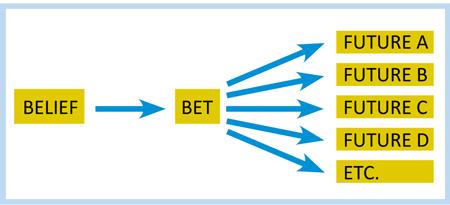
This exercise is not about approaching future predictions from a point of perfection. It’s about acknowledging that a prediction about the future is being made every time a decision is made. By at least trying to assign probabilities, we move away from believing the outcome will turn out one way or another.
Source: Annie Duke, “Thinking in Bets” (Portfolio, 2018).
The reason why I say take a stab at it is because of what you just said. You know you’re dealing with something where there’s a lot of hidden information. As you’re trying to gather as much information as you possibly can, it’s going to be incrementally helpful to the decision.
Hopefully you stress test and get people to red team it for you. In other words, you’re bringing other people into the decision that may have different, diverse views than you about what the future might look like. You get them into the decision process. You then try to map the future to take a stab at the probabilities. Can you be exact in the probabilities? Of course not. But if you don’t try at all, it’s like you’re ignoring that it’s probabilistic in the first place.
If you don’t take a stab at it, you’re acting as if it’s just somewhere between 0% and 100%, implying that you don’t know. Or maybe you’re acting like it’s 100%, like you’re sure, which is another type of mistake we make. “Well I’m just sure that this is going this way, it’s a sure thing.” That’s obviously not a good thing to do either.
We’re not just saying, “I don’t know, it’s between 0% and 100%.” The fact is that you do know something. If you can take some sort of guess about a scenario that might occur in the future, you may get to where you say, “I think that between 30% and 70% of the time this happens.” It doesn’t feel that exact, but it’s a lot more exact than leaving it at, “I don’t know, it’s somewhere between 0% and 100%.”
Once you’ve actually done that and you say, “Okay, here’s the range,” as new information comes in, you’ll now be in a much more rational state to start refining that range because you’re focused on the fact that you’re trying to make these estimates and you’re trying to get these estimates to be better. So even if you look at something as simple as, say, applying for a grant, it’s very unlikely that you’re going to be able to say there is a 60% chance of getting the grant. You know it’s much more likely that you will think it’s between 40% and 65%. And this is better than not trying to calculate the probabilities at all.
You’re not going to be perfect at it. There are going to be things that occur that you didn’t predict, that you didn’t think about, but these become new information for you to incorporate into your future scenario planning. You’re going to say, “I think that these particular scenarios occur and here’s the probability with which I think those might happen.” You’ll recognize that these are estimates. They can’t be exact, but making a try at it is better than not trying at all. All of that gets you much more focused on refining your scenario planning because at least you’re focused on the right thing.
CR: In the case where somebody doesn’t have a group they can turn to for feedback on investing, they could look at the newspaper or see what strategists and analysts are saying just to get a sense for where they might be right or wrong or at least to get different viewpoints, correct?
AD: Right. It’s especially important to seek out opinions that disagree with you. This is because we naturally notice things that do agree with us, and we already know why we think that way. Our natural tendency is to go out and find people who agree with us so that we bolster our position. You really want to go and seek out opinions that disagree with you because they might provide you with new information. Those are the opinions that might point something out that you hadn’t thought about before, that might suggest something that requires a lot more explanation.
The key is that you need to go and seek that out—go on an information safari, basically. You actually want to do an exploration of the opinions that disagree with you. What researchers have found is that if you’re not doing this intentionally, if you’re forced to read stuff that disagrees with you, it will actually backfire. It will cause you to entrench in your original position. So, this has to come from you. You have to approach it in an open-minded way as an information seeker saying, “This is going to help me, I need to view this as helpful.”
When you make that mindset shift, you can view stuff that disagrees with you as being the most helpful for making the best estimates of the future as possible. It’s actually going to be helpful to you in figuring out what the lay of the land is and figuring out what the best decisions are.
CR: That ties into something else you wrote about: How people tend to take credit for good outcomes and blame others for bad outcomes. Could you elaborate?
AD: Sure. There’s a pattern that we do for ourselves and there’s a pattern that we do for other people. But let me make it clear that this pattern, in terms of how we interpret for other people, is actually only true if we consider ourselves in some sort of comparison, like they’re our peers or our competitor.
When we have a bad outcome, when we invest in something and it doesn’t work out, we tend to blame things that were out of our control. “Well you know that was crazy. There was so much volatility in the market. I couldn’t have predicted that ... you know there was nothing I could do about [blank].” For example, “How could I know that tariffs were going to be imposed and how that was going to affect things?” Saying, “I didn’t know that was going to happen” is a way to sort of offload the result, to not accept responsibility for your own decision, but rather attributing the outcome to something that was out of your control.
When a good outcome occurs, you onboard it to your brilliant decision-making and your brilliant ability to make really good investment decisions. And that’s true, by the way, not just in investing but generally in life. It’s called self-serving bias (Figure 2).
Every decision made is a bet on a certain outcome occurring. As the future unfolds into a set of outcomes, we are faced with the decision of determining why something happened the way it did.
When doing so, be cognizant of the self-serving bias. The self-serving bias leads us to blame bad outcomes on things that are beyond our control. It also leads us to attribute good outcomes to our ability to make good decisions. This bias causes us to avoid looking back at our own decision process and taking blame for a bad outcome. When there’s a good outcome, our tendency is to use it to bolster our decision process.
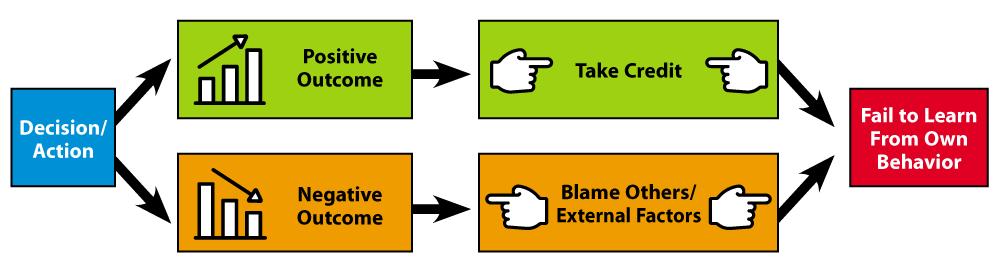
One way to fight this bias, and determine whether an outcome was due to skill or luck, is to ask if making the same decision again would predictably result in the same outcome. Alternatively, ask if changing the decision would result in a different outcome. If the same decision would predictably result in the same outcome, skill plays a big factor. If, however, an outcome occurs because of things we can’t control, the result would be due to luck.
In both cases, the idea is to focus on the process. Was there something you could have done better? Was there a mistake you made? If possible, find someone you can discuss your decision process and actions with to get objective feedback. When doing so, discuss your rationale and what you did, instead of the outcome.
I’ll give you an example from my children. My son would come home from school and he would have a really good grade on a test. When he did, it was always like, “I studied really hard and I really nailed it and I did such a great job.” When he would come home with a bad test grade, it was generally something like, “the test was really hard,” “the teacher put things on the test that they didn’t teach in class” and “the teacher doesn’t like me, you can ask anybody.”
You will notice none of the bad grades have to do with his own studying or brilliance, but they are all about things that he had no control over. This is really common. It’s an extremely common bias and it’s part of this broader pattern that when you have a bad outcome, you don’t want to go back and look at your own decision process and take blame. To do so, maybe that means that your decision process wasn’t good, and that doesn’t feel good. It kind of challenges the beliefs that you have.
Obviously if you have a good outcome, then you want to bolster your decision process. That’s sort of like the world agreeing with you that your strategy is right and the things that you think are right. The issue, of course, is that’s a huge problem for learning because there are lots of bad outcomes that are the result of perfectly good decisions, and there are lots of good outcomes that are the result of perfectly bad decisions.
This gets down to the heart of what I say in the book, which is that life is not much like chess. In chess, there’s very little hidden information and there is very little luck, so if you win a game of chess, you played well. If you lose a game of chess, you played poorly in relationship to the opponent you were playing against. It’s different than poker. In poker, I can have a pair of aces, which is the very best hand, and I can play it really well and still lose. I can also have a horrible hand, like a six and a four, play it pretty badly and still win because there’s a luck element involved.
Here is the simplest example of why self-serving bias is problematic. I’ve gone through red lights in my life and I haven’t gotten a ticket. I have had only good outcomes in my life from running red lights. I hope that doesn’t mean that I bolster the decision to go through red lights, except that’s what we tend to do.
When we have a really good outcome from an investment, our natural tendency is just to say, “I’ve made great investment decisions.” We’re bolstering the particular decision we made and we’re bolstering the strategy. It may be that we ran a red light and things just worked out okay because there’s a lot of luck. If we don’t examine that with a clear head and a clear eye, then we’re just going to bolster these decisions that maybe we shouldn’t bolster.
On the flipside, if I go through a green light and I get in an accident, that would be back luck. But what if I go through a red light and get in an accident and I just say, “Well, that was just bad luck. I had a bad outcome, and there’s nothing to be learned from it.” The fact is that in this case we can definitely say there’s something to be learned from it: Don’t go through red lights.
Yet, this is what we’re doing if we have a bad outcome and we say, “That wasn’t my fault, there were market conditions that I couldn’t predict that didn’t have anything to do with me.” What we’re announcing is that “there’s nothing for me to learn from it because it was completely out of my control.” But there very well might be something to learn from it. The self-serving bias really gets in the way of us being able to improve our decisions going forward.
CR: I wanted to ask you about emotions. If someone is in a situation where they feel their emotions are overtaking their ability to think rationally, do you have any suggestions on what they can do to try and gain back control? Or do you have suggestions on how to at least avoid making a decision when they’re feeling really emotional?
AD: Yes, absolutely. When you’re not in an emotional state and you are thinking rationally, think about the kinds of things that could get you into an emotional state where you’re not going to be a rational decision maker.
A very simple example would be when I am Sober Annie and I’m going to meet people for dinner. I know that there will be alcohol served. So Sober Annie thinks ahead and says, “You know what, after she’s had some alcohol, Annie may not necessarily be the best judge of whether she should be driving a car.” Once I recognize that some future version of me might make an irrational decision, I can do things to protect the future version of me from making those irrational decisions. I can take a ride-sharing service to dinner. Now, no matter what happens at that dinner, I have taken the choice away from myself to be able to get in a car and drive.
So, we can think about how we might apply that type of strategy. It’s called the Ulysses contract. It comes from the Roman name of Odysseus from the Odyssey. Ulysses knows that he’s going to be sailing past the island of the Sirens. The Sirens’ song is so irresistible to a human’s ears that it will cause Ulysses to steer the ship toward the shore. When any ship steers to the shore, it gets broken apart against the rocks. Ulysses recognizes this and he tells his crew to tie his hands to the mast of the ship so that he cannot steer the ship toward the shore. That’s the same thing as me taking a ride-sharing service; I’ve essentially bound my hands so that I can’t drive.
You can think about that in terms of your own emotional state. For example, if you incur a really big loss, you can imagine that you might get into a really emotional state where you’re going to make pretty poor decisions. So, think about how big of a loss you can stand. That’s a really good thing to do, actually set a loss limit. When you make that kind of commitment, you’re just less likely to be getting into emotional states in the first place because you’re setting loss limits that are within the bounds of what you think you won’t react emotionally to. The loss limit also stops you from making decisions in that moment because you’re just not allowed to invest more after that. I’m a big fan of those kinds of contracts with yourself.
Sometimes there are emotional states that come up that we don’t necessarily anticipate. Write a list of things that are really good signals of you getting into an emotional state. They might be physiological, like your cheeks start to flush, you get hot or you get that heart-racing feeling. Also write down some of the things that come out of your mouth when you know that you’re in a really emotional state and you may not be a good decision maker at that time. A really good one to write down would be a phrase like, “I can’t believe these things always happen to me.”
Make a list of these things. Pin it right in front of your desk. When those things happen, get up and walk away; just make a commitment to do that. Take 10 deep breaths, try to sleep on it or get yourself to a point where you’re calmer. Go do something to calm yourself down and then come back to whatever you’re doing with a fresh mind. The more that we explicitly think about the things that are going to be signs and symptoms, the better we’re going to be at catching and recognizing them.
CR: That’s good advice. Is there anything I haven’t asked you that I should have?
AD: I do want to emphasize that one of the things that makes us afraid of losing is that we’re not willing to allow ourselves to really examine losing in advance. I really do think that people are better off if they do this. It gets you much more comfortable with it, particularly if you’re really thinking about the probability of a bad outcome happening so you understand that it’s baked in. Because, otherwise, you become so defensive of the loss that you actually end up always just trying to minimize your losses. When all you’re doing is trying to minimize your losses, you tend to minimize your wins as well. There are some really bad things that can come out of just being emotionally afraid of losing. So, explore it. Get comfortable with it. Think about the probability of those things happening.
The other thing I would add to that is think about how your fear of losing might contribute to you being less likely to make innovative choices about what you’re doing. The reason I say that is that when we make a status-quo choice, the loss doesn’t feel as bad as when we have a loss that comes from an innovative choice. One of the ways I think that we will sometimes protect ourselves from the emotional feeling of losing, from the regret of losing, is by sticking to the status-quo choices.
I’ll give you a simple example that doesn’t have to do with investing, but I think it will get you to the right place. Let’s say you’re going somewhere with your partner and you have to be there at a certain time, say a dinner party or the movies. You take the route that you normally take and it turns out there’s tons and tons of traffic or maybe there’s a car accident along the way that makes you late.
You’re probably thinking, “What could I do … there was a lot of traffic,” because it’s the usual route you would take, right? Nobody is yelling at each other. It’s just sort of like, “Oh, what could you do?”
But what if you’re going with your partner to that exact same place and you say, “I just heard about this shortcut. Let’s take it.” The same thing happens; there’s a lot of traffic along the route. Now, there’s probably a lot of blame and recrimination going around. “I can’t believe you made us take this shortcut. Why’d you do this? Now we’re late.”
In both cases, the traffic is something that’s out of your control. You know traffic is unpredictable, but it’s only when you choose the thing that you normally don’t do that it feels really bad.
So, what I would suggest is people think about how that might apply to their lives when they’re investing. How much are you choosing the usual route because then when you lose by the usual route, it doesn’t feel as bad as when you lose by a more innovative choice? But hopefully we all want to try to be innovative. That’s where a lot of the big wins can be. Think about how those two things might be connected for you. I think if you explore that, you can start getting yourself to a place where you’re okay with making the more creative choices and giving yourself a little less recrimination.
Hear Duke explain how to decide what part of an outcome is attributable to skill versus luck as well as the biggest lesson she’s learned over the course of her career.
Behavioral Finance
Behavioral Finance
Behavioral Finance

Jim Eisenreich from MN posted over 8 years ago:
Charles Rotblut from IL posted over 8 years ago:
BARRY J from TX posted over 2 years ago:
You need to log in as a registered AAII user before commenting.
Log InCreate an account