The income statement reports on one of the most critical company figures—its earnings per share. Over the long run, a stock's value is dependent upon its earnings potential. Investors closely monitor earnings announcements. Stock price can nose dive when earnings expectations are missed by even a few pennies. Therefore, it is important to be able to read and understand an income statement and identify trends of key items that impact earnings.
The goal of the income statement is to determine revenue for the period that it covers and then match the corresponding expenses to the revenue. The income statement, sometimes referred to as the statement of earnings or statement of operations, presents a picture of a company's profitability over the entire period of time covered. This is in contrast to the balance sheet, which presents a snapshot of a company's financial condition at a specific point in time.
The income statement cumulates revenues and expenses and presents the results in a statement that is designed to be read from top to bottom. Like the balance sheet, the income statement reflects management's decisions, estimates, and accounting choices. Just looking at the bottom-line profits may mislead investors. A careful, step-by-step review of the income statement is useful in order to judge the quality and content of the bottom-line earnings figure.
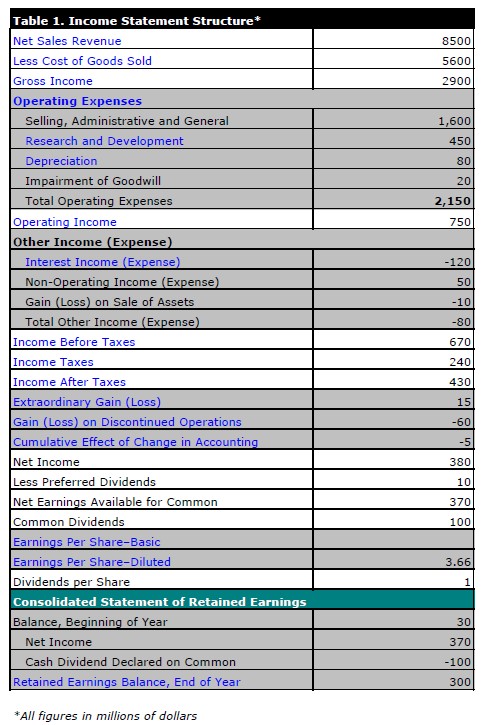
The income statement outline presented in Table 1 has five income steps: (1) gross income, (2) operating income, (3) income before taxes, (4) income after taxes and (5) net income. There is wide latitude for the format of the income statement used by firms, but the five-step format is useful in explaining the information provided by the statement.
Accrual Accounting
Before the income statement can be analyzed correctly, it is important to understand that most companies report their financials using the accrual principle of accounting. Sales revenues and expenses are recorded when they are earned and incurred whether or not cash has been received or paid. Sales should only be recorded once the exchange of goods or services has been completed and the sale has been completed. Expenses are recorded when the goods and services that generate expenses are used.
Accrual accounting includes credit sales in the sales line and records them as accounts receivable on the asset side of the balance sheet. Likewise, unpaid (accrued) expenses are presented as expenses on the income statement, but recorded as liabilities on the balance sheet.
Continue to Step 2 »

