


Related

Stock Strategies

Charles Rotblut leads a class in AAII's new Essential Investing Video Course. Go to https://www.aaii.com/ves for more information and to subscribe.
Michael Corbett is CIO and portfolio manager for all equity portfolios with Perritt Capital Management and The Perritt Funds. Recently, he discussed micro-cap investing with me.
—Charles Rotblut, CFA
Charles Rotblut (CR): Could you explain what defines a micro-cap stock?
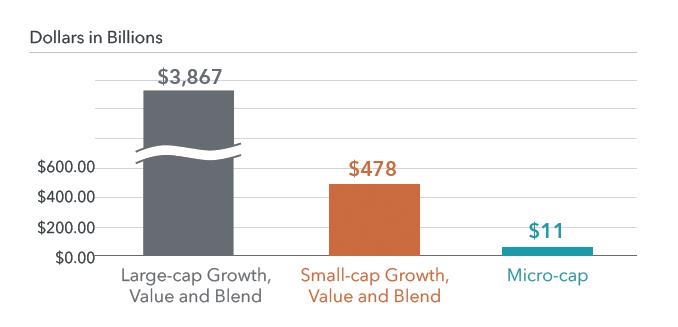
Michael Corbett (MC): Our basic premise is that these are companies with market capitalizations below $500 million. We get the number from the initial research by Rolf Banz on the so-called “small firm effect.” His research essentially said that you should rank all the companies by market cap and then separate the bottom 20% from the upper 80%.
Our market-cap cutoff is actually lower than $500 million—it’s really more in the range of $300 million or $400 million as we speak today (April 2016). It certainly changes over time, but somewhere below $500 million is where we define micro-cap stocks.
CR: And you’re basing it on all exchange-listed stocks and not just stocks listed on the New York Stock Exchange (NYSE)?
MC: Correct.
CR: Just to be clear, you’re not talking about over-the-counter and the bulletin board stocks; you’re strictly referring to exchange-listed stocks?
MC: What we start with is all the companies on the major exchanges when we rank or come up with a definition. It doesn’t mean that we don’t look at bulletin board or pink-sheet type of investments at times, but the majority of our investments are exchange-listed stocks and that’s really where the core of our definition comes from.
CR: Is there a minimum market capitalization that you generally don’t go below?
MC: We have two strategies; one is a pure micro-cap [the Perritt MicroCap Opportunity Investors fund (PRCGX)], where we typically invest in companies with market capitalization between $50 million to $500 million. The other strategy we have is an ultra micro-cap [the Perritt Ultra MicroCap fund (PREOX)], where we’ll mostly invest in companies with market cap below $100 million. We actually set $300 million as a top, but we’ll go as low as $10 million market cap for that strategy.
One of the fascinating parts about the micro-cap world is related to capacity. Due to the assets we manage with our micro-cap strategy, it is difficult to buy companies with market capitalizations below $50 million. Part of the reason we launched our Ultra MicroCap fund was to give investors the chance to invest in companies below $50 million market cap.
CR: I presume the market-cap ranges also move depending on market conditions?
MC: They do. In my 25-plus-year career, I’ve seen the cutoff for micro-cap stocks as low as $150 million to $200 million and I’ve seen it as high as $600 million to $700 million, back in the peak of the 2006 and 2007 time period, before we had the big meltdown of 2008 and 2009.
CR: Before we talk about what you look at in terms of individual stock traits, let’s discuss allocation. I know your firm has written a paper discussing allocation strategies for large-, small- and micro-cap stocks [“Adding Micro-Caps to Small-Caps: Unlock the Potential to Enhance Return and Lower Risk”]. Could you elaborate on that?
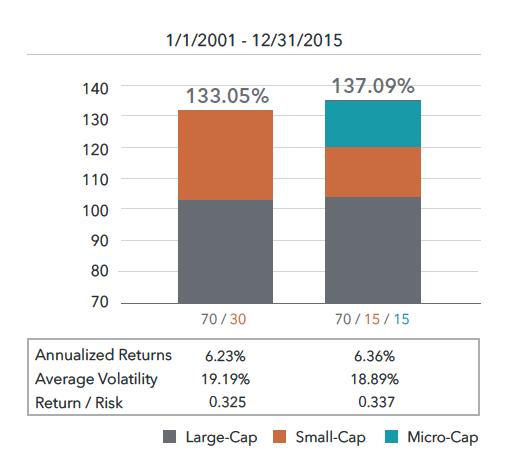
MC: In our paper, we really talk about the merits of micro-cap stocks within a portfolio. One of the traits and one of the nice things about micro-cap stocks is that they are less correlated to the rest of the market, whether you’re looking at the small-cap market or you’re looking at the large-cap market. They really just have lower correlations. The term we use a lot around here is that they just march to their own drummer and tend to do their own things. There are times when they’re zigging and the rest of the market is zagging, in a sense.
When you add a group of micro-cap stocks to a portfolio, it can provide diversification benefits. Over long periods of time, adding a small portion of micro-cap stock to a portfolio can actually reduce portfolio volatility. [See Figure 1.] So micro cap is certainly something that investors want within their portfolio.
CR: For an investor who just does not want to fully allocate to micro cap, do the financial advisers you interact with have a certain percentage they’re allocating to micro-cap stocks, or does it vary?
MC: It varies, just like anything, in terms of risk tolerance, time horizons and all the other unique circumstances that may impact a person’s investments. It can be anywhere from 2% or 3% of an investor’s portfolio to 15% to 20%. It really ranges all over the map.
CR: Regarding price volatility, everybody obviously focuses on the downside movement, even though volatility can also be to the upside. How should investors view the potentially larger swings in micro-cap prices?
MC: Unfortunately, when you get into stressed environments and down markets, the correlation increases among all asset classes, including micro-cap stocks. You’re going to experience some volatility and some excessive down periods.
Our advice has always been about the merits of long-term investing. Micro-cap stocks perform well over full market cycles, but investors need to exercise patience.
CR: Do you think some of the higher volatility with micro-cap stocks is due to fear, or is related to the lack of efficiency in the micro-cap space, or is it a combination of the two?
MC: It’s a combination. I wish I could always have an exact answer on everything, but there really isn’t one when it comes to investing, particularly for micro-cap stocks.
When markets are doing well across the board, you may have an environment where micro-cap stocks just don’t do well because they get ignored due to being an under-researched asset class. But then when markets are stressed, micro caps may go along with it or they may go down less. I’ve seen it vary from one environment to the next.
What I have seen, though, is that when you have major stress—whether it’s political fears, economic fears or other kinds of fears that are really heightened—you’re not going to be able to hide, and all classes of stocks are going to have damage, including the micro-cap space.
CR: What about the small-company premium? There’s been some talk about it going away. Do you think this is something that is more of an occurrence with the larger small-cap companies as opposed to the micro-cap stocks and the smaller small caps?
MC: That’s a really great question and one that we ponder around our firm as well. We believe it is partly tied to the opportunity set.
If you go back 15 years ago, in the late 1990s and the early 2000s, there were nearly 6,000 U.S. companies listed on all the exchanges. Today that’s shrunk down to around 3,700, which is the number we get from Frank Russell & Co. [Editor’s Note: AAII’s Stock Investor Pro fundamental stock screening and research database has around 4,500 stocks using Thomson Reuters data for the NYSE, NASDAQ & American exchanges.]
So we wonder: If the opportunity set is smaller, does it impact that whole premium debate? I can’t say in a broad-scale measure today that it’s easy to find really inexpensive investments. This is an incredibly difficult environment for finding investments that that fit inside our definition of really inexpensive.
CR: Let’s talk about your process a little bit in terms of analyzing micro-cap stocks. What is your approach?
MC: First, we screen to be sure we’re buying a micro-cap stock and its market cap is below our maximum level.We perform a cursory look to determine if the stock is under-followed, under-researched or at least has the potential to be an inefficiently priced security.
Then we really put each of companies through three quality measurements. The first one is quality of financial statements, the second one is quality of product and management and the last one is quality in terms of the price being paid for the business.
For the financial statements, we use the Piotroski Score, or the P-score as some investors refer to it. The P-score is based on nine factors calculated from the financial statements. If the company scores favorably on at least six of those nine factors, we consider it to have quality in terms of its financial statements. [See the box below for the nine factors that make up the Piotroski score.]
Joseph Piotroski, associate professor of accounting at Stanford University’s Graduate School of Business, studied low price-to-book-value stocks and developed a nine-point scale to help identify stocks with solid and improving financials. Profitability, financial leverage, liquidity, and operating efficiency are examined using popular ratios and basic financial elements that are easy to use and interpret. As interpreted by AAII, the nine factors are:
AAII tracks a stock screen based on the Piotroski approach, which calls his score the F-Score (for financial score) and looks for stocks to meet eight of the nine factors. The Stock Screens area of our website shows the full criteria used in the Piotroski High F-Score screen and a list of stocks that meet the criteria that is updated monthly.
The last two measurements are obviously much more qualitative. We’re doing an analysis of the business and the management. We usually put more emphasis on management teams that own more stock relative to how they’re compensated. The last measurement is just the amount we’re going to pay for the business—comparing the valuation to that of their industry or the market. Another question we ask ourselves is “What is the company trying to do?” and “What’s the ultimate earnings power?” So, what could this stock or this business be worth in the future?
CR: You are GARP—growth at a reasonable price—investors, correct?
MC: We certainly like to buy growth companies. The GARP approach is used in our process, but we also like to do traditional value. If we’re buying companies that aren’t going to be growth companies, then we use more of a traditional value approach. For example, stocks trading below book value or with other hidden assets can be held within our portfolios. But GARP is certainly a big part of our approach as well.
CR: Speaking of Piotroski, we have a screen based on the strategy and many of our members pay attention to it. I presume you’re drawing the line at six out of a possible score of nine just to make sure you have enough stocks that are qualifying. Is that a correct assumption?
MC: It is. What we also do with that score is look at what the company did over the last several years, not just the most recent reported quarter or year. We’re looking for consistency. It’s not that we say that they have to have a score of six all of the time, but a trend of decent to good scores suggests that they’re doing the right things to build shareholder value. That’s what we’re looking for.
Table 1. Performance of Micro-Cap Funds Co-Managed by Michael Corbett
| Total Return (%) | Avg Ann’l Ret (%) | Bull Mkt* (%) | Bear Mkt* (%) | Exp Ratio (%) | |||
| YTD | 2015 | Last 3 Yrs | Last 5 Yrs | ||||
| Perritt MicroCap Opportunity Inv (PRCGX) | -3.0 | -6.1 | 11.2 | 6.9 | 241.9 | -59.0 | 1.21 |
| Perritt Ultra MicroCap (PREOX) | -3.1 | -2.1 | 13.5 | 7.2 | 266.1 | -66.9 | 1.58 |
| Small-Cap Stock Category Average | -0.1 | -5.1 | 10.2 | 8.3 | 252.9 | -52.3 | 1.15 |
|
*Bull market defined as March 1, 2009, through May 31, 2015; bear market defined as November 1, 2007, through February 28, 2009. Source: AAII’s Quarterly Low-Load Mutual Fund Update and “Individual Investor’s Guide to Mutual Funds 2016”; Morningstar. Year-to-date returns as of March 31, 2016. Three-year and five-year returns are as of December 31, 2015, to allow for comparisons with category averages. Bold returns are in the top 25% of all funds within in the investment category. |
|||||||
CR: When looking at a micro-cap stock versus a large-cap stock, is there anything you do differently in terms of analysis?
MC: I guess the simple answer is that smaller-company stocks are not widely researched, so you can’t gather information as readily as you can with large caps. With a large-cap stock, you can grab a research report from just about anybody on the street and dig through the financials and commentaries and all sorts of information. With small companies you don’t have that depth. As we say around here, it’s about rolling up our sleeves and doing good old-fashioned security analysis on the company: Reading through the 10-K and 10-Q filings with the SEC, talking with management, as well as other channel checks.
CR: For an individual investor, they’d have to go through the SEC filings given that there’s really not going to be much of anything else available.
MC: Right. Part of small- and micro-cap investing is that you have to do your own homework.
CR: Have there been any common traits you’ve seen among micro-cap stocks when they don’t work? Is there any commonality that you’ve seen that causes you to stop and say, “I’m not going to touch this company?”
MC: It’s usually related to management. I can’t say there’s one thing with management or another, but it usually is something related to management, or even the board to stretch it out to that level. They’ll tell you one thing but then they do something different.
We visit and interview each of our company management teams. In those meetings, we listen to what management is saying about their strategy. We tend to give management a long leash to try and develop the business model. However, if management starts changing their tone or business strategy, we’ll re-evaluate our position and will generally sell the investment.
CR: Do you have a target holding period, or do you hold as long as a company remains attractive?
MC: Our turnover has been between 30% to 40%. We usually target three to five years. If a stock is attractive, we’ll try to hold it for longer, but generally what happens is that they get too big to fit our definition of micro cap. We do have a mandate that if the company gets too big—and it’s certainly a good problem to have, when they get to a $1 billion or $1.5 billion market cap—then we just move on.
CR: That’s a good problem to have. In terms of people investing in your funds, I know there is a 90-day rear load. I presume that’s to stop investors from jumping in and out?
MC: Yes, that’s correct.
CR: How do you respond to questions about the suggested holding period? What should investors think about in terms of holding the funds?
MC: We really encourage them to try and stick through a full market cycle, which is at least a three-year, if not more of a seven-year, time frame. To be able to get the benefits of the micro-cap space, you should hold through a full market cycle. Long-term nowadays, unfortunately, seems like it’s only a month with a lot of investors, but the real long term is more of at least a three-, if not a seven- to 10-year time horizon.
CR: How your funds handle liquidity—meaning the ability to easily buy and sell at prevailing prices—given the amount of money you’re putting to work?
MC: There’s several ways you can deal with liquidity. One is to practice diversification by the number of names: We generally keep our portfolios between 80 names to about 120 names. This helps us deal with liquidity coming and going.
Then the other part—and this just comes from experience—is knowing how to trade the securities. We’ve built up a great network of trading firms and other investors such that we can find liquidity. We don’t have an approach of saying that the stock has to trade a certain number of shares. We’re much more about being investors in a business, so if we find something that’s very attractive but doesn’t trade a lot, it doesn’t concern us. We want to be owners in businesses we believe in.
In fact, some of our attribution analysis shows that our biggest winners are the ones that had no liquidity in the beginning. They ended up being some of the big home runs within our portfolio. So it’s really about discipline on those types of metrics.
The last one is capacity: You just can’t manage a lot of money in the space. With our two strategies, we have a capacity of a little less than a $1 billion.
We’ve actually closed our strategies to new investors four times since inception just to prevent them from getting too big in terms of asset size.
CR: For individual investors who are trying to buy micro-cap stocks, do you have any general guidelines they should keep in mind?
MC: It’s really like most investments: Practicing discipline, focusing on the longer term and also understanding diversification. I think you can get away with less than 80 to 120 stocks in your portfolio if you are an individual investor, but you really need to have a lot of names within your portfolio.
You can go through an extended period of time where a name isn’t working and then you wake up and it works in a big way, or vice versa. That happens, and it’s pretty difficult to have perfect timing with any investment, particularly in this space.
CR: In terms of buying and selling, any suggestions on placing trade orders or how it should be reviewed?
MC: Limit orders are always great with any investment, particularly with the micro caps. If you’re trying to put a fair amount to work, even if it’s only 5,000 shares, you should use limit orders.
CR: Okay great. Anything I haven’t asked you that I should?
MC: No, I think you covered it. I love the micro-cap world, which is why I made it my career. I also think all investors should have at least a small amount allocated to micro-cap stocks.
Click here to view more of this interview. Listen to bonus audio below from Charles’ interview with Michael Corbett about broken IPOs whose market capitalizations have fallen down in the micro-cap category, as well as the investing lessons he’s learned.
Stock Strategies

AAII Model Portfolios

AAII Stock Ideas

No comments have been added yet. Add your thoughts to the discussion!
You need to log in as a registered AAII user before commenting.
Log InCreate an account