


My semiannual update of the Individual Investor’s Fund Portfolio details a number of changes. This includes not only changes to the portfolio itself, but also to the criteria and the recommendation process.
Because two of our recommended mutual funds have closed to new investors but remain on our recommended list for those who already own them, we will continue to maintain them in the model portfolio. Members who wish to invest in our recommended funds but did not do so prior to the fund closings can develop their own mutual fund portfolio from the remaining funds on the recommended list.
We wish to keep the model portfolio at a maximum of 10 funds; therefore, we will not add all the funds on the recommended list to our model portfolio, but only replace those that have a sell recommendation. While all of the funds on the recommended list meet our qualifications and we would not hesitate to own them, a real-life portfolio cannot add mutual funds forever without selling some existing funds. In order to monitor performance, we will track not only the model portfolio, but also all recommendations—whether we own them in the model portfolio or not.
Also, we realize that some members who invest in our recommended funds will not add every single new recommendation to their portfolio. Consequently, whenever we provide more recommendations than are necessary, we will list them in order of preference—based on the qualitative criteria shown in Rule No. 8 of our revised selection criteria list.
Before reviewing the revised criteria, let me once again explain the thought process that drives our selections.
As you have probably noticed from my articles, I place a great deal of emphasis on risk, but not on total risk avoidance—otherwise, I would simply own a portfolio consisting entirely of riskless Treasury bills. I emphasize risk because I believe that risk analysis provides the best route to providing the highest returns while still keeping within a suitable risk framework.
And it appears to me—as it does to many others—that the risk of a particular holding is more consistent over time than its rate of return. Or, put another way, there is a much better chance that a stock will have the same risk in the future that it had in the past, than there is that a stock’s return in the future will be the same as in the past.
As can be seen in our selection criteria, we look at risk from both theoretical and practical perspectives. We use the traditional statistical measures of volatility to require a higher risk-adjusted rate of return than the market. But we also require that a fund not have had a loss in the past 10 years, in the belief that this significantly reduces the chance of it having a loss in the future. We consider a loss to be a rolling 36-month period with a negative return, since we feel that three years is the bare minimum investment horizon for equity investing.
The revised selection rules are presented in the accompanying list. Note that the following changes have been made:
MUTUAL FUND CAP SIZE AND STYLE
We categorize mutual funds by both the size and style of their stock holdings. Size is measured by the average market capitalization (share price times the number of shares outstanding) of the stocks held by the fund, and style is based on the price-to-book value ratios (price per share divided by net assets per share) of the underlying stocks. Here is how we break down these categories:
SIZE
Category
Market Cap
Giant-Cap
$10 billion and greater
Large-Cap
$4 billion to $9.9 billion
Mid-Cap
$2.0 billion to $3.9 billion
Small-Cap
$450 million to $1.9 billion
Micro-Cap
$250 million to $449 million
Nano-Cap
$0 to $249 million
STYLE
Category
Price-to-Book-Value Ratio
Very High Value
1.49 and below
High Value
1.50 to 2.99
Moderate Value (Blend)
3.00 to 3.99
Low Value (Growth)
4.00 to 4.74
Very Low Value (High Growth)
4.75 and above
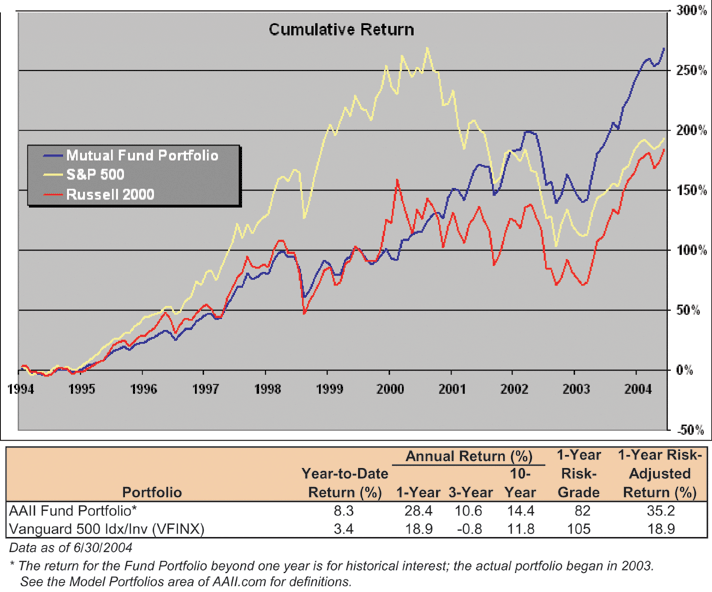
Figure 1.
Individual Investor's
Fund Portfolio
Performance
vs.
Benchmarks
CLICK ON IMAGE TO
SEE FULL SIZE.
Figure 1 graphically depicts the returns for the Fund Portfolio and illustrates the performance relative to two market indexes.
Table 1 shows the performance results for the Fund Portfolio—the individual funds in the portfolio and the historical performance over the same time period for the new qualifying funds. The table reports the actual portfolio results for the first year of the Fund Portfolio; the longer-term data is based on the history of the included funds.
As you can see, the performance results of the model portfolio have exceeded the market on both an absolute and risk-adjusted basis. While we are happy to see our funds outpace the market and most equity mutual funds, we are even happier that the portfolio has done this with considerably less risk.
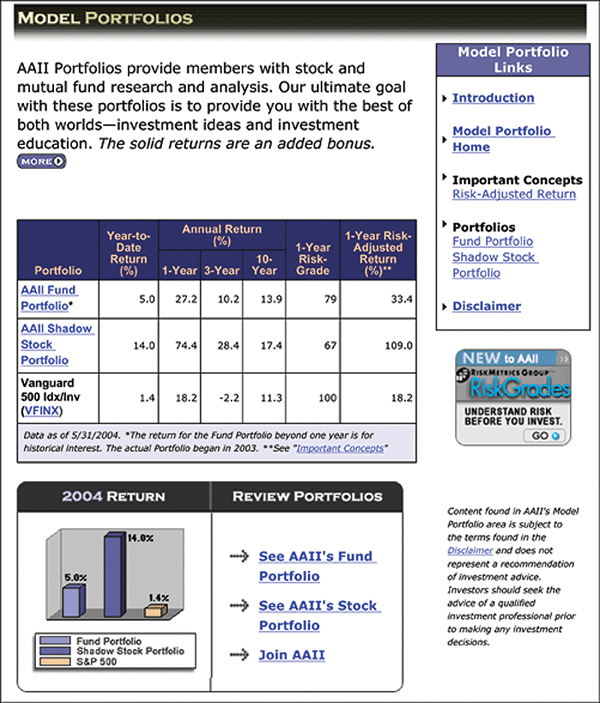
| MODEL PORTFOLIOS ON AAII.COM | |||
To access the Individual Investor’s Shadow Stock Portfolio and the Fund Portfolio, go to www.aaii.com/modelportfolios. The Model Portfolios area includes:
|
Recommended Changes: Our Rationale
In terms of the individual mutual funds on our recommended list, we are recommending the sale of one fund—the Ariel Fund (ARGFX). This fund has performed well, but we believe it has grown too large to successfully continue in its stated mission, and it does not meet the new criteria for size and expenses. However, I want to make an important point here: Funds do not change quickly. When we recommend the sale of a fund, you do not have to accomplish this quickly, particularly if there is a reason to hold the fund a bit longer. For example, if your holding is close to qualifying as a long-term holding for tax purposes, I would certainly recommend that you hold it until the year is up and then replace it—particularly considering the new capital gains rates. In a retirement account, of course, taxes won’t matter.
In the model portfolio, we are replacing the Ariel Fund with Meridian Value (MVALX). We chose MVALX over the other two qualifiers, Exeter Pro Blend A (MNBAX) and Mairs and Power Growth (MPGFX) based on practical considerations. These practical considerations are also the basis for our preference ranking, and include: number of states in which the fund is available for sale, Web site information, and shareholder services. You can see that these preference considerations are relatively minor; we certainly recommend these two funds to those who don’t hold the two funds in the portfolio that have closed, FMI Common Stock and Tamarack Microcap Value.
Fund Availability: Keeping a Foot in the Door
The last point I would like to make about the Fund Portfolio also deals with the issue of possible fund closings and keeping your options open.
While we concentrate on funds with a 10-year track record, we will occasionally point out particular funds that have a shorter life but may be attractive due to special circumstances or because there is a high probability that they will eventually qualify. We will do this particularly in the case of micro- and nano-cap stocks because so many of them close before they reach their 10th birthday. As an extreme example, Wasatch Micro Cap Value (WAMVX) was open only three hours before closing. Bridgeway, one of the few managers with nano-cap funds (they call them ultra-small) long ago closed their nano-cap funds as well as their micro-cap fund.
Consequently, while not a recommendation in the usual sense, I have purchased a small number of shares of Buffalo Micro Cap (BUFOX) just to keep the option open to buy more later if they close to new investors. They just opened last month and have said they will close when they reach $250 million. You can open an account for $2,500, or $250 in an IRA.
Buffalo has shown ability in the small stock area by running a very successful small-cap fund (BUFSX). It is not on our recommended list because it is only five years old.
I will review the Fund Portfolio here again next February. In the meantime, you can check monthly performance at the Model Portfolios area of AAII.com.
| INDIVIDUAL INVESTOR'S FUND PORTFOLIO: SECTION RULES |
To make it into the Individual Investor’s Fund Portfolio, a fund must meet the following criteria:
How Many Funds Should You Hold?
|
James B. Cloonan is founder and chairman of AAII.
Discussion
FREE REPORT

No comments have been added yet. Add your thoughts to the discussion!
You need to log in as a registered AAII user before commenting.
Log InCreate an account