


Wayne Thorp leads a class in AAII's new Essential Investing Video Course. Go to https://www.aaii.com/ves for more information and to subscribe.
There was a time when owning a home was part of the American dream. However, during the financial crisis of 2007-2008, for many owning a home turned from a dream into a nightmare, thanks to unscrupulous mortgage brokers and homebuyers overreaching their finances. While the news headlines tout an improving housing market with robust demand and ample supply, the U.S. Census Bureau reported that the homeownership rate in the first quarter of 2015 fell to 63.7%, the lowest since 1990.
Of course, for most, “homeowning” also means carrying a mortgage. Since 2009, the federal funds rate—the short-term rate objective of the Federal Reserve—has been near zero. This has also resulted in historically low mortgage rates. With each passing meeting of the Federal Open Market Committee, the policy-making board of the Federal Reserve, it seems likely that an interest rate increase is going to happen sooner rather than later, perhaps before the end of the year.
If you have a mortgage and have not taken advantage of refinancing in order to capitalize on low interest rates, your window is closing. Earlier this year, I refinanced my mortgage when my initial 7/1 adjustable-rate mortgage started floating. While my rate actually dropped once it started floating, I was able to lock in a low rate for the next 30 years, saving myself several hundred dollars a month in the process.
In this installment of On the Internet, we highlight some useful resources for those embarking on the mortgage-refinancing path. Also, be sure to check out Computerized Investing’s own mortgage refinancing calculator.
The Mortgage Professor
The Mortgage Professor website is the love child of Jack M. Guttentag, now professor emeritus of finance and formerly the Jacob Safra Professor of International Banking at the Wharton School of the University of Pennsylvania. Prior to arriving at Wharton, Professor Guttentag was chief of the domestic research division of the Federal Reserve Bank of New York. He started developing the site back in 1997.
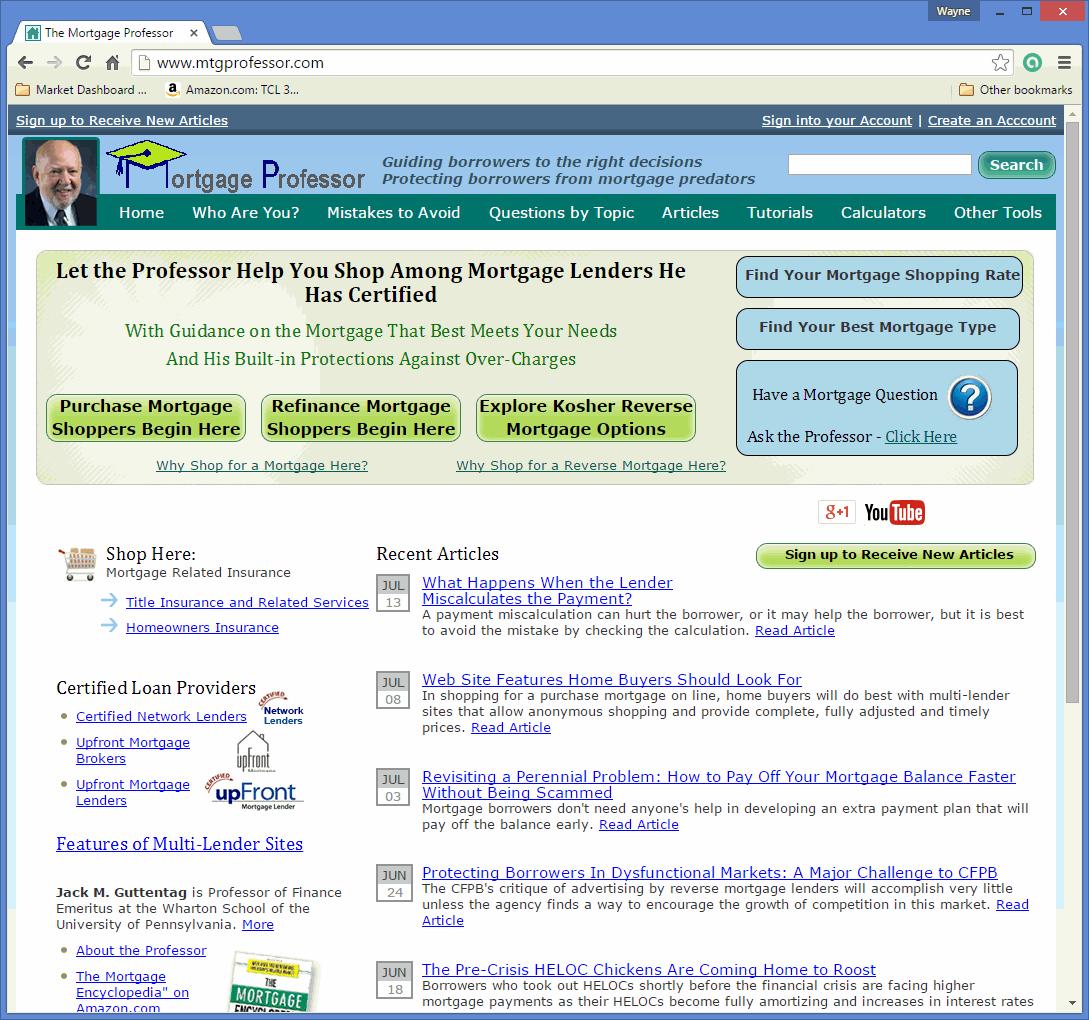
Guttentag, who offers his advice and tips and answers questions about the mortgage industry, explains the ins and outs of mortgages at this site. Each article or tutorial is dated, making it easy to find timely and newly updated information. Advice, tools and tips are broken down by category, and you can contact the professor with questions and comments.
You can shop for a mortgage directly through the site, from companies that are one of its certified network lenders (CNLs). CNLs transmit their prices and underwriting rules directly to the network, with no intermediation by loan officers. The prices posted here by each CNL are as low as or lower than those offered by that CNL directly to borrowers through any other channel. The CNL must disclose the complete price data, including interest rate, points, origination fees and all fixed-dollar fees. If you are shopping for an adjustable-rate mortgage (ARM), CNLs must provide the rate index used for rate adjustments, current index value, margin, rate adjustment caps and maximum and minimum rates. If you enter into a mortgage agreement with one of the site’s CNLs, the professor or his agent will represent you, the borrower, in getting any problem fixed. Finally, CNLs charge borrowers a maximum fee of $295 to process their loans, with the charge credited back to the borrower at closing. The lender can also collect an appraisal fee of $300 to $800, depending on the type of property and its size, to cover the appraisal cost.
Whether you are buying a new mortgage or reverse mortgage, or refinancing an existing mortgage, the site starts by helping you to see whether you qualify for a new mortgage or if you qualify to refinance. You are prompted to provide information such as your bankruptcy and foreclosure history, purpose of the loan, property value, loan amount, FICO score, property ZIP code, property type, monthly documentable income and monthly debt payments. Based on the information you provide, it shows whether you qualify based on three factors: bankruptcy/foreclosure history, down payment and FICO, and income and debt.
If you do not qualify, there are information and tips on how you can improve your mortgage credentials. If you do qualify, you can then move on to selecting your mortgage type. Based on a series of assumptions, the site will help you find the best mortgage type for your situation. After answering these questions, the site then uses that information to find a variety of the most attractive fixed-rate and adjustable-rate mortgages. You can see the rate closest to zero fees; the total monthly payment (including mortgage insurance if required); monthly mortgage insurance (if required); total cost over the number of years you expect to be in the home (you can modify this value); and the worst-case interest rate scenario for each mortgage, so you can see the possible total monthly payment at the highest possible interest rate (applicable to adjustable rate mortgages).
Once you select one of the mortgage package options, you can then indicate whether you prefer the lowest interest rate possible with the lowest lender fees, are willing to pay lender fees in order to get a lower interest rate, are willing to pay a higher interest rate so the lender will pay some or all of your closing costs, or just want to see the interest rate/fee options.
Lastly, you are given the CNLs that offer the loan package you select.
Beyond helping connect you with a lender, there is a wealth of information for first-time borrowers and those looking to refinance an existing mortgage. Under the “Who Are You” section of the top navigation bar, there is an option for borrowers refinancing to lower costs. Clicking this link will take you to a page with articles related to mortgage refinancing, including “When Does Mortgage Refinancing Really Pay?” There is also a collection of refinancing calculators, including one that would have been relevant to my recent experience: refinancing an adjustable-rate mortgage (ARM) into a fixed-rate mortgage (FRM). The refinancing “Mistakes to Avoid” area also has a collection of informative articles to help guide you through the mortgage-refinance process as well as tips on how to use the site’s numerous calculators to help make a refinancing decision. Within the “Questions by Topic” area, there are dozens of answers to refinancing-related questions.
The site’s analytical tools include over 50 mortgage calculators covering refinancing, payments, points, term, early payoff, amortization, cost comparisons, APR, mortgage insurance and more. There are also 13 spreadsheets you can download and save to your computer.
Consumer’s Guide to Mortgage Refinancings
www.federalreserve.gov/pubs/refinancings/

The Federal Reserve has put together a no-frills guide to help answer many of the common questions associated with refinancing a mortgage. This free guide is broken down into several “chapters” such as: Why consider refinancing? When is refinancing not a good idea? Are you eligible to refinance? What will refinancing cost? What is "no-cost" refinancing?
There is also a link to a refinancing calculator from the National Bureau of Economic Research that will help illustrate the amount you will save when you refinance compared to the costs you may have to pay to refinance your mortgage.
Finally, there are mortgage shopping worksheets available to download with key questions you should ask a lender when looking to refinance your mortgage.
DecisionAide Analytics
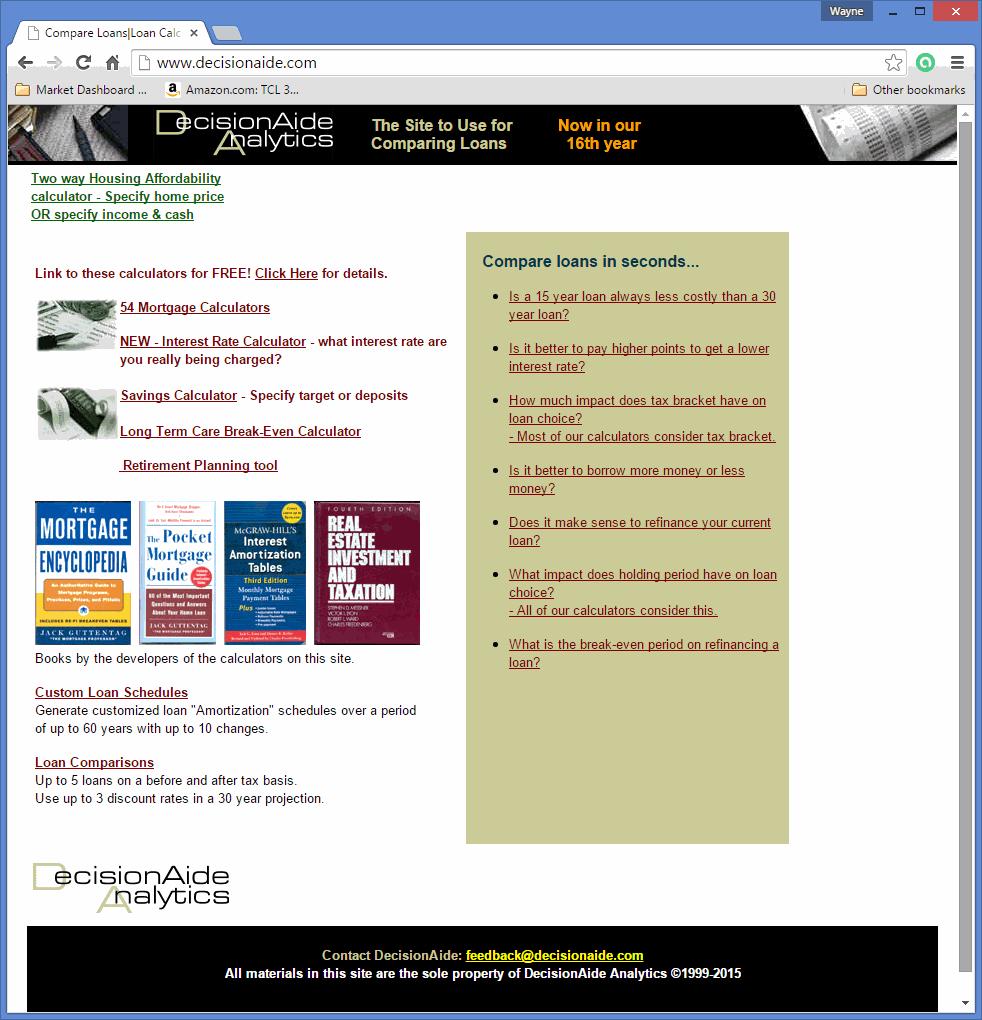
In order to make an informed decision about a new home loan or about refinancing one you already have, you need to compare various factors such as rates, loan amounts and payment options. DecisionAide Analytics allows you to compare loan features with numerous calculators. The site isn’t the most visually appealing, but it makes up for it with more than 50 calculators—including seven devoted to mortgage refinancing—and a Calculator Assistant to direct you to the calculator you need. The mortgage calculators address debt consolidation, how helpful it is to make additional principal payments, refinancing various mortgages, mortgage insurance, affordability, renting versus buying, payment amount, amortization, interest rates, points and fees and more.
You can also use calculators to compare loans with various features such as the life of the loan, paying for points, the impact of taxes, how much to borrow, the loan holding period and break-even analysis. The site also provides links to books about mortgages, real estate and interest rates. Some of the calculators have a large number of inputs, but this enables more accurate calculations.
Mortgage-X
Mortgage-X provides mortgage information and educational tools for consumers. The website offers a wide variety of tools and calculators and hundreds of articles covering various aspects of the mortgage-lending field. Mortgage-X tracks all available adjustable-rate mortgage (ARM) indexes as well as ARM index forecasts, comparison charts and historical graphs.
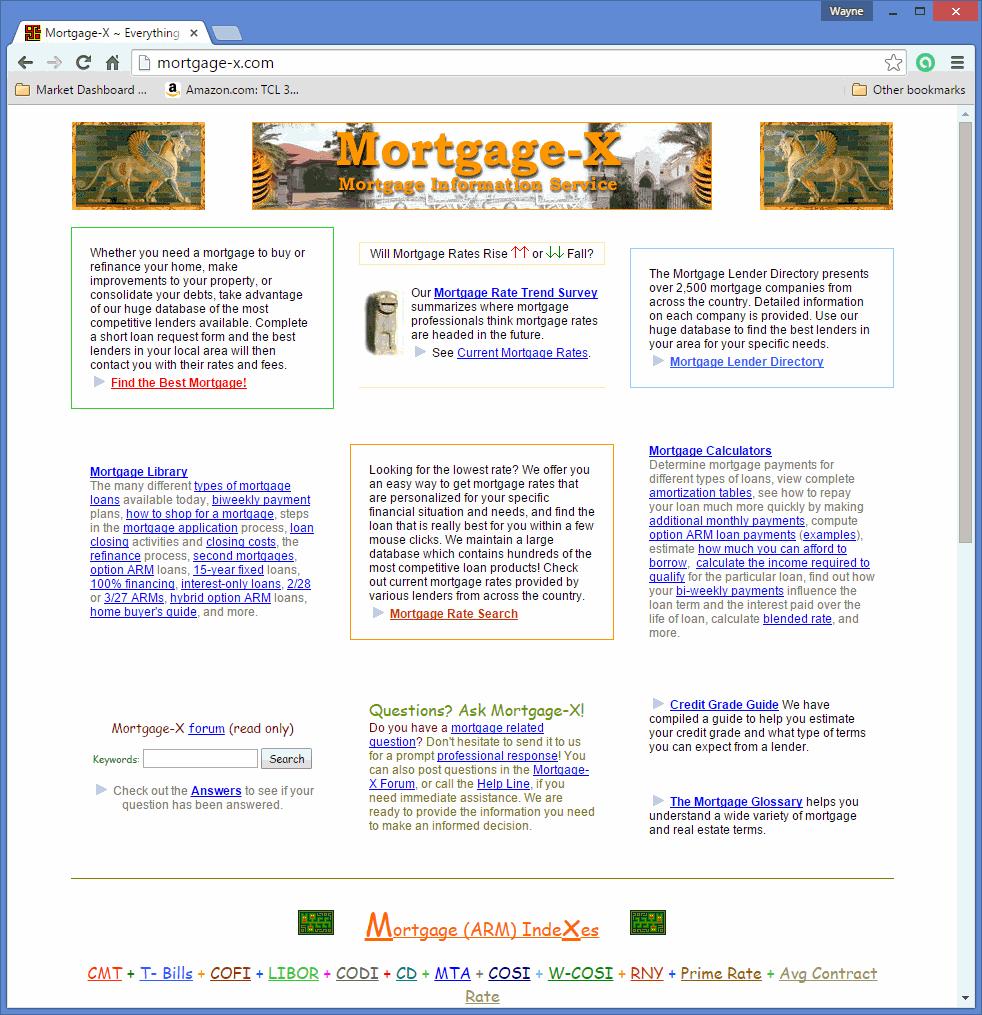
The home page has links to thousands of lenders and includes detailed company and rate information. A Mortgage Rate Trend Survey tallies over 250 mortgage professionals’ opinions as to what direction rates are headed in the next 30 and 90 days. The site’s Mortgage Library offers hundreds of articles about loans, rates, closing costs, mortgage management, refinancing and more. You can also view a glossary of commonly used mortgage terms, read about consumer protection laws and learn how to lodge a complaint about a suspected rights violation.
To search for a low rate, the Find the Best Mortgage tool compares the rates of hundreds of lenders by state. Mortgage-X provides a few original interest rate, monthly payment and loan calculators but also provides links to additional calculators found on other mortgage-related sites, including the Mortgage Professor’s site. The Ask a Mortgage Related Question service connects you to over 1,000 mortgage experts, and the Mortgage-X Forum includes hundreds of mortgage-related discussion topics.
Making Home Affordable
The Making Home Affordable Program (MHA) is a joint project of the Departments of the Treasury and Housing and Urban Development to help homeowners avoid foreclosure. The MHA website can help direct you to available programs. These include refinancing your mortgage at a lower rate, reducing your monthly payments, getting mortgage relief while unemployed, getting relief when you owe more than your home is worth, and avoiding foreclosure when homeownership is no longer affordable or desirable.
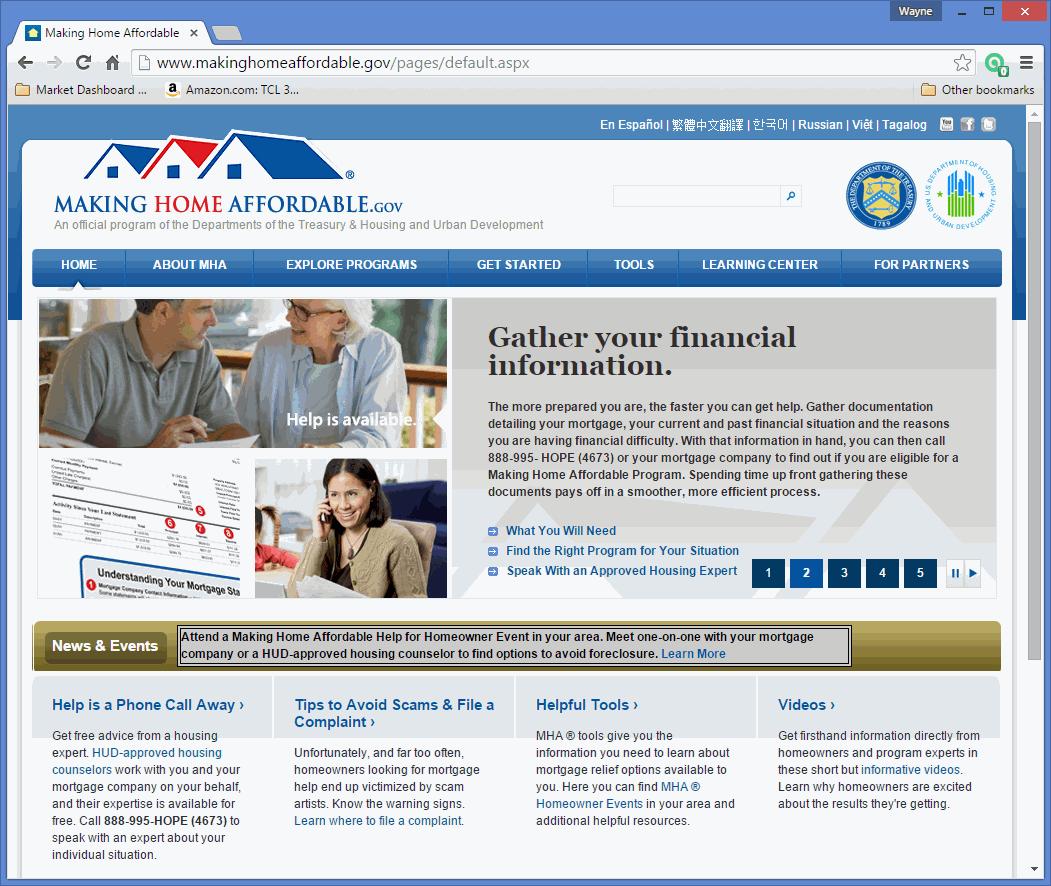
The site has a tool to help you determine if you are eligible for an MHA program. You can find programs if you need help lowering your mortgage payment, lowering your interest rate or avoiding foreclosure. Based on your needs and the answers you provide to questions related to your situation, the site will direct you to the specific programs that may be able to help you, including the Home Affordable Refinance Program (HARP) and the Home Affordable Modification Program (HAMP).
If you think an MHA program is right for you, the site also provides insights into what to expect from the process, what to expect from your mortgage company, and what to expect from a HUD-approved housing counselor. The site also outlines the documentation you will need, including your monthly mortgage statement, two most recent pay stubs for all household members contributing toward the mortgage payment, last two years of tax returns, two most recent bank statements, and account balances and minimum monthly payments due on all your credit cards.
There is also information on how you can go about requesting a modification to your mortgage once you have determined your eligibility.
Discussion
FREE REPORT

TZ from AZ posted over 10 years ago:
You need to log in as a registered AAII user before commenting.
Log InCreate an account