


United Income, founded by Matt Fellowes, is a new robo-adviser attempting to make an impact on individual investors in retirement or nearing retirement. This mission differs from other robo-advisers; many of them do not specifically target investors nearing retirement or in retirement, but offer solutions to support these investors.
This article discusses United Income’s origins, its mission, the services offered and the pricing of those services.
Matt Fellowes was chief innovation officer at Morningstar Inc. and the founder and CEO of HelloWallet, a financial guidance software company purchased by Morningstar. Fellowes was a member of the Brookings Institution and taught public policy at both Georgetown University and George Washington University as an adjunct professor. Fellowes thought that consumers who were retiring were not being properly serviced by the financial realm, and thus raised capital for United Income. Receiving $5 million to begin his company, Fellowes focused on providing a web portal and mobile-based app that would offer guidance on saving, financial products and good management techniques. More information on Fellowes and United Income’s beginning can be found here.
With its financial planning methodology and investment recommendations, United Income estimates that the average 64-year-old may increase their chance of having enough money in retirement by 55.7% (from 9.4% chance of success to 65.1% chance of success) compared to a low-cost retirement income solution.
To partake in the services offered by United Income, you must create an account. Creating an account involves not only creating a username and password, but also offering answers to questions about income, lifestyle, expected retirement age, health care, current investments, taxes, etc.
The answers given to these questions drive how the services discussed in this article will be formulated and tailored for your life.
Pricing
United Income has a fee-based pricing model that focuses on four tiers of service: free, self-service, partial service and full service.
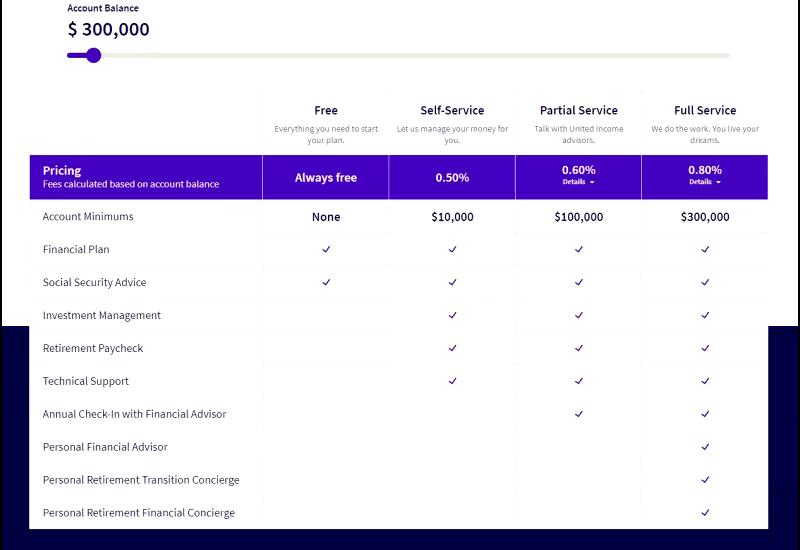
The first tier has no fee and has minimal services available. The services include a financial plan and Social Security advice. There is no account minimum required for this initial tier.
The second tier has a fee of 0.50% based on the balance within the account. A minimum balance of $10,000 is required. Services included in this second-tier plan are: a financial plan, Social Security advice, investment management, a retirement paycheck (regular withdrawal from your accounts) and technical support.
The third tier has a fluctuating fee between 0.50% and 0.60% based on the account balance. A minimum balance of $100,000 is required. Services included in this third-tier plan are: a financial plan, Social Security advice, investment management, a retirement paycheck, technical support and an annual check-in with a financial adviser.
The final tier has a fluctuating fee between 0.65% and 0.80% based on the account balance. A minimum balance of $300,000 is required. This service is all-inclusive and comprises: a financial plan, Social Security advice, investment management, a retirement paycheck, technical support, an annual check-in with a financial adviser, a personal financial adviser, a personal retirement transition concierge and a personal retirement financial concierge.
There are no fees for withdrawals and deposits. The management fees mentioned above do not include expense ratios of the funds you are invested in.
Click here to see the pricing page (also displayed in Figure 1).
Services
There are several service categories offered by United Income, and some are discussed in more detail in this section. While the basics are described in this article, it’s worth noting that users can create a free account with United Income that allows them to analyze their spending and income needs in retirement. The tool will also display your recommended asset allocation.
On United Income’s website, there is a “services” tab that has links and information on the following services offered:
-
Account sequencing
-
Asset diversification
-
Budgeting
-
Financial planning
-
Health spending plans
-
Investment management
-
Legacy and gift planning
-
Multi-factor investing
-
Reducing taxes
-
Retirement paycheck
-
Social Security
-
Withdrawal advice
Investments
United Income offers investment management and multi-factor investing. With regard to investment management, United Income gauges your risk level and creates investment strategies that vary depending on spending habits and necessities. For instance, a low-risk, highly liquid investment would be suitable for essential spending, which will be discussed later in this article. Each spending goal receives an individualized investment strategy and portfolio.
With regard to creating your investment accounts, United Income offers asset diversification as a service; it is the principle of spreading out your investments among varying asset classes and investment strategies to help you reduce the risk to your investments and retirement income prospects. There are many ways of selecting your assets in order to diversify your investments, including strategic asset allocation, dynamic asset allocation, tactical asset allocation and core-satellite asset allocation. The ways to diversify your investments will not be discussed here but United Income does offer varying strategies in regard to diversification. Multi-factor investing targets securities with traits that have historically enjoyed higher returns, lower risk or a combination of the two. These include factors such as quality, value, momentum, size and low volatility. It is based on historical return strategies and research.
Account sequencing is a service that draws from your investment accounts in a particular order once you retire so that you can get most of the money that you have invested. The purpose of this is to withdraw funds in a particular way that would best suit the needs of the individual. An individual may have multiple investment or financial accounts that vary in investments from fixed income to equities to real estate; how the investor decides to withdraw these funds determines if the amount of funds will increase in value or if the individual has enough funds from his investments to fulfill his retirement goals.
Another purpose of account sequencing is effectively utilizing your accounts to lessen the impact from income taxes on the investment funds.
Taxes
Closely situated with account sequencing, the service of reducing taxes is based around creating the most tax-efficient investment account. For taxable retirement savings (basically any money held outside of a tax-deferred retirement account set aside for retirement purposes), capital gains tax rates are lower than ordinary income tax rates. Capital gains rates apply to assets that have appreciated in value over time. The lowest capital gains rates are on long-term capital gains and apply to assets you’ve owned for more than one year. If you’ve owned an asset for less than one year, short-term capital gains rates apply, and currently these rates essentially are the same as ordinary income tax rates.
As a general rule for taxable money, you want to sell any long-term capital gains assets first when you need retirement income. Doing so means you pay less tax now and you allow any other retirement savings you have to keep growing.
There is no major tax advantage or disadvantage to taking withdrawals from a traditional IRA or a 401(k) account first; they are treated the same for income tax purposes. However, investment performance will be a major deciding factor. You may want to delay withdrawals from an annuity as long as you can, because the older you are when you start your payouts—annuitizing the asset—the greater your payout amount will be, although it too will be at least partially taxable.
In terms of payouts from your investment accounts, United Income sends you a retirement paycheck, which is a monthly check that is calculated based on the spending goals you have created in your United Income profile. The spending goals impact the amount of money you receive based on how much you will need to spend month-to-month.
United Income also provides withdrawal advice, which includes required minimum distributions, dynamic withdrawals and spending forecasting. Required minimum distributions are mandated by federal law and prescribe that individuals after age 70½ must take minimum distributions from their retirement accounts. United Income utilizes proprietary software to make calculations of your required minimum distributions by using your age, determined life expectancy and your account balances.
Financial Planning
Another service offered that is directly related to creating a financial plan is budgeting, which involves determining your expected spending and expenses in your retirement plan. United Income creates personalized spending plans and personalized health expense plans for its members. The service divides spending among five different spending classes including: essentials, lifestyle, health care, experience and bequest. Figure 2 displays the sections of spending goals.
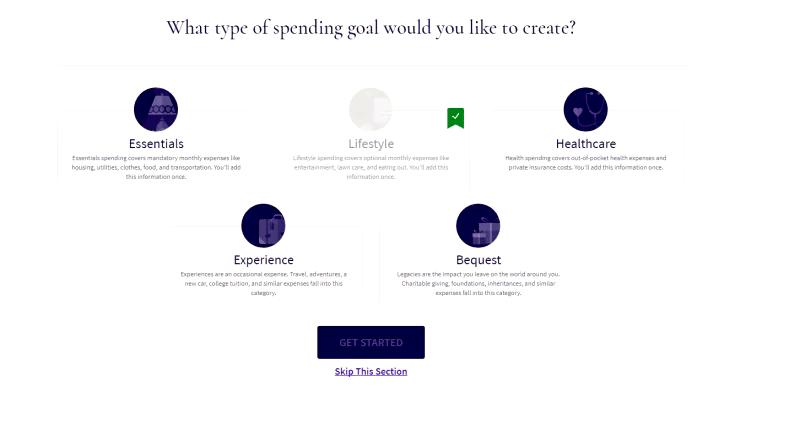
Essentials spending, according to United Income, covers mandatory monthly expenses that include housing, utilities, clothing, food and transportation. Lifestyle spending covers optional monthly expenses including entertainment, home maintenance (including lawn care) and food (outside of in-home cooking). Health care spending covers out-of-pocket health expenses and private insurance costs. Experience spending is defined as infrequent expenses including travel, adventures, vehicle, college tuition, etc. Bequest spending involves more philanthropic and estate-based expenses such as charitable giving, foundations and inheritances.
These spending categories are selected as a “spending goal,” and you must answer additional questions depending on the goal selected. The first question relates to an estimate of your future spending within the category. Options include: setting this year’s spending using future estimates, setting short-term spending using long-term estimates and setting your own short-term and long-term spending. The second question relates to current spending and requires you to input how much you are spending each month and what expectation you have for the continued spending. The third question relates to inflation—you may enter your own anticipated inflation rate or utilize United Income’s expected inflation rate. The fourth question involves your risk tolerance level and is situated on a scale ranging from lower risk to higher risk.
Associated with the spending goals, United Income offers personalized longevity estimates and health spending plans to help the investor manage health-related expenses. To ascertain your current health situation, United Income asks several probative questions. These questions ask your height and weight, whether you have diabetes, whether you smoke, whether you drink alcohol and how much of it and whether you exercise and how often.
Once all of these questions have been answered, a spending plan is created from your current age through retirement. This spending plan is used when creating your financial plan.
In addition to spending and expense planning, United Income offers legacy and gift planning. This service encompasses philanthropy and allows the investor to allocate funds from their investments for inheritance and giving to others in need.
Social Security advice is a part of the financial plan and is determined by a questionnaire section. This section asks questions such as: whether the member has received Social Security, whether the individual has worked in the United States for a certain period, how much one earns in a typical work-year and marriage status. According to the company, its tool assesses up to 64 different claiming strategies to provide each member with a personalized Social Security strategy.
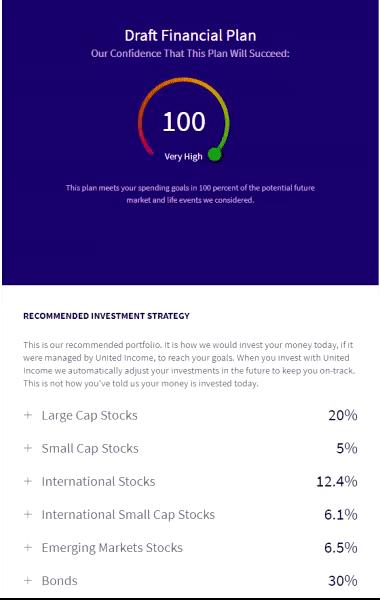
United Income, based on the input of a number of questions asked in several different categories including income, spending, expenses, etc., is able to create a financial plan for you. A sample plan is displayed in Figure 3. The financial plan encompasses several parts: investment strategy, life events (including Social Security benefits), recommended spending goals, recommended cost-saving measures for your spending goals and a projected budget. The financial plan is tailored to your life in terms of income, health care, age and other pertinent factors.
United Income also mentions on its website that it can help members consolidate financial accounts, withdraw from 401(k) plans, recommend elderly services, enroll in Medicare benefits or find supplemental health insurance.
Conclusion
The goal of United Income’s services is to create a retirement strategy that is based on planning ahead. The strategy utilizes a diverse amount of measures and inquiries to meet its goals. Similar to many online-based investment and retirement services, United Income offers personalized plans ranging from investment strategy to monthly expense planning. Although the services of United Income may seem separate, they are all linked in creating a retirement plan for the individual investor.
It is worth noting that while the service seems very comprehensive in nature, the website doesn’t really take a “deep dive” into explaining how these individual services are executed. There are a couple of sentences explaining each feature, but the actual strategies, methodologies used, etc., are not displayed on the general website.
Discussion
FREE REPORT

No comments have been added yet. Add your thoughts to the discussion!
You need to log in as a registered AAII user before commenting.
Log InCreate an account