


To gauge what kind of credit risk you may have, lenders employ the FICO score. When seeking consumer credit, many people seem to know their credit score, but few understand how it is calculated. This credit scoring, which results in a number between 300 and 900, is based on a statistical model developed by the Fair Isaac Corporation (hence the name FICO score).
The statistical model for the FICO score was not originally set up to be a consumer model, but it was the only available paradigm at the time. So, the banking industry quickly adopted the FICO model to numerically rank consumers. The FICO score is used by the three largest consumer credit agencies: TransUnion, Equifax and Experian.
The mystery behind the FICO score is how it is calculated. As the Fair Isaac Corporation is a for-profit company and publicly traded on the New York Stock Exchange, the FICO score is treated as their product and its method of calculation as a trade secret. However, there are a few websites where you can get information on the factors that contribute to your FICO score and education on using credit. These sites are described below, along with what you’ll find at the websites of the three main credit agencies.
Credit Information and Education Sites
My FICO
www.myfico.com
This site is devoted to the FICO score and offers consumers copies of their credit reports. The site also maintains a Credit Education area where consumers can learn about the FICO score and how to improve it.
Statistical information on the FICO score is provided, as well as how lending agencies view your score and what they do with it. For example, the three credit agencies vary in the information they have on credit customers; depending on how current their information is, they may have different scores for the same individual.
The makeup of the credit score is illustrated with a pie graph displaying the areas of interest for the FICO score. A listing for each area in the pie graph spells out the specific factors that can lower your score.
Another page in the Credit Education section explains the importance of credit scores and the benefits of using your credit wisely and responsibly. Tips are given to improve areas that are emphasized most—including payment history, amounts owed, length of credit history and new credit.
The last two areas deal with the credit report itself and tips on detecting errors. You can review the sections that a typical report will contain and learn what you should be concerned about. If any errors are found, steps are given to correct them.
Federal Trade Commission
www.ftc.gov
This government website provides basic information on credit retrieval. From the home page, click on Tips & Advice, then Money & Credit. Articles covering money saving ideas, credit and divorce and how credit cards work are available.
The article entitled “Credit Scores” gives brief information on what the credit score is, how it can be used and how scoring was developed. It covers the main factors taken into account when assigning a credit score and how you can improve those factors over time. It also explains what the lenders can and can’t tell you if they deny you credit. According to the Federal Trade Commission, the lender must give you a specific reason as to why you were denied.
Another article in this area contains information on the Equal Opportunity Act, a law requiring creditors to give you any requested information within 60 days.
AnnualCreditReport.com
www.annualcreditreport.com
AnnualCreditReport.com provides the ability to check your credit reports and has information you should be looking for while checking. Suggestions are to look at your personal identification information like names, addresses, Social Security number, accounts and loans. The free annual credit report you can request does not include credit scores. In the process of getting your credit reports, AnnualCreditReport.com will ask you difficult questions that might require your records to answer them. This is to ensure that no one else can acquire your credit information.
Equifax
www.equifax.com
|
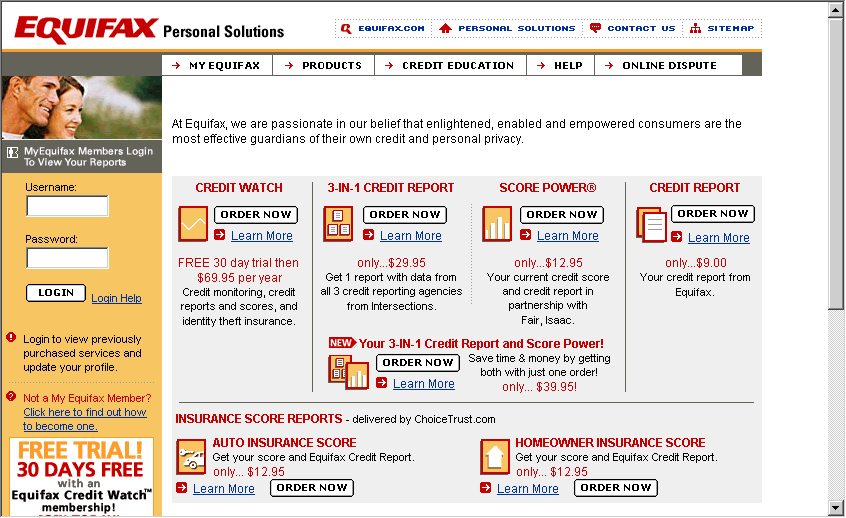
At the Equifax website, you can request a copy of your credit report as well as sign up for various other credit services.
Equifax Credit Watch monitors your credit in real-time. Other services include an instant credit report and an explanation of your report. You can also purchase a copy of all three credit agency reports (Equifax, TransUnion and Experian). Equifax offers a wide range of reports, including home insurance scores and auto insurance scores.
Experian
www.experian.com
Experian offers many of the same services as the other credit agencies, with one exception: It also offers used vehicle reports for consumers. Called AutoCheck, this area can provide information on any new or used vehicle. Information includes theft, flood damage, accidents, odometer rollbacks and whether a car has been rebuilt.
For consumer credit, Experian provides a sample version of the credit report they would send you. Products and services, including the three-in-one credit report, range from $9.99 to $29.99 billed monthly. You can try all versions free for 30 days before committing.
TransUnion
www.transunion.com
TransUnion provides many of the same services as Equifax, but also includes extensive fraud protection information and services.
Subscribers can get online access to their credit reports, sign up for weekly fraud protection emails/latest and access credit specialists and fraud resolution services.
TransUnion also provides a three-in-one credit report like Experian and Equifax.
Updated June 2019.
Discussion
FREE REPORT

No comments have been added yet. Add your thoughts to the discussion!
You need to log in as a registered AAII user before commenting.
Log InCreate an account