


Closed-end funds (CEFs) are similar to traditional open-end mutual funds in that professionally managed investment companies pool investors’ capital and invest in stocks, bonds or other securities according to an overriding investment objective. However, there are several key differences between closed-end funds and open-end funds that investors should be aware of. Closed-end funds trade on an exchange similar to exchange-traded funds (ETFs), but they are valued differently. Closed-end funds are essentially a mix between a mutual fund and a stock; they have a net asset value (NAV) and a share price. Closed-end funds do not issue redeemable shares nor do they continuously offer shares, which allows fund managers to work with a stable pool of capital. Closed-end funds have an initial public offering, much like a start-up company. After the initial public offering is closed, the fund’s shares will begin to trade on a secondary market.
The discount or premium on a closed-end fund represents the percentage difference between the share price and the portfolio’s underlying net asset value. Discounts and premiums are determined by the favorability and perception of the closed-end fund by investors in the market. Just as with stocks, investors must gauge the benefits and risks associated with investing in a closed-end fund trading at a premium or a discount. It’s important to track historical valuations to analyze whether the fund is offered at a discount or if its price actually reflects its value. There is always a chance that you will have to sell the fund at a deeper discount than when you purchased it. Therefore, liquidity is a caveat. A fund may have a premium if investors are confident in the fund, the managers’ ability or the underlying securities (and vice versa). Investors should also consider factors such as management, performance, volatility and expenses.
Investors make money by purchasing a closed-end fund at a discount to its net asset value, and selling when spread between the price and net asset value shrinks. Closed-end funds typically pay monthly or quarterly dividends, which could be attractive for investors seeking a stream of income. Expenses and fees will play an important role in total return, so keep an eye out for steep fees.
Investors need resources not only for data on closed-end funds, but also to educate themselves on how the funds operate in order to properly implement them into their portfolio. The following websites are the places to visit for more information.
CEF Connect
CEF Connect is sponsored by Nuveen Investments Inc., which is being acquired by TIAA-CREF, and was created to provide unbiased, straightforward and comprehensive closed-end fund information. Users can join CEF Connect for free and access tools to track their funds, set automated alerts, receive news updates and more.
The Daily Pricing section allows you to filter the table of closed-end funds based on investment strategies you choose. This includes options such as tax-free income, taxable income, U.S. equity and non-U.S./other. Users can click on table columns to sort by that metric for easier analysis. The table provides fund name, strategy, closing price, price change, net asset value (NAV), premium/discount, distribution rate, distribution rate on NAV and one-year return on NAV.
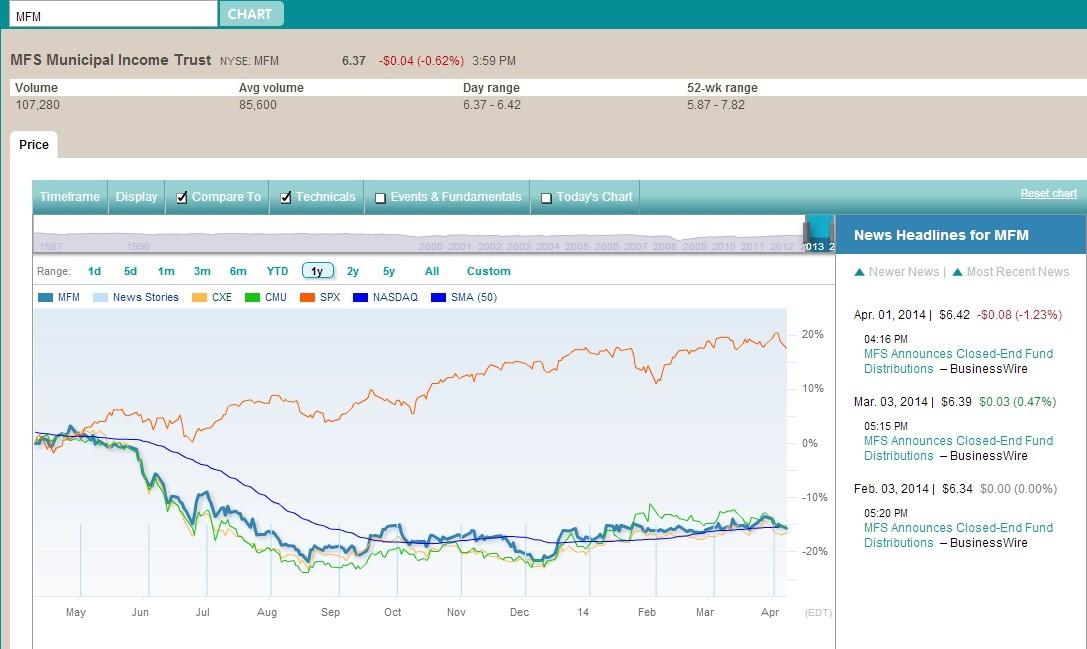
In the Fund Screener section, you will see the investment strategy filters that were available in the daily pricing table, along with added filter options. The screener shows the most common filters used. Instead of inputting values into the screener, you have the option to choose values on a sliding scale. For example, if you want to have only net asset values from $40.00 to $78.02, you simply adjust the scale accordingly. It is easy to understand and very helpful. Once the screener is finished running, passing companies will appear underneath the criteria selection table. Users can click the box to the left of the fund’s ticker to review that fund in comparison to another closed-end fund. Five funds can be reviewed side-by-side. After you’ve checked off the funds you want to compare, click the Review Up to Five button. A Fund Review will appear with a chart showing the closing prices of the funds you selected and a side-by-side display of the funds you chose for easy comparison. The Interactive Chart feature pops up another window. From there, you can compare the closed-end funds you selected and add comparison metrics, technical indicators, events and fundamentals.
Closed-End Fund Center
The Closed-End Fund Association (CEFA) is the national trade association representing the closed-end fund industry. The overall goal is to educate investors about the benefits or caveats of closed-end funds as well as provide a resource for information about its members and their offerings. Members of the CEFA are leading investment companies from the United States, Canada and abroad.
The home page of the CEFA website features content that investors can read to better understand closed-end funds and how they operate. Toward the center of the page is a table that displays the five top- and bottom-performing asset classes daily. The home page also provides podcasts, insight videos and industry news.

Investors have the option to sign up for the site in order to create their own portfolio tracker. The fund selector tab lets users create an advanced search for funds. By picking performance criteria, specific fund advisers or classifications, investors can search through the closed-end fund universe. Results are displayed in tabular format and include essential valuation metrics. The tool works essentially like a closed-end fund screener.
The “learn” section provides users with a place to further their education regarding closed-end funds, offering a print version of an educational booklet, basics, research articles, data definitions and an educational video.
Shortcut buttons along the left-hand side of the page allows users to quickly move to areas of interest. For example, by clicking “IPOs” investors can view closed-end funds that began operation recently. The list is updated on a monthly basis. Other shortcuts include CEF advisors, asset classes, leveraged funds, managed distributions, rights offerings and fund companies.
Morningstar.com
Update: Morningstar.com no longer supports a CEF section. However, you can find an active Closed-End Fund discussion group at the Morningstar Community on the topic.
Morningstar.com is another useful resource for investors looking to research closed-end funds. After arriving at the Morningstar website, simply click the CEFs tab in the top menu bar (between ETFs and Markets). Morningstar.com provides a variety of articles regarding closed-end funds so investors can stay on top of recent news and analysis. At the bottom of the page there are several links to articles on closed-end funds with topics such as “Two CEF Mistakes to Avoid,” or “The Importance of Limit Orders When Investing in CEFs.”
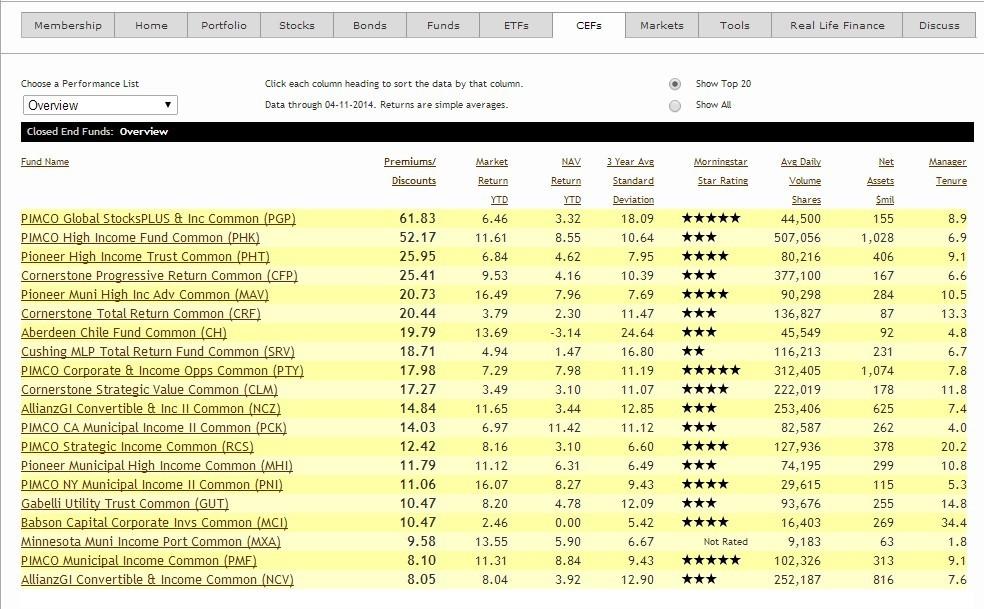
The website also offers a “solution center” for closed-end funds, where users can get up to speed on a broad range of topics. This section is helpful for those who have never invested in closed-end funds as well as those who already use them as portfolio staples. Another particularly useful tool by Morningstar is the Closed-End Fund Weekly Update. By clicking on any given week, it brings up a PDF that lists different categories of funds, with the weekly standouts in each category and discounts and premiums offered for that week.
By clicking “performance table,” users can sort through a table of closed-end funds. If you click on the title of any column heading, the table will be sorted by that metric. Premium Morningstar subscribers have access to analysis reports and Morningstar analyst ratings on closed-end funds.
Discussion
FREE REPORT

Joseph Stoutenburgh from MN posted over 12 years ago:
Ralph McClintock from ID posted over 12 years ago:
Jackie McClellan from IL posted over 12 years ago:
Ray from MN posted over 12 years ago:
Neil Sherman from TX posted over 12 years ago:
Neil Sherman from CO posted over 11 years ago:
John Sierakowski from CT posted over 9 years ago:
Joseph Bucciaglia from CT posted over 9 years ago:
Roderick Baldwin from California posted over 7 years ago:
You need to log in as a registered AAII user before commenting.
Log InCreate an account