

Related

Behavioral Finance
by Meir Statman | April 2017

Most people use the term “rational” in everyday language as being equivalent to “normal-smart.”
Financial economists, however, use the term more narrowly in their writings and models. Rational investors want only utilitarian benefits. Rational people are either immune to cognitive and emotional errors or are always able to overcome them in the world of economics. In the real world, normal people, even smart and knowledgeable ones, are susceptible to cognitive and emotional errors and are not always able to overcome them.
Psychologists Keith Stanovich and Richard West and Nobel laureate psychologist Daniel Kahneman described two systems in our minds: System 1 and System 2. System 1 is the intuitive “blink” system—automatic, fast and effortless—whereas System 2 is the reflective “think” system— controlled, slow and effortful.
Use of System 2 is easier when we have time to engage it, and most beneficial when the consequences of poor choices by System 1 are substantial. Choosing the fish entrée from a restaurant’s menu by our System 1 gut is a good cognitive and emotional shortcut when a waiter hovers over us and our tablemates are impatient. Choosing to buy a house without use of System 2 thinking is an error, and so is a choice to forgo diversification in our portfolios.
Rational people use the reflective System 2 whenever the intuitive System 1 misleads, whereas normal people regularly forgo reflection once they have found an answer by System 1. Yet normal people vary, standing at points along the range from ignorant to knowledgeable. Knowledgeable people have learned, imperfectly and with much effort, to use System 2 when System 1 misleads. In this article, I share some insights from my latest book, “Finance for Normal People: How Investors and Markets Behave” (Oxford University Press, 2017) about how to avoid, or at least limit, System 1 and other behavioral errors when investing.
Normal people frequently invoke System 1 when presented with numbers. These errors manifest in both our assessment of probability and our tendency to use mental benchmarks.
One of the ways we hurt ourselves is by forming conclusions based on a limited amount of information. This behavior is known as a representativeness error.
An example is a belief in the “law of small numbers,” a tongue-in-cheek offshoot on the robust “law of large numbers.” The latter is an important law of statistics. It teaches us, for example, that the percentage of heads in a sequence of coin flips is likely to be closer to 50% when we flip a coin a large number of times, such as 30, than when we flip it a small number of times, such as six. One manifestation of belief in the law of small numbers is that six years of beating the market is interpreted as representative of a skillful mutual fund manager as much as 30 years of beating the market is.
Insensitivity to predictability exacerbates representativeness errors. We can predict quite accurately the quality of future meals at a restaurant by the quality of six past meals, but we cannot predict nearly as accurately the future performance of a mutual fund by the performance of the past six years.
Consider judging the probability that a particular mutual fund manager will generate returns exceeding the benchmark returns. Analysis free of representativeness errors guides us to examine both representativeness information about the returns of this particular fund relative to its benchmark, and base-rate information about the returns of all funds relative to their benchmarks. Judging a fund by its representativeness information alone, we might be tempted to conclude that a manager who beat the benchmark six years in a row clearly has skill. However, once we note that base-rate information indicates that few mutual fund managers beat their benchmarks consistently over years and know that this fund manager is one among hundreds or thousands of fund managers in the population of funds, we understand that it is as likely that there would be lucky fund managers who beat their benchmarks six times in a row as there are lucky coin flippers who flip six heads in a row.
Yet investors, even institutional investors, continue to neglect base-rate information. Institutional investors trust their judgment about the application of representativeness information in identifying skilled money managers, evaluating their performance and choosing to retain or terminate them. Stated reasons for preferring active management include whether a handful of skilled active managers can be identified and combined to generate market-beating returns. In contrast, the stated reasons are only vaguely associated with base-rate information about the performance of the average manager.
Quantitative models are powerful correcting methods. These models and algorithms regularly outperform human judgment. An investment model, or even a stock screen, may be based on the inputs of profitability, financial stability, susceptibility to bankruptcy and margin of safety. Quantitative models simplify the investment selection process and help avoid cognitive errors that might degrade the selection process. Yet people regularly prefer human judgment over quantitative models and algorithms. They also lose confidence in algorithmic forecasters faster than they lose confidence in human forecasters after seeing them make the same mistake.
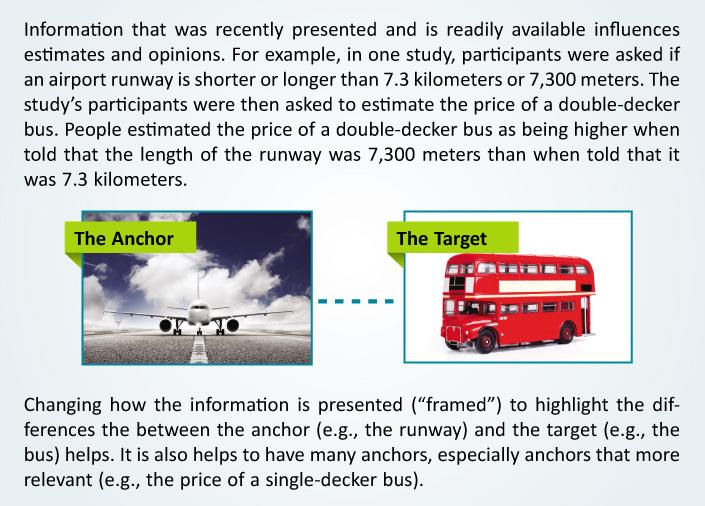
We also, usually unintentionally, base conclusions on previous and readily available information, a process known as anchoring. Anchors affect estimates of targets by highlighting features shared by the anchor and the target, and obscuring features of the target that differ from those of the anchor.
An example would be an experiment where groups of people are told that the length of a runway is either 7,300 meters or 7.3 kilometers. Both groups are then asked to estimate the price of a double-decker bus. People estimated the price of a double-decker bus as being higher when told that the length of the runway is 7,300 meters than when told that it is 7.3 kilometers (Figure 1).
The length of the runway is the “anchor” in this experiment and the price of a double-decker bus is the “target.” Anchors affect estimates of targets by highlighting features shared by the anchor and the target, and obscuring features of the target that differ from those of the anchor. Transportation is highlighted as a feature shared by runways and buses. But while the shared transportation feature is highlighted, features that are not shared by airport runways and buses are obscured—for example, air transportation is a feature of runways, whereas ground transportation is a feature of buses.
Changing how the information is presented—a practice known as framing—helps. Proper framing highlights differences between the features of anchor and target. It makes the length of a runway less prominent in the evaluation of the price of a bus and weakens the chain that links the length of the runway to the estimated price of a bus.
Proper framing also corrects anchoring errors when it makes us consider many anchors rather than one. Plausible anchors for the price of a double-decker bus, such as the price of a single-decker bus, exert greater influence on estimates than implausible ones, such as the length of a runway. People facing multiple anchors evaluate the plausibility of each anchor relative to the others. People facing the length of a runway as one anchor for the price of a double-decker bus and the price of a single-decker bus as another anchor choose the price of a single-decker bus as an anchor because it is more plausible.
Psychologist Craig McKenzie and behavioral finance analyst Michael Liersch found that anchoring errors in the intuitive System 1 leads people into underestimating exponential growth of savings. It causes them to underestimate the effects of compounding and the potential growth of money saved when young. Consequently, System 1 misleads people who want adequate old-age income into inadequately saving when young.
Good shortcuts are a useful System 2 correcting method. The “rule of 72” is a cognitive shortcut used to estimate the number of years it would take an amount to double when it grows exponentially. It involves dividing 72 by the annual rate of growth, such as 6%, yielding an estimate of 12 years.
People using the rule of 72 can estimate that, at 6%, $1,000 will grow into $2,000 in 12 years, $4,000 in 24 years, and $8,000 in 36 years. Their estimate of growth at the end of 40 years would be $9,920 if they calculate the last four years linearly, short of the correct $10,286 but not by much.
People who know exponential growth might choose to save more when they are young, motivated by wants for ample spending when they are old. They might also choose to save less when young, motivated by wants for ample spending now, knowing that smaller savings will grow exponentially to amounts large enough to satisfy their wants for adequate, but less-than-ample, spending when old.
Consider receiving a coffee mug as a gift that is yours to keep. How much would you be willing to pay for such a mug if you were to buy one? And how much would you ask for the mug if you are to sell it? If you are like most people you are likely willing to pay a lower amount, say $6, for the mug if you are going to buy it. You will also be likely to ask for a higher amount, say $10, if you are asked to sell a mug you own. This tendency is the endowment effect. It occurs when the act of being endowed with an item enhances the item’s worth in the eyes of a person who owns it.
What rationale underlies the endowment effect?
The usual rationale offered for the effect is loss aversion. Specifically, giving up an item we own involves a loss, a loss absent when we are considering acquiring that same item. Yet the emotional benefits of pride and especially the emotional costs of regret are likely prominent among rationales underlying the endowment effect. Think of a lottery ticket you received as a gift and is yours to keep. Would you be willing to exchange it for another lottery ticket? You probably won’t because you can easily imagine the regret you would feel if your original ticket won the lottery. Fewer than half of people agreed to exchange a lottery ticket they received as a gift for another lottery ticket. In contrast, more than nine in 10 agreed to exchange a pen they have received as a gift for another pen.
The endowment effect can be corrected by encouraging “thinking like a trader”—being ready to bear the emotional costs of regret. It is possible that professional traders have learned not just facts about investments, but strategies for addressing the normal emotional responses that might prevent amateurs from making the same decisions, given the same information.
A long-held concept in investing is the “efficient frontier.” This is the point at which the maximum level of portfolio return is realized for a given level of portfolio volatility (variance).
Normal investors do not seek high volatility for its own sake. Rather, high volatility is payment for a low probability of falling short of reaching a financial goal. Portfolios assessed as high risk because of high volatility can be assessed as low risk by normal investors when such portfolios offer low probabilities of not achieving target wealth.
Traditional portfolio theory treats investors as seeking the optimal level of return for a given level of risk. Behavioral portfolio theory differs by factoring in the benefits investors seek from their portfolios, which may extend beyond just traditional measures of risk and return. (See Table 1 for a comparison.)
Table 1. Comparing Traditional Versus Behavioral Portfolio Theory
Traditional portfolio theory treats investors as seeking the optimal level of return for a given level of risk. Based on Harry Markowitz’s theory, a portfolio is considered to be efficient when investors are properly compensated for assuming a certain level of variance (volatility) in their returns. Behavioral portfolio theory differs by factoring the benefits investors seek from their portfolio, which may extend beyond just traditional measures of risk and return.
| Traditional Portfolio Theory | Behavioral Portfolio Theory |
|---|---|
| 1. Efficient portfolios are on the mean-variance frontier. | 1. Efficient portfolios are on the behavioral-wants frontier. |
| 2. Portfolios on the mean-variance frontier satisfy wants for utilitarian benefits (high expected returns and low risk). | 2. Portfolios on the behavioral-wants frontier satisfy wants for utilitarian benefits, but also for expressive and emotional benefits (e.g., sincere social responsibility, high social status). |
| 3. Investors consider portfolios as a whole. | 3. Investors consider portfolios as layered pyramids, where each layer is a mental account or “bucket” associated with a want and goal. |
| 4. Investors measure risk by the variance of returns. | 4. Investors measure risk by the probability of shortfall from a goal, the amount of shortfall, or a combination of both. |
| 5. Investors have a single risk aversion in their portfolio as a whole. | 5. Investors have many risk aversions, one for each mental account. |
| 6. Investors are always risk-averse, where risk is measured by the variance of returns. | 6. Investors are always risk-averse, where risk is measured by the probability of shortfall from a goal, the amount of shortfall, or a combination of both. Risk aversion, as measured in behavioral portfolio theory, can correspond to risk-seeking, as measured in modern portfolio theory. |
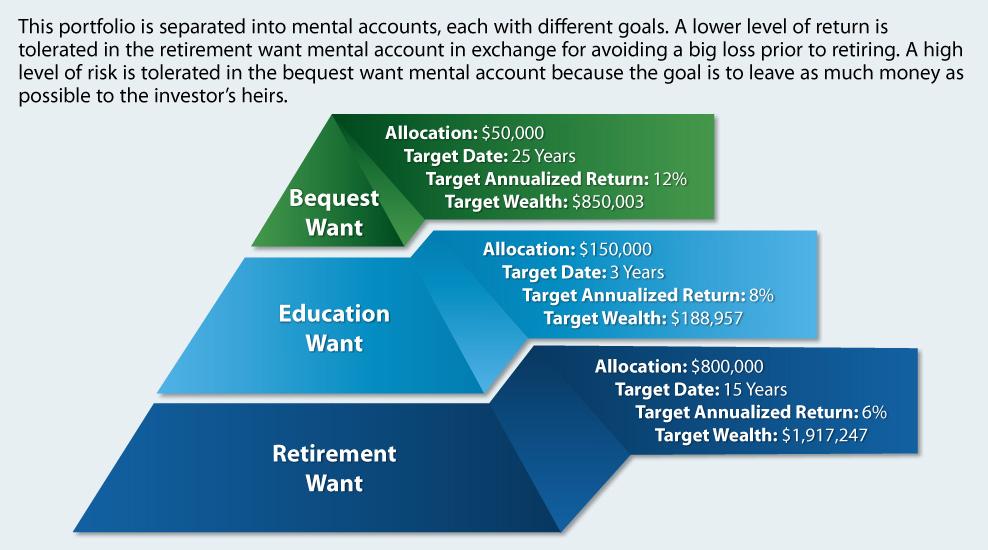
A central feature in behavioral portfolio theory rests on the observation that investors view their portfolios as sets of distinct mental account layers in a portfolio pyramid. Each mental account corresponds to a particular want, associated goal and their utilitarian, expressive and emotional benefits. An optimal behavioral-wants portfolio is one that effectively balances wants while avoiding cognitive and emotional errors.
Investors in behavioral portfolio theory have many attitudes toward risk, measured by shortfall from target wealth in each mental account. Investors might be willing to accept high shortfall risk in their “upside potential” mental account, but little shortfall risk in their “downside protection” mental account.
The mental account that corresponds to wants for downside protection would have utilitarian benefits, such as protection from consumption constrained by poverty, and it would also have expressive and emotional benefits including financial independence and freedom from fear of poverty. The mental account that corresponds to wants for upside potential would have utilitarian benefits such as consumption and accumulation of assets enabled by riches and expressive and emotional benefits including high social status and pride.
The downside protection mental account is likely composed of a diversified set of stocks, bonds and similar investments, while the upside potential mental account is likely composed of an undiversified handful of stocks and similar investments. Indeed, the pyramid structure of behavioral portfolios is reflected in “core and satellite” and “risk budget” portfolios composed of a well-diversified core layer geared to downside protection and a less-diversified satellite layer geared to upside potential.
Investors can begin the process of constructing behavioral portfolios by dividing their portfolio as a whole into mental accounts of wants and associated goals, as shown in Figure 2. Such portfolios include features shared by both standard and behavioral portfolio theory, such as diversification, low costs and simplicity.
Wants-based mental accounts let investors articulate each want and associated goal, the target wealth at the target date, and the attitude toward risk, measured by expected volatility, in the mental account of each want and associated goal.
Jean Brunel, a financial adviser to very wealthy families and author of “Goals-Based Wealth Management” (John Wiley & Sons, 2015) employs a method he calls “forward sequencing.” The first sequence focuses on wants and associated goals, ranking them as “needs,” “wants,” “wishes” and “dreams.” People are not likely to distinguish an 80% probability of reaching a goal from a 90% probability, but they are likely to distinguish something they need from something they merely want, and something they wish they had from something they dream they will have. Eliciting helps to attach probabilities to clients’ needs, wants, wishes and dreams.
We are better at identifying blind spots in others than in ourselves. Blind spots are exacerbated by our tendency to trust our own introspections about judgment and behavior more than we trust perceptions by others.
Financial advisers can guide investors by providing human-behavior and financial-facts information. They can also correct cognitive and emotional errors. For example, advisers can point out the cognitive errors of availability and hindsight when mutual fund advertisements are about to steer clients into funds with high recent returns, but unlikely high future returns. They can point out the emotional errors of exaggerated fear when these errors threaten to steer clients into selling all their stocks after stock market crashes. Financial advisers are especially effective at improving the financial behavior of their clients when they educate them with “just-in-time” human-behavior and financial-facts knowledge.
Financial planner Harold Evensky noted that it is important for advisers to help clients see potential trade-offs among goals as they reflect on their wants and resources. Helping clients to evaluate trade-offs between wants and to consider scenarios that resonate with them is at the heart of planning.
Behavioral Finance

Behavioral Finance

Financial Planning

No comments have been added yet. Add your thoughts to the discussion!
You need to log in as a registered AAII user before commenting.
Log InCreate an account