

Related

Portfolio Strategies
For most retirees, it makes economic sense to delay taking Social Security benefits until age 66.
by Robert Muksian | May 2011

A dilemma facing workers who have reached their full retirement age (FRA) is whether to take the Social Security benefit and continue working or wait to take advantage of an increased regular benefit and a significant delayed retirement credit.
I addressed this question in the August 2000 issue of the AAII Journal [“Social Security Benefits at 65: Delay, or Take the Money & Run?”], but with a “new” group of AAII members approaching elective retirement, this is a topic worth reviewing.
The Social Security benefit is based on indexed wages from the year of age 22 through the year of age 59 plus actual wages for the year of age 60 through the year prior to the elected retirement year (e.g., 2010 for those electing to take benefits in 2011). In order to determine indexed wages, an index factor for each year is calculated by dividing the national average wage index (NAWI) for the age-60 year by the NAWI for each year from the year of age 22 through the year of age 59. Indexing stops with the age-60 year. Then, the actual Social Security taxable wage earned each year, up to the limit for Social Security payroll (FICA) taxes, is multiplied by the corresponding index factor. The largest 35 of these indexed wages are totaled, and that sum is divided by 420 (12 months per year times 35 years) to obtain an average indexed monthly earnings (AIME) amount.
The earliest that Social Security benefits may be taken electively is at age 62. A formula is applied to the AIME such that more of the wages are included in the benefit for low wage earners than are included for high wage earners. The 1977 Amendments to the Social Security Act established bend points that are used to determine a person’s primary insurance amount (PIA) from the AIME.
Although these bend points are indexed with the national average wage index, the Consumer Price Index for Urban Workers (CPI–W) of the fourth quarter of the federal fiscal year (July, August and September) has a direct effect on which bend points are applicable for the age-62 year. The average CPI–W of the fourth quarter of the current year, 2010, is compared to the average CPI–W of the fourth quarter for the most recent year that a cost-of-living adjustment (COLA) was positive, which was 2008. If the difference between these two CPI–Ws is positive, that value would be the amount of the cost-of-living adjustment. Since the latest difference between the two is –0.6%, there is no cost-of-living adjustment for 2011. (Benefits are never reduced.) Therefore, the bend points of 2010 are used for retirement in 2011 at age 62. Table 1 summarizes the Social Security benefits for average and maximum wages earners who might elect to retire in 2011.
Table 1. Determination of Benefits for Retirement in 2011 at Average and Maximum Wages
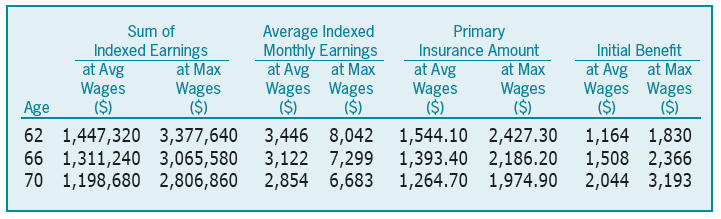
The Social Security benefit for those who elect to retire prior to full retirement age is reduced for early retirement (ages 62–65 for those born between 1946 and 1954). The formula for the reduction is five-ninths of a percent per month for the first 36 months of early retirement plus five-twelfths of a percent per month for the next 24 months. Thus, for a full retirement age of 66, if a person takes benefits at age 62, the maximum reduction is 25% of the primary insurance amount calculated as of the year of age 61, 48 months earlier. However, only those born on the first day of the month are considered to be 62 in the month of their 62nd birthday. All others must wait one month for the first benefit, and therefore those people have retired 47 months early with a reduction of 24.583%. The initial benefits in Table 1 for age 62 are 74.417% of the respective primary insurance amounts. The cents are dropped after the multiplication, therefore the reduction is slightly greater than the formula calculates.
In reality, however, the reduction is significantly greater than indicated by the formula. To the primary insurance amount at the age-62 year, four cost-of-living adjustments would be applied to arrive at the benefit for age 66. With wage increases and cost-of-living adjustments of 3% per year, had the maximum wage earner waited until age 66, instead of taking benefits at age 62, his benefit would have been $2,795. This makes the $1,830 benefit an effective reduction of over 35%. In reality the benefit at age 66 would be almost 53% greater than the age-62 benefit.
From a purely economic perspective, it would seem prudent to delay and not “take the money and run” at age 62. Additionally, there is an earnings limit for wages ($1,180 per month in 2011) between 62 and the full retirement age. One dollar out of every $2 in earnings above the limit is withheld. Health care insurance could also be a problem unless a working spouse has coverage up to the Medicare age of 65.
Another important consideration is the length of time before total benefits from both options (early and delayed) are equal—the breakeven age. Table 2 shows the breakeven ages and benefits between age 62 and age 70 for a 62-year-old in 2011, assuming a birth month of February and the first benefit in March. Should the retiree survive beyond the breakeven age, it would have been an economic mistake to “take the money and run.”
Table 2. Breakeven Ages and Benefi ts Between ages 62 and 70
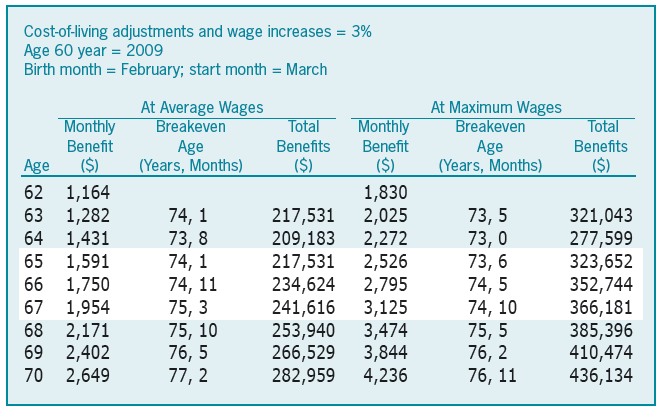
For a person who will be 62 in 2011, full retirement age is 66. With a life expectancy of 81 (based on the 2004 United States Life Tables of the Department of Health and Human Services), the probability of a male surviving to 66 is about 94%. With a life expectancy of age 84, the probability of a female surviving to 66 is about 96%. Therefore, unless there are other considerations, delaying benefits from age 62 to age 66 appears to be worth the wait.
The delay to age 66 facilitates two factors: (1) an increase in Social Security benefit due to four additional years of work and (2) the option to collect benefits and continue working with no payback of benefits—there is no earnings limit once the full retirement age has been reached. The breakeven ages and total benefits between age 66 and age 70 are shown in Table 3 for a 66-year-old in 2011 with a birth month of February taking the first benefit in March. Should the retiree survive beyond the breakeven age, it would have been an economic mistake to “take the money and run.”
Table 3. Breakeven Ages and Benefits Between Ages 66 and 70
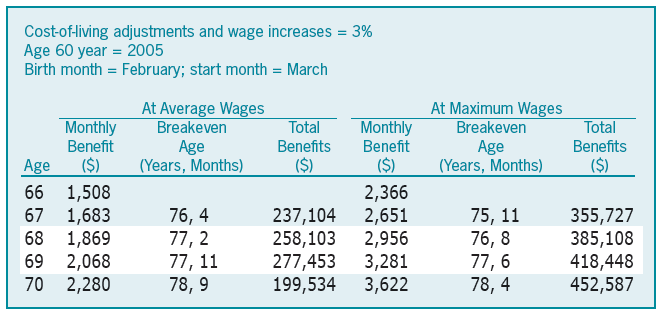
The magnitude of the benefits for the average-wage earner virtually mandates delaying taking benefits until age 66 or later because it might be unrealistic to assume that an average-wage worker would be vested in a retirement plan that would provide an appropriate supplemental benefit. With approximately $14,000 from Social Security, he would need supplemental income between $18,000 and $26,000 in the first year to have a retirement income between 80% and 100% of the final-year wage. In addition, he will have to address the problem of health care insurance. Further, the monthly benefit four years from now, in 2015, will have been increased by about 50% (from $1,164 to $1,750), a $586 increase. This would give the worker an option to increase total income from the average amount of about $45,000 to about $66,000, of which only $45,000 would be subject to FICA taxes. Probably only 50% of the Social Security benefit would be subject to income taxes. Lastly, by delaying to age 66, the $586 additional benefit might be used to pay the premium for decent Medicare Supplement insurance for a couple.
It is the maximum-wage earner who is not in need of the benefit at the full retirement age. Therefore he or she has the option of taking or delaying Social Security, given wages in excess of $106,800 in 2011. The monthly benefit after age 66 could increase as a result of two factors: (1) the wages earned each year a worker is employed might replace wages of a lower-earnings year from the previous 35 years in the monthly earnings calculation and (2) after four to eight cost-of-living adjustments are applied, a delayed retirement credit of 8% simple interest would increase the primary insurance amount by up to 32%. (Benefits are mandatory at age 70.)
Table 4 shows the annual Social Security benefits for starting the benefit at age 66 and at age 70. It indicates that the total benefit for the delay exceeds the full retirement age benefit between ages 78 and 79. That is, breakeven is between ages 78 and 79.
Table 4. Annual Social Security Benefits Starting at Age 66 Vs. Age 70
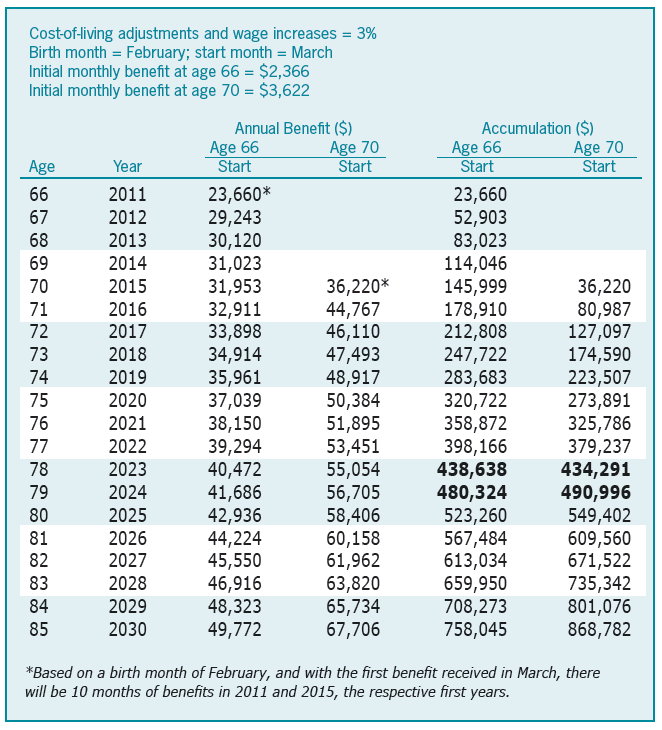
With a life expectancy age of 82, the probability of a 70-year-old male reaching age 79 is about 64%. Should he survive to age 82 he will have received $58,488 more Social Security benefits by the delay. With a life expectancy age of 85, the probability of a 70-year-old female surviving to age 79 is about 74%. Should she survive to age 85, she will have received $110,737 more in Social Security benefits by the delay. The respective delayed benefits increase the longer each person survives beyond their respective life expectancies.
The foregoing analysis implies that it is worth waiting until age 70 in order to take advantage of the delayed retirement credit, in addition to the greater primary benefit. Should the primary worker die during the delay, the surviving spouse will receive the greater of his or her own benefit or the worker’s delayed benefit, so the worker’s Social Security taxes will not have been paid in vain. If the primary worker is at the full retirement age and if the spouse is at least 62, the spouse is entitled to a benefit between about 35% and 50% of the primary worker’s benefit. The spouse could begin receiving benefits while the worker could suspend his or her benefit until a later age. (Information about spousal benefit options may be obtained at the Social Security Administration website, www.ssa.gov/retire2/yourspouse.htm.) Thus, the spouse could receive a benefit between about $833 and $1,183, while the primary worker continues to work and delay benefits. The disposition of the worker’s benefit could be a factor in the decision to delay or not delay.
The ideal case for an individual is that he will have a retirement plan that will provide all the funds necessary during retirement and that the post-income-tax Social Security benefit will be invested as a legacy to his estate. Table 5 shows the age-66 and age-70 monthly benefit to be $2,366 and $3,622, respectively.
Table 5. The Accumulation of Invested Social Security Benefits
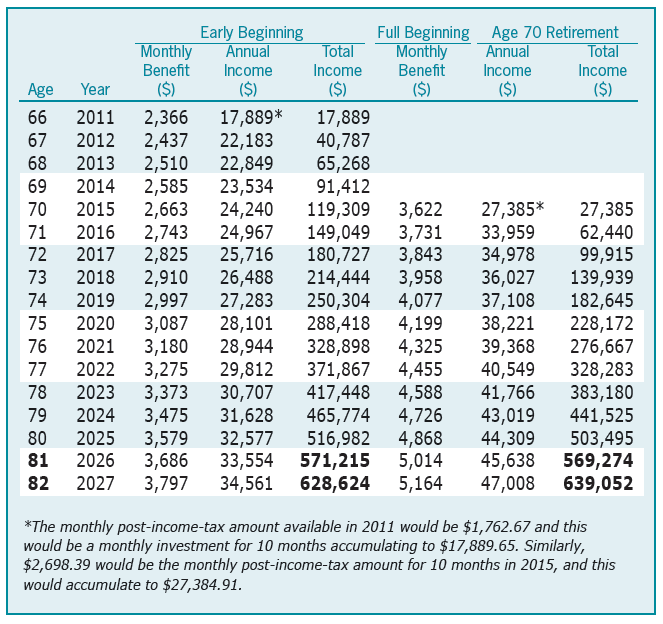
Thus, for a post-income-tax investment rate of 4% and combined federal and state income tax rate of 30%, breakeven occurs between ages 81 and 82, as is shown in Table 5.
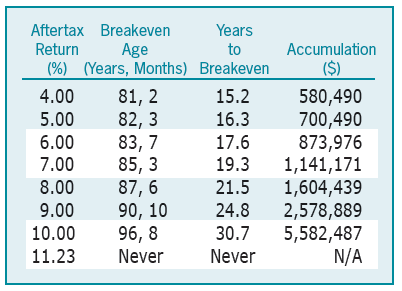
If aftertax rates of return are greater than 4%, the breakeven ages increase to “never” at a rate of return of 11.23%. Table 6 shows these ages and accumulations for returns between 4% and 10%, inclusive.
Table 6 brings life expectancy into greater perspective. If an individual can reasonably expect to earn an aftertax rate of return of 5% in a mix of stocks and bonds, for example, breakeven would be at his or her approximate life expectancy age of 82. This suggests that it would be prudent to “take the money and run” at the full retirement age as a precaution against not surviving to 82. The female would have an additional three years, but at 82 she would have an accumulation of over $700,000, and that might be sufficient reason for her to also “take the money and run” at the full retirement age. These breakeven ages and accumulations would be further extended if a spousal benefit is also invested. For the maximum wage earner, the combined benefit at age 66 would be $3,549 and the benefit at age 70 would be $4,994, based on wage increases and cost-of-living adjustments of 3%. At the 4% aftertax rate of return, the breakeven age would be 87, which is beyond the life expectancy of both male and female; therefore, it might be prudent to “take the money and run.”
Table 6. Breakeven Ages and Accumulation
This analysis indicates that the decision of whether to begin Social Security benefits at age 62 depends upon two factors. If the worker has a retirement plan that, when combined with the Social Security benefit, replaces to a great extent the final-year wages, and if health care insurance is not a problem, taking the benefit at age 62 would be reasonable. If this benefit is based on a spouse’s work history, the worker might delay taking benefits until full retirement age to take advantage of the greater benefit and up to eight years of greater income for the family. If the worker is in good health, the breakeven age occurs prior to life expectancy age and the total income at that age will be greater because of the delay. Should the primary worker die during the delay, the spouse would receive the larger of his or her own benefit or the worker’s delayed benefit.
The individual who has delayed taking Social Security benefits until his or her full retirement age faces a slight dilemma. Workers who have attained full retirement age can collect benefits and continue working without a payback of any Social Security benefits. (Actually, those wages need not even be reported to the Social Security Administration.) There is no question if the individual simply retires. But if the individual is going to continue to work, the economic consideration is “breakeven.”
Breakeven for average- and maximum-wage earners is in the latter half of the 13th year (between ages 78 and 79). Life expectancy at age 66 is approximately 16 more years for a male and 19 more years for a female. Thus, for all wage earners, if an individual is not in good health, taking the benefit is indicated. If he or she is in good health, delaying the benefit is indicated for the maximum-wage earner. Since benefits are automatic at age 70, greater retirement income will be available with reasonably good probabilities of surviving beyond the breakeven age.
It seems reasonable that the average-wage earner would use the Social Security benefit to add to their lifestyle, and so taking the benefit is indicated at age 66. The maximum wage earner may never need the benefit and would simply invest the aftertax amount. At aftertax rates of return between 4% and 10%, the breakeven age is at least the life expectancy of a male and just short of the life expectancy of a female; therefore, taking the benefit at age 66 is indicated. Should the combined worker and spousal benefit be invested, the breakeven age is well beyond both life expectancies and, again, taking the benefit at age 66 is indicated.
Portfolio Strategies
Portfolio Strategies

D from CA posted over 15 years ago:
Laura from MA posted over 15 years ago:
Steve from MI posted over 15 years ago:
R from AL posted over 15 years ago:
Navin from WA posted over 15 years ago:
Barry from MN posted over 15 years ago:
Michael from WI posted over 15 years ago:
John from MN posted over 15 years ago:
Paul from CA posted over 15 years ago:
Hans from FL posted over 15 years ago:
Maynard from TX posted over 15 years ago:
Scott from OR posted over 15 years ago:
Roger from TX posted over 15 years ago:
Chris from NJ posted over 15 years ago:
Gregory from NJ posted over 15 years ago:
Richard from FL posted over 15 years ago:
Stephen from MA posted over 15 years ago:
Dennis from TX posted over 15 years ago:
Barney from CO posted over 15 years ago:
Douglas from AZ posted over 15 years ago:
Milton from NJ posted over 15 years ago:
J from VA posted over 15 years ago:
Roger from AZ posted over 15 years ago:
Arthur from CA posted over 15 years ago:
Peter from IL posted over 15 years ago:
Gale from IL posted over 15 years ago:
Ed from TX posted over 15 years ago:
Dennis from KY posted over 15 years ago:
Don from TN posted over 15 years ago:
Michael from RI posted over 15 years ago:
Thomas from WI posted over 15 years ago:
Henry from MA posted over 15 years ago:
Dan from TX posted over 15 years ago:
C from NH posted over 15 years ago:
Anthony from CA posted over 15 years ago:
George from TX posted over 15 years ago:
George from TX posted over 15 years ago:
Marcin from AZ posted over 15 years ago:
Steven from MN posted over 14 years ago:
Jim from Pa posted over 13 years ago:
Jim from Pa posted over 13 years ago:
Gerald from PA posted over 11 years ago:
You need to log in as a registered AAII user before commenting.
Log InCreate an account