

Related

First Cut Stocks
The benefit or harm of a stock buyback is dependent on several factors, including how it is funded and the alternative uses for the cash.
After a brief pause in 2009, companies returned to buying back stock with a vengeance, with more than $500 billion in stock buybacks in 2014.
As stock prices rise and anxiety about bubbles and real economic growth also comes to the surface as I write this, it is not surprising that some are trying to make a connection, rightly or wrongly, to the buyout numbers. In my view, much that is written about buybacks reflects a fundamental misunderstanding of what stock buybacks are and what they can do for companies.
For much of the last century, companies were not allowed to buy back stock, except in exceptional circumstances. In the United States, the pace of buybacks did not really start picking up until the early 1980s, which some attribute to a Securities and Exchange Commission rule (10b-18) passed in 1982, providing safe harbor (protection from certain lawsuits) for companies doing repurchases. Figure 1 shows aggregate stock buybacks and dividends at U.S. companies going back to 1980.
Figure 1. Aggregate Dividends
and Stock Buybacks for U.S. Firms

While dividends represented the preponderance of cash returned to investors in the early 1980s, the move toward buybacks became clear in the 1990s, and the aggregate amount in buybacks exceeded the aggregate dividends paid from 2005 to 2007. In 2007, the aggregate amount in buybacks was 32% higher than the dividends paid in that year. The market crisis of 2008 did result in a sharp pullback in buybacks in 2009, and while dividends also fell, they did not fall by as much.
The practice of buybacks has also now spread far and wide across the corporate spectrum, with small and large companies as well as those in different sectors partaking in the phenomenon.
To understand buybacks, it is best to start simple. Publicly traded companies that generate excess cash often want to return that cash to shareholders, and shareholders want them to do that. There are only two ways a company can return cash to shareholders. One is to pay dividends, either on a regular basis (quarterly, semiannually or yearly) or as special dividends. The other is to buy back stock. From the company’s perspective, the aggregate effect is exactly the same, as cash leaves the company and goes to shareholders. There are four differences, though, between the two modes.
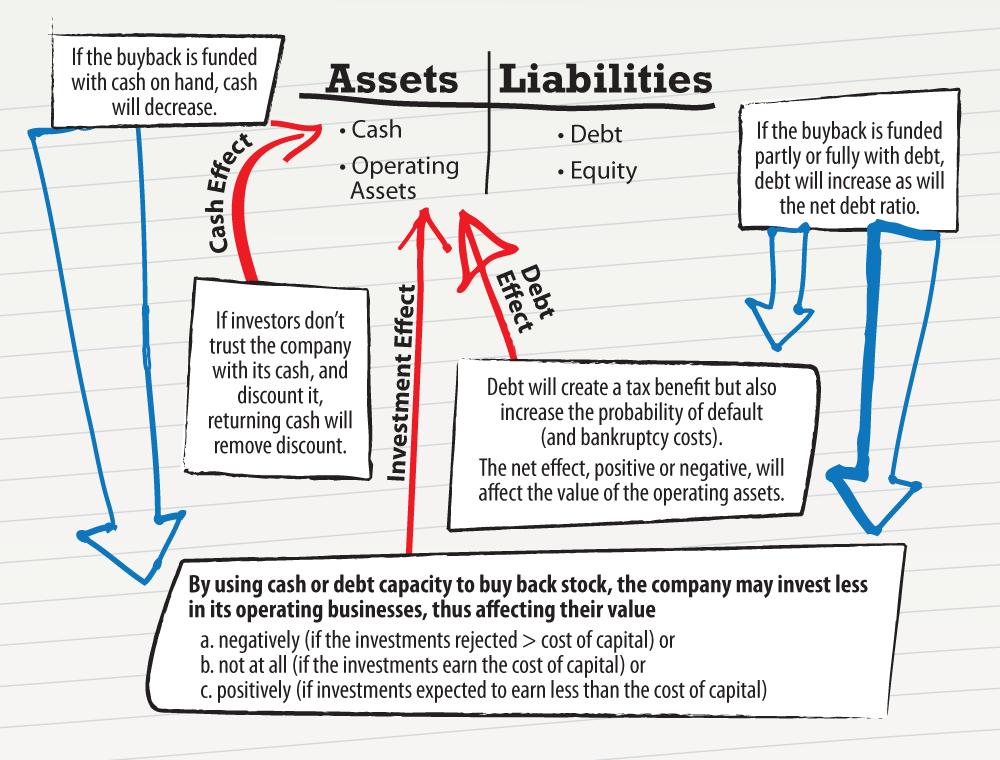
Buybacks can have no effect, a positive effect or a negative effect on equity value per share, depending on where the cash from the buyback is coming from and how it affects the firm’s investment decisions. To illustrate the effects, let’s start with a simple financial balance sheet (not an accounting one), where we estimate the intrinsic values of operating assets and equity and illustrate the effects of a stock buyback on the balance sheet (see Figure 2).
Note that the buyback can be funded entirely with cash, partly with cash and partly with new debt, or even entirely with debt. (I am going to leave out the perverse, but not uncommon, scenario of a company that funds a buyback with a new stock issue, since the only party that is enriched by that transaction is the investment banker who manages both the issuance and the buyback).
The value of the operating assets can change, if the net debt ratio of the company changes after the buyback (thus affecting the cost of capital) or if the buyback reduces the amount that the company was planning to invest in its operating assets (thus changing the cash flows, growth and risk in these assets).
This framework is a useful vehicle to look at the conditions under which buybacks have no effect, a positive effect and a negative effect on value.
For buybacks to have no effect on value, they should have no effect on the value of the operating assets. That must effectively mean that the buyback is entirely funded with cash off the balance sheet or that even if funded with debt, there is no net value effect (tax benefits cancel out with default cost) and that the buyback has no effect on how much the company invests back into its operating assets. As an example, consider the $13.2 billion in stock buybacks made by Exxon Mobil (XOM) in 2013. The company funded the buybacks entirely with cash surpluses; not only did it have more than enough cash to cover reinvestment needs, it also continued to generate billions of dollars in excess cash (over and above its reinvestment needs).
There are three pathways through with which a buyback can have a positive effect on value.
The first is when the market does not trust the management of a company with a large cash balance and is discounting that cash on the assumption that the company will do something stupid with the cash. Paying the cash out eliminates the discount.
The second is when an under-levered firm borrows money to do a buyback, effectively raising its value by the net benefit of the added debt, calculated as the difference between the tax benefits from the debt and the increase in bankruptcy costs.
The third is when a company that is in a bad business stops investing in that business and redirects the cash to shareholders.
There are two ways in which a buyback can have a negative effect on value.
The first is if the firm is over-levered and chooses to finance the buyback with even more debt, since that would push the cost of capital higher after the buyback (as the expected bankruptcy costs overwhelm the tax benefits of borrowing).
The second way a negative effect on value could result is if the firm takes cash that would have been directed to superior investment opportunities (where the return on capital is greater than the cost of capital) and uses it to buy back stocks. This requires that the company also face a capital constraint, imposed either internally (because the company does not like to raise new financing) or externally (because the company is prevented from raising new financing).
If buybacks have no effect on value, can they still affect stock prices? Sure, and there are three possible factors that may cause the effect.
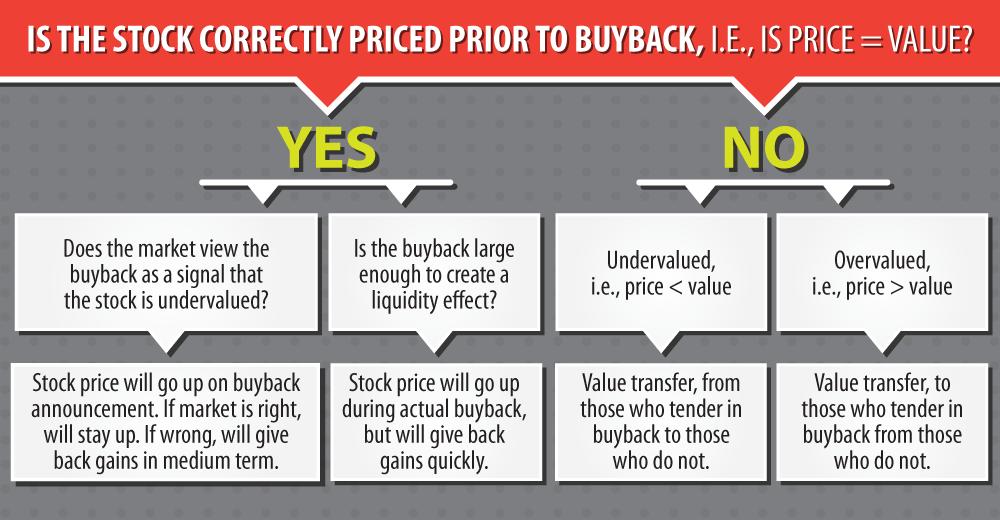
The first is if there is a market mistake at play, where the stock is priced above or below its intrinsic value and the buyback occurs at a price that is not equal to the value. The second is that markets extrapolate from corporate actions and may view the buyback as a signal about what managers of the company think about its fair value. The third is that a buyback, especially if large and/or on a lightly traded stock, can have liquidity effects, tilting the demand side of the pricing equation. All of the effects are captured in Figure 3.
If the stock is mispriced before the buyback, the buyback can create a value transfer between those who tender their shares back and those who remain as shareholders, with the direction of the transfer depending on whether the shares were over- or undervalued to begin with.
If the price is less than the value (i.e., the stock is underpriced), a buyback at the prevailing price will benefit the remaining shareholders, by letting them capture the difference but at the expense of the shareholders who chose to sell their shares back at the “low price.”
If the price is greater than the value (i.e., the stock is overpriced), a buyback will benefit those who sell their shares back, at the expense of those who hold on to their shares.
In either case, there is no value creation, but rather only a value transfer, from one group of shareholders in the company to another, and each stockholder gets to decide which group to join.
For better or worse, markets read messages into actions and then translate them into price effects. Thus, when companies buy back stock, investors may consider this to be a signal that these companies view their stock to be undervalued. If there is a signaling effect, the stock price should be expected to jump on the announcement of the buyback and not at the time of the actual execution.
The problem with this signaling story is that it attributes information and valuation skills to the company’s executives that they do not possess. The fact that buybacks peak when markets are booming and lag in bear markets suggests that managers are not great market timers.
A stock buyback, especially if it is a large percentage of outstanding shares, does create a liquidity effect, with the buy orders from the company pushing up the stock price. For this to occur, though, the shares bought back have to be a high percentage of the shares traded (not the shares outstanding).
If there is a liquidity effect, the stock price should be expected to rise around the actual buyback (and not the announcement) with the price effect fading in the weeks after.
In summary, buybacks can increase value if they lower the cost of capital and create a tax benefit that exceeds expected bankruptcy costs, and they can increase share prices for non-tendering shareholders if the stock is undervalued. Buybacks can destroy value if they put a company’s survival at risk by either eliminating a cash buffer or pushing debt to dangerously high levels. They can also result in wealth transfer to the shareholders who sell back over those who remain in the firm if the buyback price exceeds the value per share.
What about the share count effect? This is the red herring of buyback analysis: a number that looks profoundly meaningful at first sight, but on deeper analysis is useless in assessing the effect of a buyback. A stock buyback will always reduce share count, and the assessment of whether a buyback is good news often boils down to estimating how much earnings per share goes up after it happens. In a world where price-earnings (P/E) ratios stay constant, come out of sector averages or are just made up, this will translate into a higher price per share. The problem is that a buyback alters the risk profile of a firm and should also change its price-earnings ratio (usually to a lower number).
To assess the effect of a buyback, consider the full picture. Look at how a company is financed (and the effect it has on the debt ratio and cost of capital) and how the stock price relates to its fair value (underpriced, correctly priced or overpriced) to make a judgment on whether shareholders will benefit or be hurt by the stock buyback.
There are some critics who argue that stock buybacks are the most destructive trend in corporate America. Looking at the value destruction pathways described in the last section, this group believes that the stock buybacks at U.S. companies are increasing leverage to dangerously high levels and/or reducing investment in good projects. But are these contentions true?
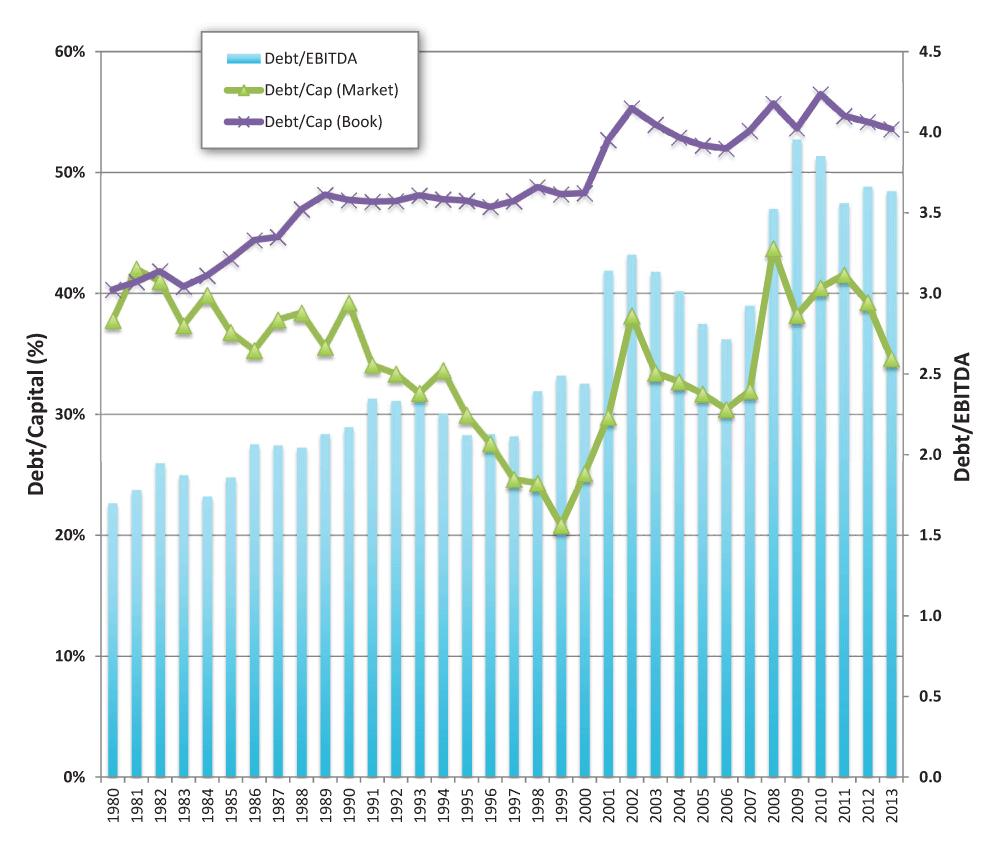
The notion that U.S. companies are dangerously over-levered seems to be built on two arguments: the aggregate debt levels of businesses as reported in the U.S. national accounts, and anecdotal evidence. To examine this argument, I have estimated debt levels at U.S. companies from 1980 to 2013 in Figure 4, both as a percentage of capital (book and market) and as a multiple of EBITDA (earnings before interest, taxes, depreciation and amortization).
It is true that overall financial leverage, at least as measured relative to book value and EBITDA, has increased over time, though it has remained relatively stable as a percent of market value. While this increase can be partially explained by decreasing interest rates over the period, it is worth asking whether buybacks were the driving force in the increased leverage. To answer this question, I compared the debt ratios of companies that bought back stock in 2013 to those that did not. There is nothing in the data that suggests that companies that do buybacks are funding them disproportionately with debt or becoming dangerously over-levered, as Table 1 shows.
Table 1. Debt Levels of Companies With and Without Buybacks
|
|
Number |
Debt to Market Cap (%) |
Debt to Book Value (%) |
Debt to EBITDA (%) |
|---|---|---|---|---|
| Companies without buybacks | 3,879 | 23.26 | 28.12 | 7.42 |
| Companies with buybacks | 1,997 | 21.51 | 32.39 | 4.93 |
| Total market | 5,876 | 22.66 | 29.86 | 6.21 |
| Data from 2013. | ||||
Companies that bought back stock had debt ratios that were roughly similar to those that didn’t buy back stock and much less debt, scaled to cash flows (EBITDA), and these debt ratios/multiples were computed after the buybacks.
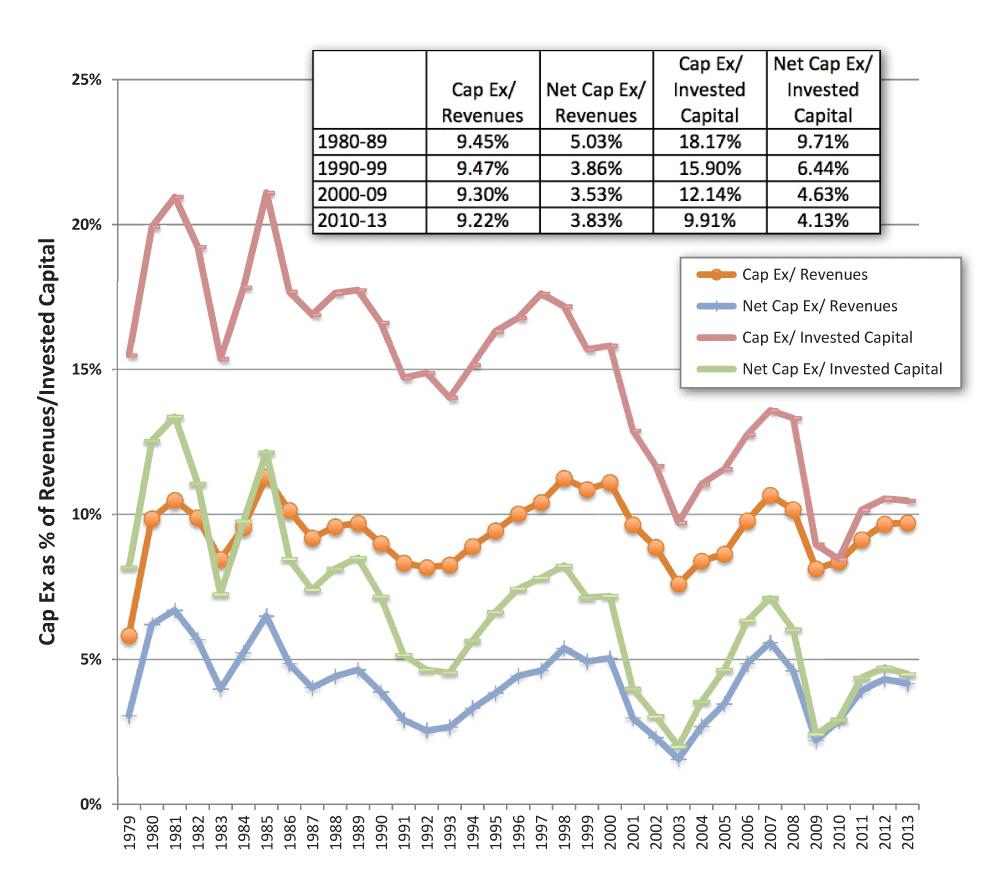
The belief that U.S. companies in sectors other than technology have been reinvesting less back into their businesses is widespread, but let’s check the facts again. Figure 5 shows capital expenditures at U.S. firms collectively, as a percent of revenues and invested capital, from 1980 to 2013.
The trendline does back the conventional wisdom, and since buybacks went up over the same period, the bad news bears seem to win this round, right? Before jumping to conclusions, there are three things to remember in this debate.
First, there is little evidence that companies that buy back stock reduce their capital expenditures as a consequence. At least in 2013, companies that bought back stock had more capital expenditures, as a percent of invested capital and enterprise value, than companies that did not. Second, the cash that is paid out in buybacks does not disappear from the economy. It is true that some of it is used by shareholders on conspicuous consumption, but that is good for the economy in the short term, and a great deal of it is redirected elsewhere in the market. In other words, much of the cash paid out by Exxon Mobil, Cisco Systems (CSCO) and 3M (MMM) was reinvested back into Tesla Motors (TSLA), Facebook (FB) and Netflix (NFLX), a testimonial to the creative destruction that characterizes a healthy, capitalist economy. The third is that the notion that more reinvestment by a company is always better than less is absurd, especially if that reinvestment is in bad businesses.
Table 2 lists the 10 companies that were the biggest buyers of their own stock over the last decade. Can shareholders of any of these companies honestly say they would rather have had these companies reinvest back in their own businesses? Put differently, how many investors wish that Microsoft (MSFT) had not bought back $100 billion worth of shares over the last decade and instead pumped that money into more Zune music players and Surface tablets? Or prefer Hewlett-Packard (HPQ) bought three more companies like Autonomy (and written them off soon after) instead of paying out $60 billion to shareholders?
If, as some argue, these companies are cannibals for buying back their own stock, investors in these companies wish they had more voracious appetites and had eaten themselves faster.
Table 2. Corporate Cannibals (The Economist): Large Buyers of Their Own Stock
|
|
Buybacks ($ Billion) |
As a % of Cash Flows From Operations |
|---|---|---|
|
|
||
| Company | ||
| Exxon Mobil (XOM) | 220 | 45 |
| Microsoft (MSFT) | 115 | 50 |
| IBM (IBM) | 110 | 64 |
| Procter & Gamble (PG) | 72 | 54 |
| Cisco Systems (CSCO) | 68 | 69 |
| Hewlett-Packard (HPQ) | 65 | 59 |
| Wal-Mart Stores (WMT) | 60 | 29 |
| Goldman Sachs Group (GS) | 58 | na |
| Pfizer (PFE) | 57 | 38 |
| Intel (INTC) | 55 | 39 |
There are two other issues brought up by critics of stock buybacks.
One is that firms may buy back stock ahead of positive information announcements, and those investors who tender their shares in the buyback will lose out to those who do not.
The other is that there is a tie to management compensation, where managers who are compensated with options may find it in their best interests to buy back stock rather than pay dividends; the former pushes up stock prices while the latter lowers them. Note that doing a buyback ahead of material information releases is already illegal, and any firm that does it is breaking the law. As for management compensation, I agree that there is a problem, but buybacks are again a symptom and not a cause of the problem. In my view, it is poor corporate governance practice on the part of boards of directors to grant huge option packages to managers and then vote for buybacks designed to make managers even better off. Again, fixing buybacks does nothing to solve the underlying problem.
I think that both ends of the spectrum on buybacks are making too much of a simple cash-return phenomenon. To the boosters of buybacks as value creators, it is time for a reality check. Barring the one scenario where companies that buy back stock stop making value-destructive investments, almost every other positive story about buybacks is one about value transfers: from taxpayers to equity investors (when debt is used by an under-levered firm to finance buybacks) and from one set of shareholders to another (when a company buys back undervalued or overvalued stock).
To those who argue that buybacks are destroying the U.S. economy, I would suggest that such claims are a vehicle for real concerns about the evolution of the U.S. economy. Those who are worried about insider trading, executive compensation, tax-motivated transactions and/or under-investment by the manufacturing sector may have well-placed fears.
Stock buybacks did not cause these problems, however, and banning or regulating buybacks by companies falls squarely in the feel-good but do-bad economic policy realm.
First Cut Stocks

Financial Statements


John Simpson from AR posted over 11 years ago:
John Ross from KY posted over 11 years ago:
Paul Stadnik from OR posted over 11 years ago:
Carl Lemp from CT posted over 11 years ago:
Cliff Rafter from FL posted over 11 years ago:
Edward Ward from Georgia posted over 11 years ago:
William Fusco from CT posted over 11 years ago:
George Ciardi from CT posted over 11 years ago:
Charles Rotblut from IL posted over 11 years ago:
Jamie from Canada posted over 11 years ago:
Dan from Pennsylvania posted over 11 years ago:
Bruce from Sansom posted over 11 years ago:
Yoshinori Himel from CA posted over 10 years ago:
Michael Daillak from CA posted over 9 years ago:
j santmyer from AZ posted over 7 years ago:
Dave G from WA posted over 7 years ago:
Don P from USA posted over 2 years ago:
RICHARD B from OH posted over 2 years ago:
You need to log in as a registered AAII user before commenting.
Log InCreate an account