


Charles Rotblut leads a class in AAII's new Essential Investing Video Course. Go to https://www.aaii.com/ves for more information and to subscribe.

Diversification and regular portfolio rebalancing provide measurable benefits to investors. This statement holds true even though the last decade bought two bear markets for stocks and the outlook for the future is currently anything but certain.
I realize that saying diversification and rebalancing help may surprise some of you. The roller-coaster ride stocks have been on and the portfolio devastation experienced by many investors has created a great deal of skepticism about whether the cornerstones of portfolio management still work. Yet the data shows that they do in fact work.
To prove this point, last December I created a simple portfolio consisting of $50,000 in the Vanguard 500 Index  (VFINX) and $50,000 in the Vanguard Total Bond Market Index (VBMFX) mutual funds. I ran the numbers as if the portfolios had been held during the “lost decade” of 2000 – 2009. As some of you may remember from my commentary in our weekly AAII Investor Update e-newsletter on December 16, 2010, there was an advantage to annual rebalancing.
Though the simplicity worked to prove a point, advocates of diversification suggest that investors hold more than just large-cap stocks and bonds. Plus, I received e-mails from members asking what would happen if other assets were included. So, I decided to expand the number of funds included in the portfolio and rerun the numbers. As you will soon see, a diversified portfolio would have given better returns. Rebalancing on a regular basis (e.g., annually) would have lowered the volatility of the fully diversified portfolio, making for a winning combination.
The Portfolios
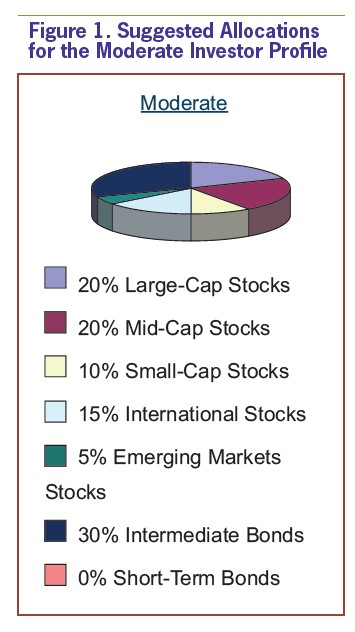
The portfolios were designed based on one of the AAII Asset Allocation Models, which can be viewed at www.aaii.com/asset-allocation. I chose the Moderate Investor profile, which assumes an investment horizon of 20+ years. Figure 1 shows the composition of this model. (Allocation ultimately depends on age, health and wealth. The longer the time period before you need to withdraw cash and the less cash you need relative to the size of your portfolio, the higher your exposure can be to risky assets such as stocks and stock funds.)
To conduct the test, I wanted to duplicate what an actual investor would have been able to do. I chose Vanguard index mutual funds for the portfolios to limit the influence that an active manager would have had on the returns. Additionally, using a single fund family limited transaction costs.
An investor might have been able to achieve higher returns by making astute choices about actively managed funds and not sticking to a single fund family. The trade-off, however, would have been higher management fees, transaction costs and the timing issues of switching from one fund family to another. By choosing Vanguard, I avoided the issues of expenses and switching fund families, at the cost of not achieving the most optimal return.
Because I was solely using Vanguard, I had to start the study at the beginning of 1988. This was the first full calendar year that an investor would have been able to own the Vanguard’s Extended Market Index fund (VEXMX).
I also was not fully able to exclude active management, even by sticking with Vanguard. In 1988, the only international funds that the company offered were actively managed. Therefore, I used the Vanguard International Value fund (VTRIX), an actively managed fund, until the end of 1996. At the start of 1997, I was able to switch to a passively managed fund, the Vanguard Total International Stock Index fund (VGTSX). This fund was incepted in April 1996.
Finally, the decision to stick with Vanguard meant that funds for all the desired asset classes were not available for the entire period. For example, Vanguard Emerging Markets Stock Index fund (VEIEX) was not incepted until 1994. To get around this, I used the broad-based Vanguard International Value fund (VTRIX) until the end of 1994 and then split some of the portfolio dollars into the emerging market fund (more on this momentarily).
The Mutual Funds
The mutual funds used for the portfolios are listed below. Funds were included at the start of the 1988 or at the start of the first full calendar year after their inception.
- Vanguard 500 Index (VFINX),
-
Vanguard Extended Market Index (VEXMX),
- Vanguard Mid-Cap Index (VIMSX),
- Vanguard Small-Cap Index (NAESX),
-
Vanguard International Value (VTRIX),
- Vanguard Emerging Markets Stock Index VEIEX,
-
Vanguard Total International Stock Index (VGTSX), and
-
Vanguard Total Bond Market Index (VBMFX).
The starting portfolios held Vanguard 500 Index, Vanguard Extended Market Index, Vanguard International Value, and Vanguard Total Bond Market Index funds.
The Vanguard Extended Market Index tracks the performance of the Standard & Poor’s Completion Index. This index contains all regularly traded U.S. exchange-listed common stocks, except those stocks included in the S&P 500 index. The fund was held until the start of 1999, when the holding was switched to two other funds: 67% of the fund’s value was shifted to the Vanguard Mid-Cap Index and 33% was moved to the Vanguard Small-Cap Index. In order to avoid overweighting small-cap stocks, I kept the small-cap fund out of the portfolio until the mid-cap fund became available.
At the start of 1995, 25% of the dollars held in Vanguard International Value were moved to Vanguard Emerging Markets Stock Index to match the model’s allocation weightings. At the start of 1997, the remaining dollars held in Vanguard International Value were moved to Vanguard Total International Stock Index, a broad-based, passively managed international fund.
Portfolio Construction & Management
Three portfolios were created: static, moderate and rebalanced. All three had a starting value of $100,000. Allocations for the moderate and rebalanced portfolios matched the Moderate Investor profile as close as would have been possible at the start of 1988.
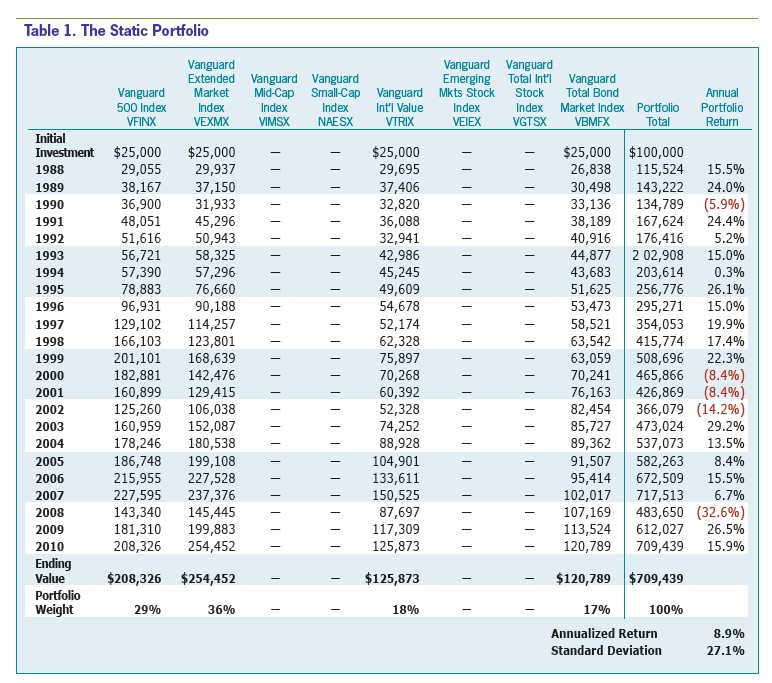
The Static Portfolio assumes that an investor looked at the asset allocation model, developed a basic understanding of the need for diversification and split $100,000 evenly among Vanguard 500 Index, Vanguard Extended Market Index, Vanguard International Value, and Vanguard Total Bond Market Index funds at the start of 1988 ($25,000 in each fund). No changes were made after the funds were originally bought. This strategy may most closely resemble the manner in which many investors have managed their IRA accounts. The Static Portfolio is presented in Table 1.
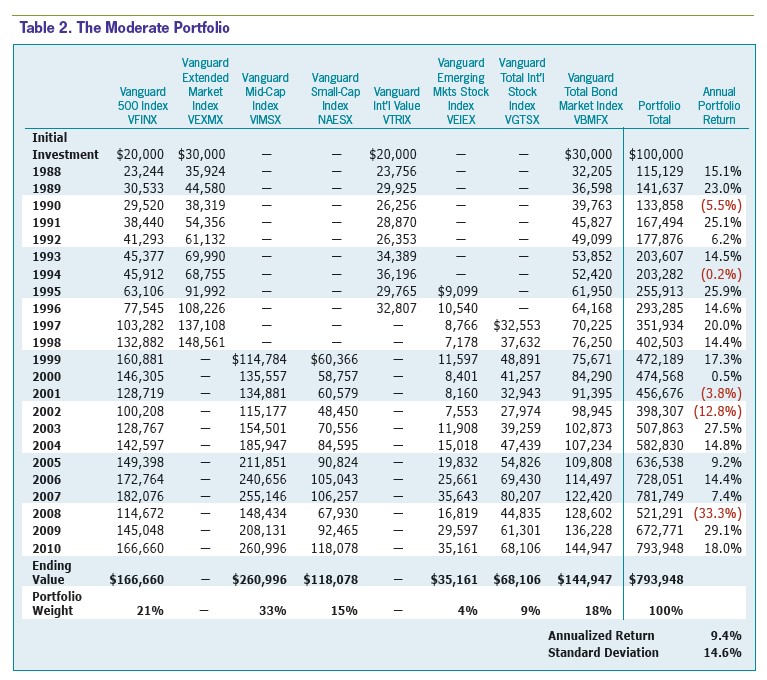
The Moderate Portfolio was originally designed to mimic the Moderate Investor profile. Portfolio dollars were allocated to Vanguard 500 Index, Vanguard Extended Market Index, Vanguard International Value, and Vanguard Total Bond Market Index funds in proportion to the asset allocation model at the start of 1988. For example, $20,000 was invested in the large-cap Vanguard 500 Index fund and $30,000 was invested in the fixed-income Vanguard Total Bond Market Index.
After the portfolio was originated, however, it was not rebalanced. The only changes occurred when new funds became available. On those occasions, portfolio dollars were simply shifted from the older fund to the newer fund. As a result, changes in allocations reflected fluctuations in each fund’s comparative performance, but not any direct involvement on the part of the investor. The Moderate Portfolio is presented in Table 2.
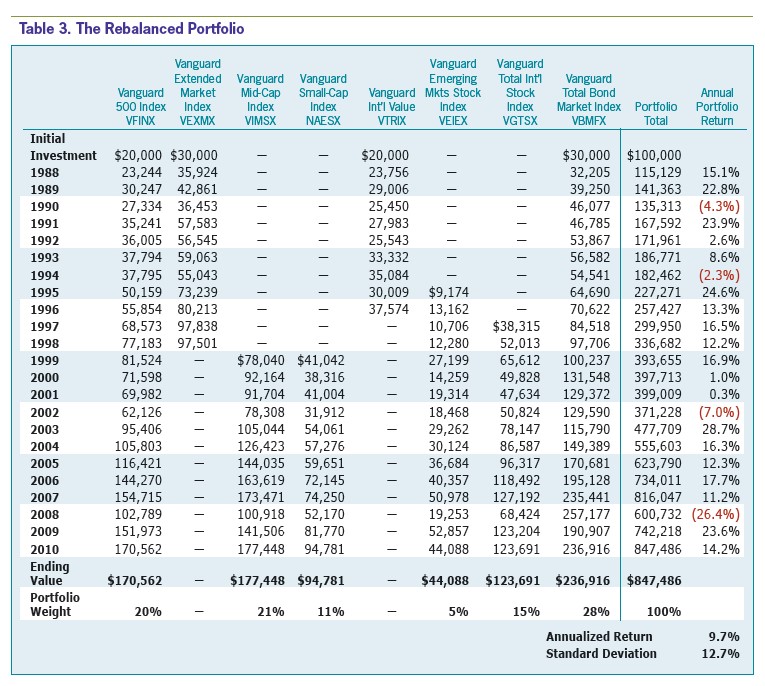
The Rebalanced Portfolio was also designed to mimic the Moderate Investor profile, with funds proportionately allocated to Vanguard 500 Index, Vanguard Extended Market Index, Vanguard International Value, and Vanguard Total Bond Market Index funds at the start of 1988. This portfolio, however, was rebalanced annually to ensure that it continued to mimic the model’s allocation percentages as closely as possible. (For example, the large-cap portion of the portfolio was adjusted so that it comprised just 20% of the portfolio’s total value at the start of every calendar year.)
This meant shifting money out of the best-performing funds and into the worst-performing funds. When a new fund was added, dollars were first shifted from the older fund into the newer fund and then entire portfolio was reallocated. The Rebalanced Portfolio is presented in Table 3.
Performance Results
Diversification and rebalancing provided clear benefits. The Rebalanced Portfolio, which was rebalanced annually to match the allocation percentages of the Moderate Investor profile, provided the highest annualized return, 9.7%, and the lowest level of volatility, a standard deviation of 12.7%. The Moderate Portfolio, which was originally set up to track the Moderate Investor profile and then mostly left alone, produced a lower annualized return of 9.4% and higher level of volatility (standard deviation of 14.6%). The Static Portfolio fared the worst with an annualized return of just 8.9%. It also experienced the highest level of volatility with a standard deviation of 15.4%.
The Moderate Portfolio and The Rebalanced Portfolio were adjusted to provide increased exposure to Vanguard Emerging Markets Stock Index fund (VEIEX), and this boosted their performance. Emerging markets was one of the best-performing mutual fund categories over the past five years, as was shown in the March 2011 AAII Journal. Furthermore, Vanguard Emerging Markets Stock Index fund had the highest annualized return since 1999 of all funds listed in this article. The trade-off, however, was that the fund also experienced the highest level of volatility. High returns never come without high risk, and Vanguard Emerging Markets Stock Index fund is evidence of this.
It is important to realize that an investor would not have needed foresight about the performance of emerging markets to invest in Vanguard Emerging Markets Stock Index fund when it became available. Rather, an investor would have just needed an understanding of the role emerging markets can play an overall diversification strategy. A big upside of diversification is that it increases the odds of being in the right asset class at the right time.
It should also be noted that the Static Portfolio did not hold Vanguard Emerging Markets Stock Index fund and still had the highest level of overall volatility. An often overlooked benefit of diversification is that adding a volatile asset can lower a portfolio’s overall risk level if the asset is not highly correlated with the other investments. Emerging market stocks have historically experienced different long-term return characteristics than U.S. and European stocks.
Perhaps the biggest lesson is the importance of a being a proactive investor. Merely rebalancing the portfolio annually increased returns and lowered volatility, as the return data shows. For example, the Rebalanced Portfolio lost 26.4% in 2008 versus 33.3% for the Moderate Portfolio and 32.6% for the Static Portfolio. The Rebalanced Portfolio also experienced smaller losses than the other two portfolios in 1990 and 2002. In addition, it posted a fractional gain in 2001, whereas the other two portfolios lost money.
In exchange for cushioning the blow of bear markets, rebalancing annually will cause returns to lag during a strong bull market for the largest asset classes held in a portfolio. Such was the case in the late 1990s when the Rebalanced Portfolio posted smaller gains than the other two portfolios. The reason is that rebalancing forces an investor to take profits from the best-performing asset class and put the money into the worst-performing asset class. This is the classic “buy low and sell high” strategy.
Since the money is moved out of the “winners” and into the “losers,” annual rebalancing can give the impression that it is not working over short periods of time. This is a misperception because rebalancing is designed to force an investor to sell into momentum. In other words, it reduces downside volatility by lowering the impact that a bubble in a particular asset class would have on the portfolio.
Are There Alternatives?
As the annual results show, neither diversification nor rebalancing will prevent a portfolio from fluctuating in value. They certainly will not prevent a portfolio from losing money in a severe bear market such as 2008.
The alternatives, however, produce even worse performance and more volatility. Failing to rebalance hurt the returns, as shown here. Market timing is intended to signal when to buy and sell a particular asset, but it fails to make correct calls on a consistent basis. Worse yet, if a market timing system causes you to be late with your buy and sell decisions, you could lock in big losses and miss out on big rebounds.
Options could provide a hedge, but they also hurt returns due to commissions and the probability that they will expire worthless. Plus, exercising a put option (a contract to sell a security at a set price within a given time period) subjects you to the risks of market timing.
Conclusion
Both diversification and rebalancing are long-term strategies, and they should be treated as such. A common mistake that investors make is abandoning the strategies rather than sticking with them. Failing to stick with these strategies increases your portfolio’s exposure to the whims of the market, as the data in this article has shown.
There is no magical formula to building and preserving wealth. Rather, it requires patience, discipline and a sound portfolio strategy.
How Your Age Affects Diversification and Rebalancing
How you allocate your portfolio depends on age, health and wealth. The longer the period of time before you need to withdraw cash and the smaller the proportion of total savings that will be withdrawn, the greater your tolerance for risk.
Investors in their 20s will not need their retirement savings for several decades. Therefore, they can withstand a lot of volatility within their portfolios and should have a very high allocation to stocks.
Retirees, conversely, usually need to withdraw from their portfolios. The amount of the withdrawal will depend on lifestyle, health and other sources of income (e.g., a pension). Such investors may need a higher allocation to bonds then is suggested in the Moderate Investor profile.
Both kinds of investor will need to factor in their age and changes in their lives as they rebalance. A rule of thumb is to increase the allocation to bonds by 1% each year. This measure must be adjusted, however, for any changes in financial needs.
An investor needing to withdraw money should use annual rebalancing to free up cash. Proceeds from the best-performing asset classes should first be used to fund the withdrawal. The portfolio is then rebalanced.
Finally, be sure to consider tax issues when diversifying and rebalancing. The most tax-efficient assets—including municipal bonds and stock index funds—should be held in taxable accounts. Investments that are more likely to incur taxes should be held in tax-deferred accounts. Similarly, income-producing investments—including dividend-paying stocks—may be more suitable for a traditional IRA than a Roth IRA because they produce cash for required minimum distributions (RMDs).

Discussion
FREE REPORT

Get your free copy of our special
report analyzing the tech stocks
most likely to outperform the
market.
James from VA posted over 15 years ago:
Nancy from MD posted over 15 years ago:
Robert from OR posted over 15 years ago:
Charles Rotblut from IL posted over 15 years ago:
Patrick from WI posted over 15 years ago:
Philip from IL posted over 15 years ago:
Jim from MI posted over 15 years ago:
Charles Rotblut from IL posted over 15 years ago:
HNM from TX posted over 15 years ago:
Josephine from SC posted over 15 years ago:
Charles from IL posted over 15 years ago:
Gary from IL posted over 15 years ago:
H from TX posted over 15 years ago:
Charles Rotblut from IL posted over 15 years ago:
Dan from CO posted over 15 years ago:
Dave from WA posted over 15 years ago:
Charles Rotblut from IL posted over 15 years ago:
James from OH posted over 15 years ago:
Charles from IL posted over 15 years ago:
You need to log in as a registered AAII user before commenting.
Log InCreate an account