

Related

Stock Strategies
A cut-to-the chase synopsis of Graham’s rules, which were based on buying stocks trading with a margin of safety.
by Ben Branch | January 2018

Benjamin Graham, the father of value investing, was the teacher and mentor to the greatest investor of all time: Warren Buffett.
Buffett recommends Graham’s classic book, “The Intelligent Investor: The Definitive Book on Value Investing” (HarperBusiness; Revised, Subsequent edition, February 21, 2006), as the best book ever written on investing. All serious investors would profit from reading the book at least once and preferably several times. For those who do not wish to take the time to read all 600-plus pages, or want to experience a taste before reading it, I offer the following cut-to-the-chase synopsis.
Graham began by seeking to educate potentially “intelligent investors” by defining what he considered investing to be:
“An investment operation is one which, upon thorough analysis, promises safety of principal and an adequate return. Operations not meeting these requirements are speculative.”
For Graham, any trading of stocks, bonds or other types of investible assets is truly investing only if it:
Otherwise, it is mere speculation, which Graham strongly discouraged.
Graham urged investors to view their stock holdings as reflecting part ownership of a business. He advised investors to value their stock at what a potential buyer would be willing to pay for the business as a going concern.
This is an important insight. All too many aspiring investors view stocks as certificates that trade on the stock market for a price, which they hope will rise, preferably quickly. Viewing stocks as representing part ownership of a business shifts the focus from their day-to-day price fluctuations to the factors that tend to drive their valuations, which are their long-term fundamentals.
Graham cautioned investors to largely ignore any single quarter’s or single year’s reported earnings. Transitory factors often cause such numbers to vary significantly from period to period. Accordingly, they may be unrepresentative of the underlying values.
Averaging earnings over several years tends to dampen the effect of individual year-specific factors. Thus, the long-term trend in average earnings is likely to be much more representative of a firm’s underlying intrinsic valuation.
Graham also cautioned investors not to be fooled by so-called pro forma earnings. Fully diluted earnings prepared using generally accepted accounting principles (GAAP) are much less likely to mislead. Graham’s focus on average long-term earnings led to Yale professor Robert Shiller’s cyclically adjusted price-earnings (CAPE) concept.
Graham introduced an imaginary trader called Mr. Market in order to illustrate the random nature of stock price fluctuations. Mr. Market is a trader who continually offers to buy your shares or to sell you his at the current market price. Much of the time Mr. Market’s price is a reasonable estimate of the underlying value. At other times, however, he offers to pay an excessive price or to sell for much too little. Graham urges investors to ignore Mr. Market’s offers to buy or sell most of the time.
On occasion, however, Mr. Market’s numbers will depart substantially from fundamental valuations. At such times, the investor may want to take advantage by selling when the offer is well above intrinsic values or buying when Mr. Market’s price is too low.
This statement has been attributed to Graham: “In the short run the stock market is a voting machine, but in the long run, it is a weighing machine.” So far, no one has been able to locate this quote in any of Graham’s published work. Whether he said it or not, the statement clearly reflects his and Buffett’s thinking.
The short-run fluctuations in Mr. Market’s stock prices may or may not reflect changes in underlying values. Graham advised intelligent investors to ignore Mr. Market’s voting machine prices. In the long run, stock prices are driven by underlying values as reflected in the (weighing machine) prices that a potential buyer of the entire business would be willing to pay for a company as a going concern. Such a buyer will focus on fundamentals such as sales, profits, cash flow and asset values.
AAII tracks three stocks screening strategies specifically based on Benjamin Graham’s approach to investing.
—Charles Rotblut, AAII Journal Editor
Performance of AAII’s Graham Approaches
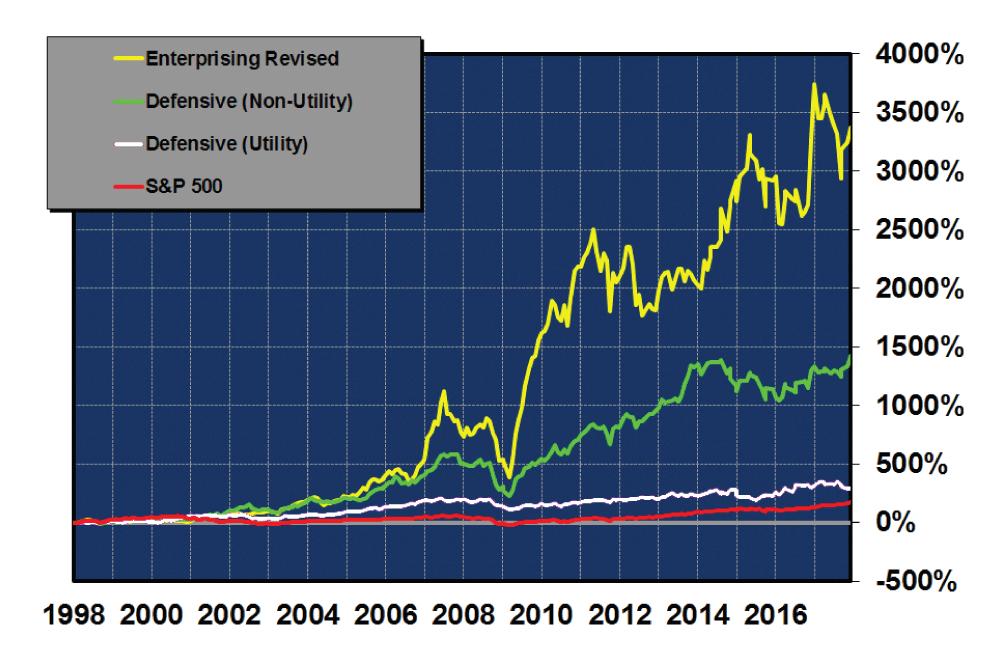
The “margin of safety concept” is key to Graham’s approach to value investing. Graham’s intelligent investors only invest in things that are selling for substantially less than their intrinsic values based on fundamental factors such as earnings, dividends, assets and net worth.
Graham explained:
“(T)hose who emphasize protection are always especially concerned with the price of the issue at the time of study. Their main effort is to assure themselves of a substantial margin of indicated present value above the market price—which margin could absorb unfavorable developments in the future.”
In other words, if you purchase an investment for substantially less than your analysis indicates that it is worth, you have provided some protection for unforeseen developments. A well-protected investor owns a diversified portfolio of such investments. An investor who assembles a diversified portfolio of such stocks and holds them patiently until the market has time to recognize their true intrinsic value, is very likely to earn an attractive return. It sounds simple, but how does one find such opportunities?
One of Graham’s favorite types of stocks having the desired margin of safety were what he called “net-nets.” To identify a net-net, one starts with the total value of the firm’s current assets (cash, marketable securities, accounts receivable and other assets that turn into cash within a year) and subtracts the total amount of both long- and short-term debt. Dividing that net amount by the number of shares outstanding will yield the net current assets per share. If the stock’s price is appreciably below the resultant number, Graham called the stock a net-net. Such a stock’s price is less than its net current assets per share, ignoring the value to its long-term assets.
Anyone who could buy all of the net-net’s shares at Mr. Market’s current price could simply use the money from liquidating his/her current assets to pay off all of the firm’s debts. The buyer would then own the net-net’s long-term assets for free. Such a deal!
Graham recommended assembling a diversified portfolio of net-net stocks and patiently waiting for the market to realize their value. This strategy worked well when net-nets were plentiful. However, as Graham himself noted, much of the time the market does not cooperate. Net-nets may be relatively plentiful when the overall market is severely depressed, but quite rare or nonexistent when the market is booming. One cannot rely exclusively on a net-net strategy over time.
A second type of margin of safety stock involves a firm’s borrowing capacity. Graham considered a debt-free company having enough borrowing capacity to pay for all of its outstanding shares at their current price as likely to exhibit a margin of safety. Once again, Graham recommended diversification and patience.
Relating back to the idea that a company is worth what someone would be willing to pay for it as a going concern, Graham’s borrowing capacity concept makes sense. A business with enough borrowing capacity to finance the purchase of all of its outstanding shares is likely to have an adequate margin of safety. Indeed, the strategy used for leveraged buyouts utilizes this same concept.
As with net-nets, however, firms with sufficient borrowing capacity to buy all of their outstanding shares are often rare to nonexistent. Such situations may well occur in a bear market. At most other times, however, few if any firms with such borrowing power exist.
Neither net-nets nor companies with borrowing capacity sufficient to buy all of its shares are plentiful enough to facilitate a useable investment strategy over the market cycle.
Graham also considered two seemingly attractive approaches, which he rejected. First, he explored the idea of buying when the market is depressed and selling when its valuations are excessive. While conceding that some experts may, in theory, be able to call the turns in the market well enough to succeed, he does not think individual investors should try. The movements of Mr. Market were too unpredictable for the vast majority of investors to attempt this approach. Leave it to the speculators, most of whom will do a lot of trading (making money for their brokers) in order to earn subpar returns.
The second rejected approach involves growth stocks. Graham defined growth stocks as those of companies that have done well in the past and Mr. Market expects to do well in the future. With the benefit of hindsight, picking growth stocks looks appealing. Indeed, those who got in early and held on generally do quite well. Getting in early requires identifying the success stories before the market has recognized their potential. Many young companies look like they could become growth stocks. However, identifying the ones that achieve that status when they are still cheap is challenging, to say the least. Many investors are searching for potential growth stocks and bidding up their prices when only a few will achieve true growth stock status. Graham offered no guidance for those who would try this approach. That was not his way.
Graham saw a couple of problems with assembling a diversified portfolio of already recognized growth stocks. First, once Mr. Market recognizes a stock as a growth stock, its high price-earnings (P/E) ratio removes any margin of safety that the stock might have had. If a firm tagged as a growth stock fails to live up to its expectations, its stock price will suffer. Indeed, Mr. Market can be brutal to a growth stock that disappoints. Even if the growth stock’s company produces the expected growth rate, its stock price will have already reflected that performance. Only if the company outperforms the market’s expectations will the growth stock really shine.
Graham did not totally reject investing in growth stocks. He did urge investors to avoid paying the high prices that such stocks typically command. If, however, one can invest in a company with strong growth potential at a price that is consistent with its going concern value, proceed. Such a situation has a sufficient margin of safety even if the expected growth does not occur. This approach amounts to trying to buy growth stocks at value stock prices. Such opportunities are likely to be exceedingly rare.
One should not expect to find net-nets, companies with sufficient borrowing capacity to buy all of their shares and growth stocks priced like value stocks very often. Graham did, however, discuss three additional opportunities that may be more plentiful. Graham began this discussion by asserting:
“To obtain better than average investment results over a long pull requires a policy of selection or operation possessing a twofold merit:
In other words, it must have an adequate margin of safety and not be the type of situation that attracts many professional investors/speculators.
Starting with the proposition that the market tends to overprice glamorous growth stocks, Graham reasoned that Mr. Market will tend to:
“Undervalue—relatively, at least—large companies that are out of favor because of unsatisfactory developments of a temporary nature.”
He advised investors to focus on relatively large established companies because:
“First, they have the resources in capital and brain power to carry them through adversity and back to a satisfactory earnings base. Second, the market is likely to respond with reasonable speed to any improvement shown.”
As an example, Graham suggested looking among the 30 stocks in the Dow Jones industrial average for large companies whose stocks are currently out of favor for temporary reasons.
According to Graham, a stock: “is not a true “bargain” unless the indicated value is at least 50% more than the price.”
If a stock is selling for $10 a share, Graham would consider it to be a bargain only if its intrinsic value was $15 or more. That 50% differential between price and intrinsic value provides an adequate margin of safety. The key to this approach is coming up with a reliable estimate of the intrinsic value.
Graham continued:
“There are two tests by which a bargain common stock is detected. The first is by the method of appraisal. This relies largely on estimating future earnings and then multiplying these by a factor appropriate to the particular issue.”
Therefore, if a conservative estimate of the company’s earnings per share is $1.50 and its fundamental situation indicates that it should sell for a price-earnings ratio of 10, its intrinsic value would be $15. Graham would call that stock a bargain if it sold for $10 per share or less.
“The second test is the value of the business to a private owner. This value also is often determined chiefly by expected future earnings—in which case the result may be identical with the first. But in the second test more attention is likely to be paid to the realizable value of the assets, with particular emphasis on the net current assets or working capital.”
Thus, in this second valuation approach, one considers both the firms’ going concern and its liquidation values.
Graham went on to explain why Mr. Market sometimes provides bargain prices:
“We have what appear to be two major sources of undervaluation:
Yet, Graham noted that:
“Neither of these causes, if considered by itself alone, can be relied on as a guide to successful common stock investment … Unfortunately, we could cite many examples of declines in earnings and price which were not followed automatically by a handsome recovery of both.”
“(T)he investor would need more than a mere falling off in both earnings and price to give him a sound basis for purchase. He should require an indication of at least reasonable stability of earnings over the past decade or more—i.e., no year of earnings deficit—plus sufficient size and financial strength to meet possible setbacks in the future.”
While Graham preferred large well-established companies, he was willing to consider smaller companies as well. He noted that Mr. Market tends to pay much more attention to large-cap companies. As a result, small-cap companies are more likely to be neglected by analysts and professional investors and, as a result, be underpriced. Accordingly, a carefully assembled portfolio of bargain-priced small-cap stocks having a sufficient margin of safety is also a reasonable part of a Graham-based investment program.
Graham also liked what he called “workouts”:
“The underlying factor here is the tendency of the security market to undervalue issues that are involved in any sort of complicated legal proceedings.”
Among the areas that often involve complicated legal proceedings are mergers and bankruptcies.
Benjamin Graham provided a large amount of investing guidance in his two well-regarded books, “Security Analysis: Principles and Techniques” (reprinted, McGraw-Hill Education, 1996) and the more accessible “The Intelligent Investor: The Definitive Book on Value Investing” (HarperBusiness; Revised, Subsequent edition, February 21, 2006). Here is a brief overview of his insights and rules, as discussed in this article:
Graham last revised “The Intelligent Investor” in 1972. He died four years later, but not without updating his advice. Working with James Rea, the result was an article published in The Journal of Portfolio Management shortly after Graham’s death (“Remembering Benjamin Graham—Teacher and Friend,” Summer 1977). Graham and Rea compiled a list of 10 criteria for selecting stocks with an attractive margin of safety. In an analysis of 50 years of experience, they found that three criteria were particularly likely to yield strong results. The three criteria are:
In the Graham/Rea 50-year analysis, stocks meeting each of these criteria generated an average annual return of 19.9%, 19.5% and 14.2%, respectively, compared with a 7.5% average return for the Dow Jones industrial average over that same 50-year period.
In a Financial Analysts Journal follow up study of stocks that simultaneously satisfied all three criteria, Henry Oppenheimer found an annual excess return of 17% over the 1973–1976 (pre-publication) period and 4.5% over the 1977–1980 (post-publication) period (“A Test of Ben Graham’s Stock Selection Criteria,” September/October 1984).
Once again, Graham advised investors to assemble a diversified portfolio of stocks meeting these criteria and patiently hold for Mr. Market to recognize their intrinsic values.
More than 40 years have passed since Benjamin Graham last opined on investing. Yet his wisdom seems as wise today as when it first appeared in print. His concepts of Mr. Market and margin of safety remain to guide the value investors of the 21st century. It would be difficult to argue with the success of Warren Buffett, Graham’s star student.
Stock Strategies

AAII Stock Ideas
Investing Gurus

Howard West from GA posted over 8 years ago:
Evans Harrell from GA posted over 8 years ago:
Edwin Olbinski from WI posted over 8 years ago:
Doug from NY posted over 8 years ago:
Suzanne Baker from OH posted over 8 years ago:
You need to log in as a registered AAII user before commenting.
Log InCreate an account