


The book “Investing at Level3: Higher Returns With Minimal Risk for the Long-Term Individual Investor” summarizes many of the key investing concepts that James Cloonan observed since he founded the American Association of Individual Investors (AAII) nearly 40 years ago.
AAII was started with the belief that with the right education, information and discipline, individual investors are fully capable of becoming effective managers of their own assets. “Investing at Level3” lays out a practical framework suited for individuals that helps investors overcome short-term emotional decisions that hurt long-term performance.
Individual investors have unique needs, opportunities and risks compared to the institutional (professional) investor. Cloonan notes that while individuals have the ability to get out from under the burdens institutions must bear, the investment services industry has been able to convince individual investors to voluntarily accept and bear the same burdens as the institutions. These burdens include:
-
short- to intermediate-term investment horizons,
-
the need to perform relative to competition,
-
the need to take very large positions,
-
the need to appear competent by complying with academic theory and, most importantly,
-
the acceptance of meaningless measures of risk.
“Investing at Level3” explains how individuals can lift these burdens to maximize their long-term wealth.
The book gets its name from the range of approaches employed by investors:
Level 1 is unorganized investing driven by impulse and emotion. It is influenced by random observations and advice and is in a constant state of flux. Unfortunately, this is still the level of investing for too many individual investors.
Level 2 represents the investing strategy that has evolved from modern portfolio theory. It assumes an efficient market with random events in which investors take rational actions to seek optimal outcomes from models based on statistical measures of return and risk. It has also been formulated without these models but maintains academic measures of risk. Variations of this model are considered best practices by most investment advisers.
Level3 Investing is the strategy offered by Cloonan that looks to maximize long-term wealth and is specifically geared to the individual investor. It is reality-based rather than mathematically based in that return and risk are derived directly from actual historical data and common sense without attempting to force them into a mathematical distribution or model first.
Cloonan explains that each of the three investing levels are continuums with a range of approaches and theory within each level.
The focus of this article is to present the withdrawal strategy detailed in Level3 that allows investors to stay invested in assets that offer the greatest potential for long-term wealth growth while satisfying current funding needs and minimizing real risk.
Measuring Risk Properly
Before we can explain the Level3 withdrawal strategy, we must examine the proper measure of investment risk for the long-term investor. We are bombarded with news and warnings regarding market volatility and have come to equate volatility with risk. However, Cloonan notes that real risk is the chance of investment loss. It’s a mistake to tie short-term volatility to long-term investment risk and let it dictate our long-term investment decisions.
Cloonan’s formal definition of risk is the likelihood that when we must withdraw assets from our portfolio for consumption, they will have a lower value than we could reasonably expect based on our investment strategy.
Volatility is somewhat related to the chance of loss in the short term, but has only a limited relationship to it in the long run.
Real risk is the chance of underperformance, while volatility or phantom risk describes how stock returns vary up and down through time. For short-horizon portfolios, volatility contributes to real risk. For long-horizon portfolios, volatility has a much-reduced role. Attempts to reduce short-term volatility tend to reduce our long-term expected return, thereby actually increasing our long-term real risk of not having enough financial assets for our needs. A classic example of this is investing in both stocks and bonds in a long-horizon portfolio in an effort to reduce short-term volatility, with the likely result that you will underperform a 100% stock portfolio over the long term.
Cloonan argues that traders and investors with short-term time horizons trying to avoid market volatility help to push up the returns realized by investors with a long-term investment horizon. The fear index for traders becomes the opportunity index for long-term investors.
It is important not to panic at times of market distress. Selling during a bear market turns a paper loss into a real loss, especially when the market recovers and you are sitting on the sideline. It helps to be a student of the market and understand that regular market drops are not only possible but likely. It’s likely that every investor will see two or three severe stock market collapses of 40% or more in their investing lifetime. Expecting the drops will make them easier to endure. Your comfort comes from the understanding that the market has always come back to reach new highs.
Investors need to be smart about market risk and avoid excessive leverage, moderately diversify their investments and time-diversify new large investments. Cloonan recommends that investors should consider spreading out their investment over 18 months if committing to a large relative investment when the market is within 5% of its high.
Defining the Long Term
It is important to determine where to draw the line between short term and long term in terms of our strategy.
Cloonan makes a case for using four years as the length that divides short term from long term. Funds needed in four years or less should be treated as short-term funds and invested in defensive securities. Funds not needed in the next four years are invested without regard to short-term volatility and oriented toward maximum return over the long term.
Over the past 50 years, there have been two occasions (1973–1974 and 2007–2008) where the bear market was severe enough that the period needed to recover the losses lasted over five years, using the S&P 500 index as our portfolio. However, if you examine the equal-weighted Wilshire 5000 index, the maximum loss duration was four years. Protecting a portfolio for five years is less cost-effective, but Cloonan says that risk-sensitive individuals can use five years if it makes them more comfortable. More aggressive investors can use three years as the safe period.
Short-Term (Defensive) Assets
Funds needed in the short term should be invested in assets safe from significant price volatility as well as safe from default. Cloonan points out that short-term Treasuries or insured CDs are very good options.
If the timing of your withdrawals is definitely known, then Treasury STRIPS can be effectively used. (See “A Pseudo-Life Annuity: Guaranteed Annual Income for 35 Years,” by Robert Muksian, June 2012 AAII Journal.)
Basis for Withdrawal Plan
The Level3 withdrawal strategy builds upon the idea that you should maximize your long-term return potential by being fully invested in stocks until you reach a point that you anticipate the need to withdraw funds for expenditures. The primary time that this will happen is at retirement when investors are now faced with short-term risk. While conventional wisdom has investors diversifying into a wide range of assets, Cloonan presents a compelling argument for establishing a short-term defensive allocation and keeping the remainder of your assets in stocks.
The major concern in Level3 when it comes to facing short-term risk is to find an operational definition of “short term” that balances the two bad things that can happen:
-
not earning enough return on your portfolio, and
-
losing too much in down markets.
We lose capital in down markets if we are forced to sell our equities while the market is down and has not had sufficient time to recover.
Unfortunately, the risk of too little return and the risk of loss are linked, so both can’t be avoided. The superior long-term return of the equity market comes about as compensation for being exposed to volatile short-term market moves. The key is to find an approach that balances risk and return in a rational way. The approach of Level3 Investing is to protect the assets needed in the near future from market downturns.
Rules for Withdrawal Stage
Beginning four years before your retirement date, estimate the annual dollar amount you will need to withdraw, with a maximum of 5% of your portfolio, and move that amount of assets into defensive investments.
Transfer the same amount for each of the next three years into defensive investments, so that when you reach retirement you have four years of necessary portfolio withdrawals in short-term investments.
Cloonan recommends making allocation decisions generally only once a year. There may have to be exceptions to this if your requirements change significantly, but acting only once a year will reduce short-term volatility and risk as well as simplify activity and record-keeping. Making a strategic process as simple as possible greatly increases the chances that it will be followed.
If you don’t retire at the exact end of a year, make a one-time adjustment so that your decisions are always near year end. This makes all kinds of market data easily available and, more importantly, gives you a chance to act just before or just after the calendar year based on income tax considerations.
At decision day each year (December 31), check the level of the S&P 500 index at that time and compare it to the all-time highest level of the S&P 500. If the current level is more than 5% below the all-time high of the S&P 500, put your portfolio in defensive mode. Your withdrawal in the year you determine as a down year will be taken from the safe investment part of your portfolio.
Cloonan notes that using 5% as the level is arbitrary. You could use 1%, 10% or even 20%, which is the usual definition of a bear market. The higher the criteria, the less activity there will be. It’s your choice, but pick one and stick to it. Consistency will reduce the chance of mistakes coming from behavioral pressures.
Continue withdrawing from the safe portion each year until on a decision day the S&P 500 is above the level that you used to choose defensive mode. At this point, you not only resume annual withdrawals from the equity holdings of your portfolio, but you immediately begin to restore the four-year withdrawal level to the safe investment segment. Cloonan recommends doing this over two years—restoring half of the deficit (the amount below four years of withdrawal) each year. Any restoration would stop if a new down year occurred and withdrawals were to revert to the safe portion.
If the defensive mode lasts long enough that the safe investment part of the portfolio is depleted, you would have to withdraw from the equity part, but Cloonan’s research indicates that this has not happened since the Great Depression of 1929.
If a down market occurs at decision time while you are in the process of building the safe investment portion of the portfolio (one to four years before retirement), don’t put the one-year withdrawal amount into the safe investment portion of the portfolio until your definition of the end of defensive mode applies. If the down market continues into the actual withdrawal period, withdraw from any safe assets until they are used up and then sell equities. Build the safe investment portion up again after the market recovers.
There are choices in determining how to measure market highs. The market could be measured by a number of indexes or by your own portfolio. Cloonan selected the S&P 500 because it is generally accepted as the primary market measure. The performance of the S&P 500 is used to represent the weighted average of all portfolios. This is not quite true since there are considerably more than 500 stocks, but the totality of the remaining stocks is minuscule compared to the 500. In addition, data on the S&P 500 is readily available.
Since we are much more concerned with our own portfolio than with the overall market, why not use our own portfolio as the market indicator? We could, but this involves extensive record-keeping and we would have to make adjustments for withdrawals and additions. Rule simplicity avoids rule violation.
An additional problem involves assigning market highs. We can use intraday levels, closing daily levels or closing levels of the week, month or even year. Cloonan feels that looking at the market only once a year would likely be the wisest thing any of us could do, but in the real world it is unrealistic to think that the vast majority of investors can ignore market behavior in the short run.
The process described in moving into retirement mode is shown in Table 1.
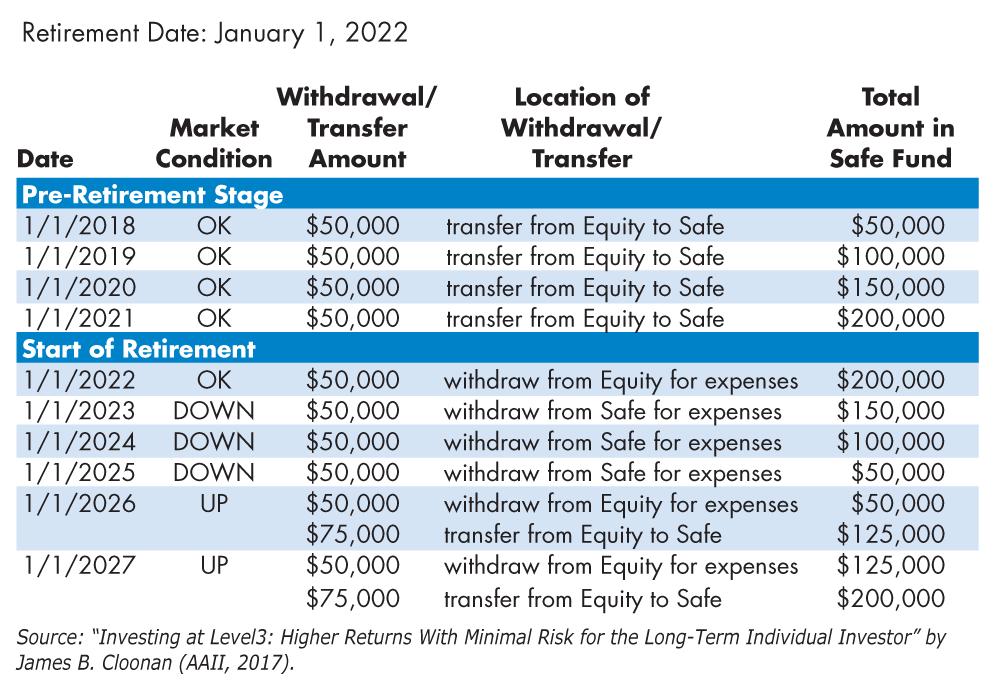
As you can see, based on a retirement date of January 1, 2022, money begins to be shifted into the safe portion of the portfolio at one year’s withdrawal rate during the four years prior to retirement. Withdrawals are made from the equity portion of the portfolio while the market is in a flat or up mode.
When on January 1, 2023, the market is 5% below its previous all-time high, we switch to defensive mode. Annual withdrawals are taken from the safe portion of the portfolio until the market returns to within 5% of its previous high. At that time, annual withdrawals once again are taken from the equity portion of the portfolio. Any deficit is restored to the safe portfolio in annual transfers spaced equally over a two-year period.
Withdrawal Strategy in Down Markets
The key to the strategy is to use the funds put aside for rainy days when it rains. As stated, if the market has not fully recovered in four years then the safe funds may have run out and you may have to liquidate some stock. But this scenario would not have occurred in the last 50 years using the strategies employed by Level3 investors.
Table 2 traces the Level3 defensive strategy through the Great Recession until the recovery. Actual S&P 500 returns are used rather than the advanced Level3 portfolio strategies to illustrate how the defensive approach would have worked during that time. Four percent is used as the return on the safe investment portion of the portfolio, which could be a blend of short-term Treasuries and other very safe investments.
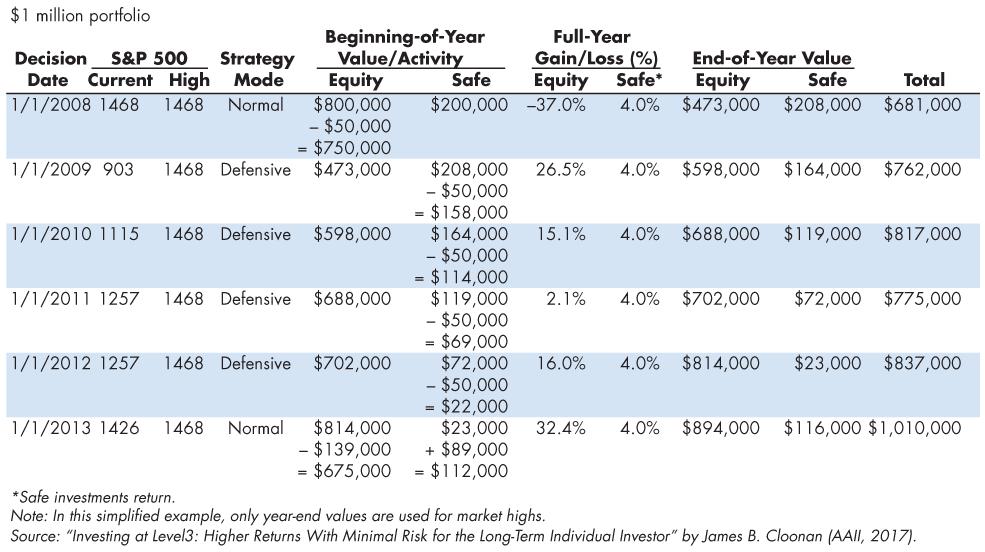
The impact of inflation is ignored on the $50,000 annual withdrawal in order to simplify the example; inflation was not very significant over this short period and would not have impacted any decisions. The 5% withdrawal rate, however, is inflation-adjusted.
It is important to note that the withdrawal amount is in dollars, not in percentage of the portfolio. If the market drops 10%, your mortgage payment doesn’t. You would still need $50,000 a year, even though that is now 5.56% of your portfolio rather than 5%.
In Table 2, the portfolio had $1 million on January 1, 2008, and an annual withdrawal rate of $50,000. The market was not lower than the previous January and so the normal withdrawal process was used, taking the funds from the equity portfolio.
The portfolio took a 37% hit that year, and so at January 2009 the portfolio was put in defensive mode and the $50,000 withdrawal was taken from the safe portion of the portfolio. The table shows the results of the strategy and the returns for each year.
At January 1, 2013, the market returned to within 5% of the old high and the strategy reverted to normal mode, taking the $50,000 withdrawal from the equity part of the portfolio along with restoring half ($89,000) of the existing shortfall in the safe portion.
Going into 2014, there was $894,000 in equities and $116,000 in bonds (if you allow the bond to grow at 4% during 2013). The portfolio was back above its original value even after taking $300,000 out in cumulative withdrawals.
Despite the severe downturn, the four-year reserve of $200,000 in the safe portion of the portfolio was enough to handle all the withdrawals. However, one more down year would have required going into the equity holdings.
Variations on the Level3 Withdrawal Strategy
The very specific defensive approach illustrated in the Level3 example was taken for two reasons:
First, if you have a very specific approach with defined rules, it is easier to avoid deviating randomly and substituting guesses about market direction at various points in time. Certainly, withdrawing a full year’s needs at one time or acting only on the first of the year is not a requirement for the Level3 defensive approach.
Second, a specific version of the Level3 approach was needed to illustrate its application. Different variations of the general approach will give different results depending on the actual market behavior over time.
Discussion
FREE REPORT

Tom Jeffrey from MA posted over 8 years ago:
John Lambert from NJ posted over 8 years ago:
James Borgeson from NJ posted over 8 years ago:
John Lambert from NJ posted over 8 years ago:
Bill Roberts Jr. from OR posted over 8 years ago:
Jan Cornish from CA posted over 8 years ago:
Rex Peterson from Wisconsin posted over 8 years ago:
Dave Gilmer from WA posted over 8 years ago:
John Lambert from NJ posted over 8 years ago:
Bryan Loy from KY posted over 8 years ago:
Peggy Boike from AZ posted over 8 years ago:
Ronaldo Jenkins from MD posted over 8 years ago:
Dave Gilmer from WA posted over 8 years ago:
Dave Gilmer from WA posted over 8 years ago:
Dave Gilmer from WA posted over 8 years ago:
R Stephens from WA posted over 8 years ago:
Dave Gilmer from WA posted over 8 years ago:
Herbert Schechter from MN posted over 8 years ago:
D Logan from MI posted over 8 years ago:
Kevin from CA posted over 7 years ago:
You need to log in as a registered AAII user before commenting.
Log InCreate an account