

Folio Investing is a unique brokerage-robo adviser hybrid that allows users to invest in bundles or “folios” of stocks, exchange-traded funds (ETFs) and mutual funds that they can trade in a single transaction.
On Folio Investing’s website, it defines a “folio” as: virtual baskets containing stocks, ETFs, mutual funds or any combination. You can create as many folios as you want with up to 100 stocks, ETFs and/or mutual funds in each one. Buying, selling or rebalancing can be done all at once—in one transaction, with one click—or securities can be traded in the folio individually.
Benefits that folios offer given at the website include:
- Diversification: Your folios can comprise a broad range of sectors, asset classes and strategies.
- Consistent investing: You can add money to folios in dollar amounts, even if it means buying fractions of shares, and set up an automatic investing discipline.
- Lower costs and taxes: With the Folio Unlimited Plan, you pay no commissions for buying, selling or rebalancing a folio. Automated Tax Lot Management Tools allow you to offset long- and short-term capital gains.
Account Types
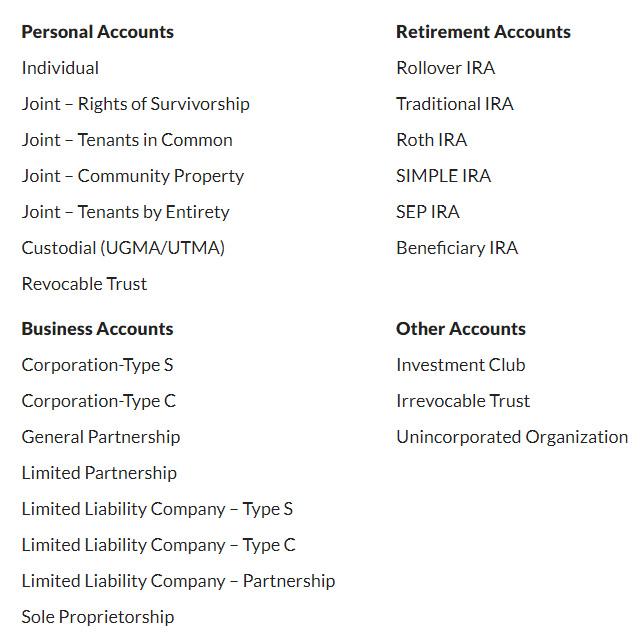
Figure 1 shows the different account types that Folio Investing offers.
How It Works
Folio Investing allows users to invest with specific dollar amounts, share amounts and even fractional share amounts. For example, you can invest $1,000 per month across an entire folio of 100 stocks, even if that means you are buying only a quarter share of each stock. As previously stated, a folio is essentially a portfolio of securities. Users are given the option to take a Folio Wizard quiz, which creates an “investor profile,” suggests proposed portfolios with levels of risk and provides portfolio allocations and performance data with each proposed portfolio.
Questions include:
1. What is the goal for the funds you are investing?
- These funds are for my retirement
- These funds are for another goal
2. When will you need to use the money that you are investing?
- Within the next 4 years
- 4 to 8 years from now
- 8 or more years from now
3. How important is reaching your goal, given your current financial situation?
- Achieving this goal with this investment is very important. I have no other funds available to help me reach this goal.
- Achieving this goal with this investment is very important, but I have some alternative funds available to me if I lose part of this investment.
- I am flexible with regard to reaching this goal and I will be okay whether I reach the goal at the desired date or not.
- Reaching this goal is not very likely—this is a “stretch goal” for me and I am willing to take greater risks to achieve it.
4. Let’s say you just heard the following news: The stock market has plunged; the most widely watched stock indexes have fallen 20% over the past week. You check your investments and see that they have also declined 20%. How do you think you’ll react?
- You sell all or nearly all your investments
- You sell some of your investments
- You do nothing and wait for the market to turn around
- You add to your investments by buying more shares
5. How would you describe your level of investing experience?
- Very inexperienced
- Novice
- Experienced
- Very experienced
6. Consider the following scenario: You were given a gift which, after taxes, amounted to 20% of your total savings. How would you invest the money toward your goal?
- Hold the money in cash in the form of an insured account
- Put half the money in cash and half in fixed-income securities
- Put half the money in fixed income securities and half in stocks
- Put one-fourth of the money in fixed-income securities and the rest in stocks
- Put all of the money in stocks
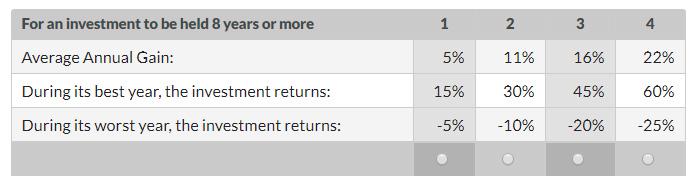
7. The four scenarios below describe hypothetical investment returns for your portfolio. Which do you feel most comfortable with?
Based on how I filled out the questionnaire, Folio Investing recommended the “Long-Term Aggressive” portfolio. This folio has 50% invested in large and mid-cap domestic stocks, 20% in international stocks, 15% in fixed income and 15% in real estate investment trusts (REITs). The Long-Term Aggressive portfolio is one of Folio Investing’s Ready-to-Go folios.
Users can start with a Ready-to-Go (or RTG) folio or customize any RTG folio to fit their specific needs. Ready-to-Go folios include both managed and unmanaged offerings, some of which may require a subscription to third-party services. For example, “Large-Cap Growth” is an RTG folio listed on Folio Investing’s website.
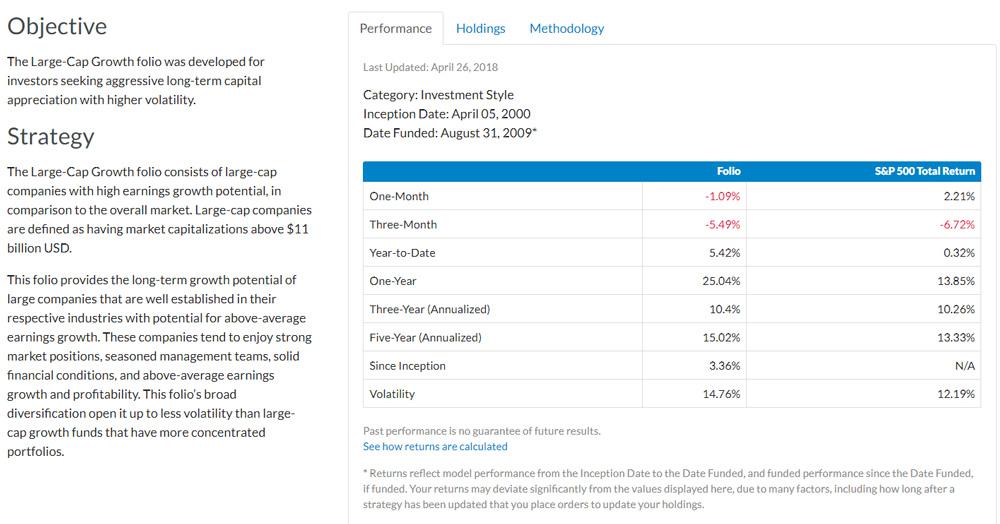
This folio has 30 equally weighted holdings, which you can view on the “holdings” tab of the folio-specific page.
The Methodology tab describes the steps to create the folio, the number of securities and the update frequency. For example, here are the listed steps for the Large-Cap Growth folio:
- We identified large-cap stocks as those having market capitalizations greater than $11 billion and consistent sales and earnings growth over the past year.
- We determined the average sales and earnings growth projections in a given sector.
- We screened for stocks with above-average earnings growth and sales projections compared to the sector average.
- We ranked these large-cap stocks and targeted the sector weights to be comparable to those of the S&P 500.
- We equally weighted all securities in the folio.
The Large-Cap Growth folio is updated quarterly.
Aside from selecting RTG folios, users can create their own by selecting which stocks, ETFs or mutual funds will be added to the folio. Custom folios can range from one security to a maximum of 100 securities.
Folio Investing also offers basic filtering tools to help users exclude specific securities or sectors. Users also have the ability to set “social issue exclusions,” which would exclude companies that may be involved with tobacco or gambling, for example.
Folio Investing’s universe includes “almost” all U.S.-listed stocks and American depositary receipts (ADRs), which are shares of foreign stock listed on U.S. exchanges. They generally do not support over-the-counter (OTC), pink sheet, bulletin board or debt securities. Check here for the list of available securities.
The company makes a point to mention that folios are distinct from mutual funds and are not registered investment companies.
Ways to Trade
Aside from being able to trade individual securities (stocks, ETFs and mutual funds) with a market, limit, stop or stop-limit order, users have additional ways to place trades.
Rebalancing
Folio Investing offers the ability to target weights for different securities within a folio. After desired weights have been determined, users can invest a specific dollar amount and Folio Investing will use the target weights to calculate how much to invest in each security. Users can choose to equally weight each security, set weights by market capitalization, use the current weights of the holdings, or set custom weights.
Users have the following rebalance options:
- Rebalance: Buy and sell so that your current weights equal your folio’s target weights.
- Exchange Among Folios: Buy and sell as needed to exchange this folio for another Ready-to-Go Folio (at the Ready-to-Go Folio’s target weights).
- Exchange From Watch Folio: Buy and sell as needed to exchange this folio for your Watch Folio (at the Watch Folio’s target weights).
Rebalancing can help a portfolio stay on track and help to manage risk. Over time, portfolio weights drift from their target weights due to over- and underperformance. As securities outperform the market, they become a larger percentage of the portfolio’s value, making the portfolio’s performance more heavily dependent on that particular security.
FolioTrade
Users have the option to trade their entire folio as a “window trade,” which groups orders together and executes them at specified time. Instead of buying, selling and rebalancing each individual security within your folio, this gives you the option of updating and trading the entire folio as a single unit. Conceptually, this is similar to the fact that buying and selling one share of a mutual fund is really buying and selling positions in all of the securities within the mutual fund.
The options for an entire folio are as follows:
- Buy express: Add money at current weights.
- Buy dollar cost average: Add money at target weights.
- Buy-only rebalance: Add money and attempt to rebalance to target weights.
- Buy and rebalance: Add money and rebalance to target weights.
Unfortunately, Folio Investing doesn’t go into much more detail aside from showing these options through a screen shot.
Invest in Dollar Amounts
Folio Investing shows Figure 4 on its website to illustrate that users can invest in dollar amounts.

The ability to invest in exact dollar amounts, as opposed to whole shares of stock, is a unique feature. Instead of having to purchase one share of a stock at a time, Folio Investing lets users purchase fractional shares, which can make rebalancing or auto-investing easier for many users.
Tax Management
Folio Investing provides 10 automated tax strategies for selling securities. The website states, “One click automates the entire tax lot selection process—every trade you make in your account will be based on the strategy you select.”
Folio Investing describes what a tax lot is: “Tax lots are records that track the date of purchase and sale, cost basis and transaction size for each security in an account portfolio. Each of your security holdings will have at least one tax lot. If you purchased a security on multiple occasions, each purchase will be represented by a tax lot.”
Below are the different options that the company lists for different tax strategies available within Folio Investing.
Strategies to Minimize Capital Gains
-
Maximize Losses/Minimize Gains, Tax Weighted
Adjust short-term gains/losses based on capital gains tax rates. Sell shares in the order of largest loss to largest gain. -
Maximize Losses/Minimize Gains
Sell shares with the largest losses first, largest gains last, regardless of long- or short-term tax status.
Strategies to Maximize Capital Gains
-
Maximize Gains/Minimize Losses, Tax Weighted
Adjust short-term gains/losses based on capital gains tax rates. Sell shares in the order of largest gain to largest loss. -
Maximize Gains/Minimize Losses
Sell shares with the largest gains first, largest losses last, regardless of long- or short-term tax status.
Other Strategies to Manage Capital Gains and Losses
-
First In, First Out
Sell shares in the order that they were purchased from oldest to most recent. -
Last In, First Out
Sell shares in reverse order of purchase from most recent to oldest. -
Maximize Short-Term Losses
Sell shares with short-term losses (large to small), then long-term losses (large to small), then long-term gains (small to large), then short-term gains (small to large). -
Maximize Long-Term Losses
Sell shares with long-term losses (large to small), then short-term losses (large to small), then short-term gains (small to large), then long-term gains (small to large). -
Maximize Long-Term Gains
Sell shares with long-term gains (large to small), then short-term gains (large to small), then short-term losses (small to large), then long-term losses (small to large). -
Maximize Short-Term Gains
Sell shares with short-term gains (large to small), then long-term gains (large to small), then long-term losses (small to large), then short-term losses (small to large).
Folio Investing coined the term Tax Football as a name for their patented tax tool that helps users identify securities in their accounts that they could sell to achieve a specific tax result. According to the website, “In just a few clicks, automatically generate a sell order that will give you the cash amount you request paired with the tax consequence of your choice.”
All gains and losses can be downloaded into popular tax software such as Quicken or TurboTax.
While the Tax Football tool seems interesting, I am somewhat disappointed with the lack of detail that Folio Investing provides on the feature without having you subscribe to the service.
Pricing
Folio Investing offers two different plans.
According to Folio Investing, “With the Folio Unlimited Plan, you can invest in as many folios as you want, in as many accounts as you need, with up to 2,000 commission-free window trades each month. There’s no charge for the first 60 days after you fund your account.”
“If you’re just getting started, plan to trade fewer than eight securities each month, maintain smaller folios, or rebalance less often, you can still get discounted trade commissions with Folio Investing’s Basic Plan.”
Figure 5 displays the differences listed between the two plans on the company’s pricing page.
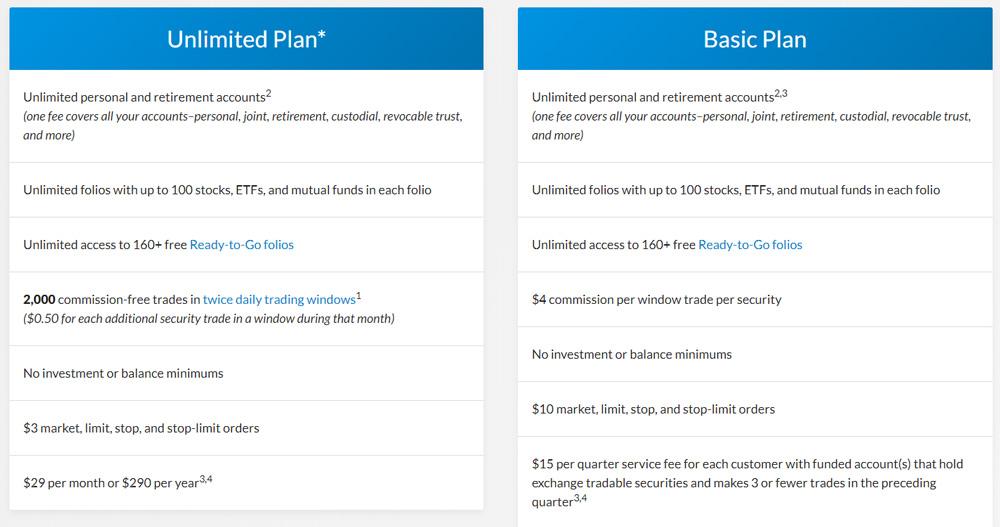
It’s worth noting that quarterly fees of $15 are charged for inactive accounts, defined as three or fewer trades per quarter. This is interesting considering that the company seemingly promotes longer-term investing and continually mentions that fees can cut into performance.
There is also an annual fee of $25 for all IRA accounts.
“Window trades” are only placed twice a day and the current trade times can be found here. Folio Investing also includes the clause, “We cannot guarantee that every Window will occur as scheduled or at all. You understand and agree by submitting your Window Trade order that there may be times when Windows are delayed or are cancelled for various reasons, such as quote vendor failures, computer failures or events affecting the markets. We reserve the right to add, remove and change Window Trade deadlines, without notice, at any time,” which is slightly concerning when you read it, but also probably similar to disclosures that other brokers provide.
Also in the Basic Plan, market, limit, stop and stop-limit trades are $10 per trade. This is much higher than other discount brokerages. So essentially your options (with the Basic Plan) are to pay $4 to do a window trade at either 11 a.m. Eastern Time or 2 p.m. Eastern Time, or pay $10 to place a “regular” trade, not required to be at a specific time.
Conclusion
Folio Investing sounds like a great option, but it’s important to read reviews and understand some of the issues that other users have had. I can only give a basic overview based on what I’ve seen on their website, but I will often read third-party reviews to get an idea of some common comments. People who continually use the platform everyday will have much more specific feedback than someone who is merely stating what the company offers (like I did in this article).
I looked at the Investor Junkie review of Folio Investing and saw some notable comments that may be helpful.
- “Folio Investing makes window trades twice a day and everybody gets the same execution price. I was with them for 2 years and 9 months and I didn’t like the execution prices I got. I could see market anomalies a few minutes after the 11 a.m. and 2 p.m. windows as the trades hit the market en masse. Worst, when I switched to Interactive Brokers, Folio Investing wouldn’t prorate the annual fee that I had just paid on two accounts! They just kept the money and told me that’s their policy. Plus, customer service is awful—slow and uninformed. Stay away.”
- “I was with Loyal3 but after they shut down, my $21,000 worth of stocks was transferred to FolioFirst [part of Folio Investing, designed for Loyal3 customers]. After using them for a few months I have nothing outright bad to say except that their website doesn’t function that good. This service is meant for people who like to use Direct Stock Purchase Plans. You can buy an individual stock with as little as $25. (If you purchase a batch of 10 stocks at one time the minimum is reduced to $5 a stock.) The fee is $5 a month for up to 2,000 trades a month. Their regular website charges $29 a month but if you were a former Loyal3 customer they only charge you $5. To sum up: If you’re a long-term investor who wants to buy a little each month and just forget about it, this isn’t that bad of a service. I have E*Trade and use that for my larger stock purchases and shorter-term trades. FolioFirst is for my buy a little each month and forget about it stocks.”
Another downside was that the company doesn’t offer a mobile app, which is a major drawback to many investors that like to trade on the go.
There have also been reports that once users have invested in RTG folios, the returns were not as strong as the results displayed on Folio Investing’s website. This could simply be a timing issue and, as we all know, past results are not indicative of future results. Folio Investing also makes it seemingly clear on an individual RTG folio’s page which time periods’ returns, if any, were backtested results as opposed to actual results.
Keep in mind that since Folio Investing window trades are only placed twice a day, this system may not be the best for active day traders. Additionally, forwards, futures and options are not available on this platform.
Aside from these negative comments, I have also heard positive comments from some of our members. As I’m sure you’ve noticed, people are usually more willing to write a bad review than a good one, which can skew the reviews for a given product. Nonetheless, they’re important to read.
If you’ve used Folio Investing and have some insight into its functionality, or things you like/don’t like, feel free to comment on this article so other readers can benefit from your experience.
Discussion
FREE REPORT

No comments have been added yet. Add your thoughts to the discussion!
You need to log in as a registered AAII user before commenting.
Log InCreate an account