

There’s an extreme tug of war taking place in the bond market: It is between the deficit doves and the deficit hawks.
You cannot be a bond investor today without letting politics creep into your decision-making psyche. Whether you are for continued spending or increased austerity, whether you vote for liberal candidates or more conservative ones, realize that Congress will not decide who wins this tug of war. The bond market will make the ultimate decision. The bond market will be the judge and jury, hangman and executioner, all rolled into one giant arbiter.
As the Greek debt crisis went into full swing during May 2010, many television talking heads downplayed the suggestion that the United States is like Greece. After all, our economy is considerably larger and produces a much bigger variety of goods. Our real similarity with Greece, however, lies in our entitlements and in our continued practice of spending with abandon.
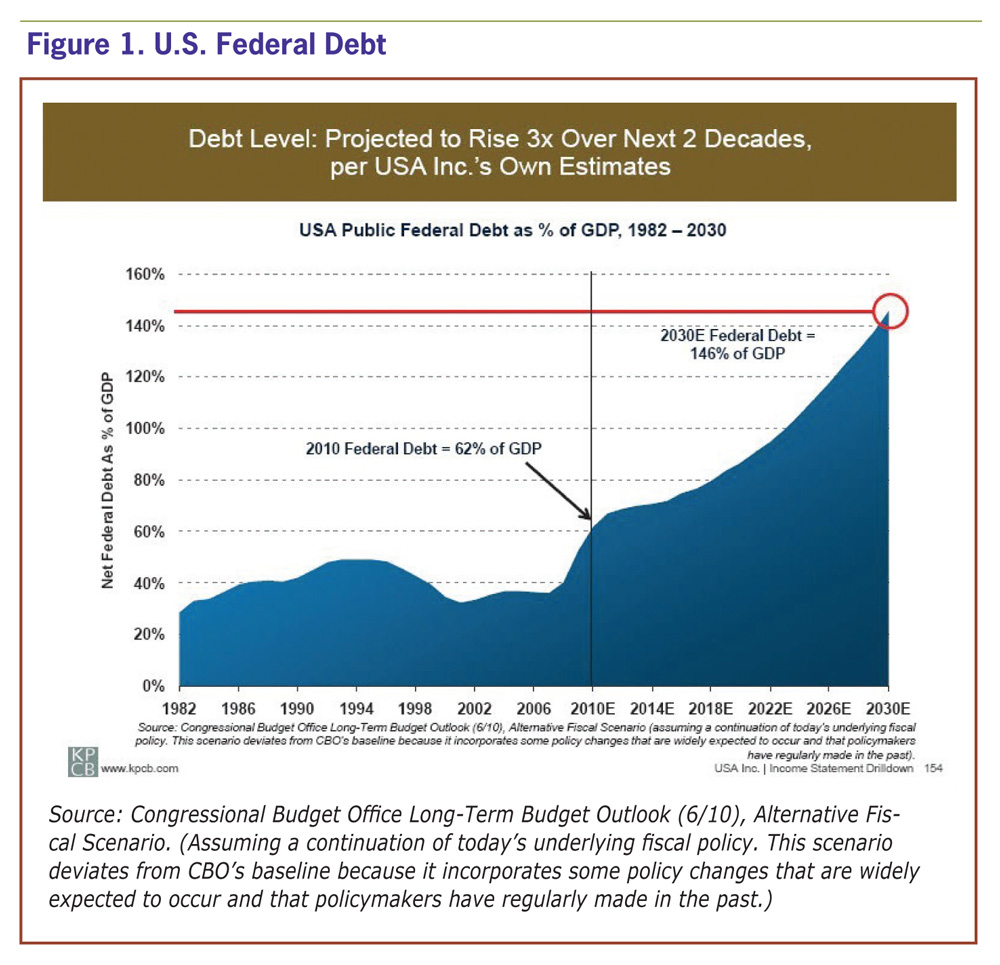
At the current spending rate, by 2030 United States public debt as a percentage of gross domestic product (GDP) will be 146%. Figure 1, which is taken from the Congressional Budget Office’s Long-Term Budget Outlook, shows that the outlook is not pretty.
You may be asking yourself, why and how has debt risen so much? Public debt is now double what it was over the past three decades. The largest of several 800-pound gorillas driving this debt is entitlement spending.
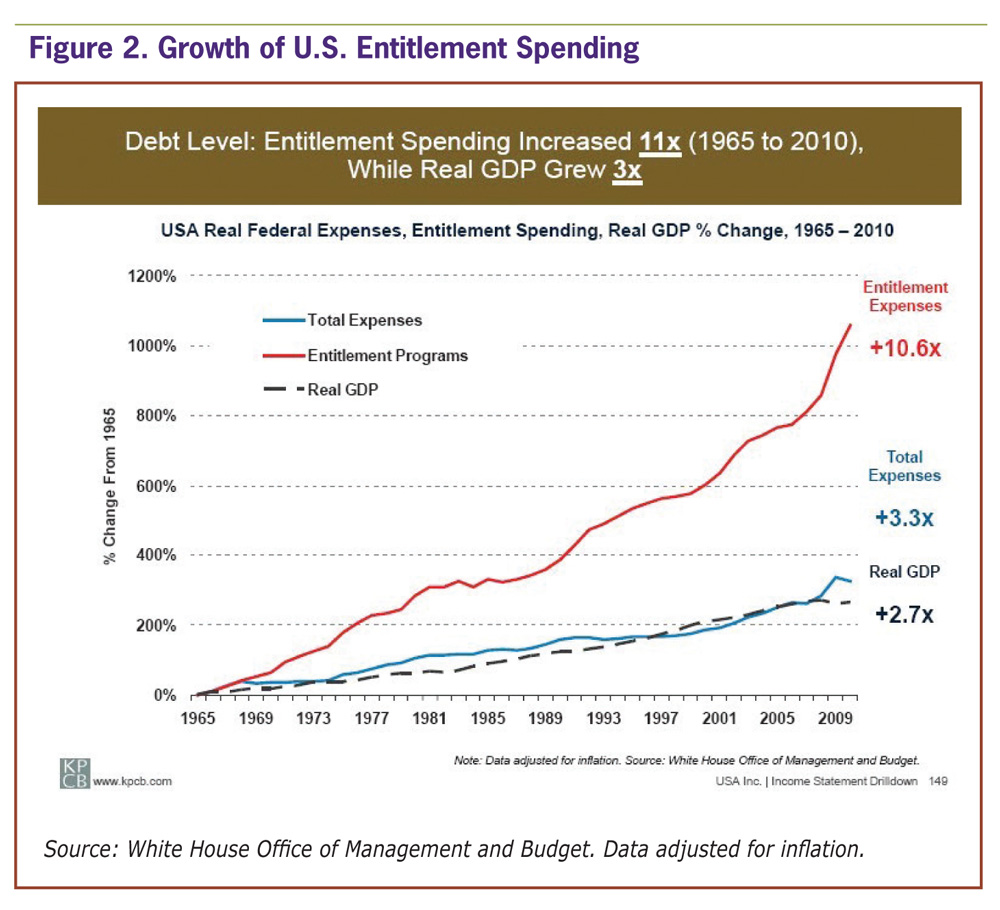
Figure 2, which is from the White House Office of Management and Budget, graphically depicts how entitlement spending increased nearly elevenfold from 1965 to 2010, while real GDP grew only threefold. Whether or not you have ever studied trajectories, you can visually “tell” that the path of spending over time cannot be sustained.
So where and how does all of this gel with the high price of commodities? The debasement of the dollar? The increased inflation that the Federal Reserve continues to disavow? It all ends “with” and “in” the bond market, when the bond vigilantes scream they’ve had enough and make their tactical moves.
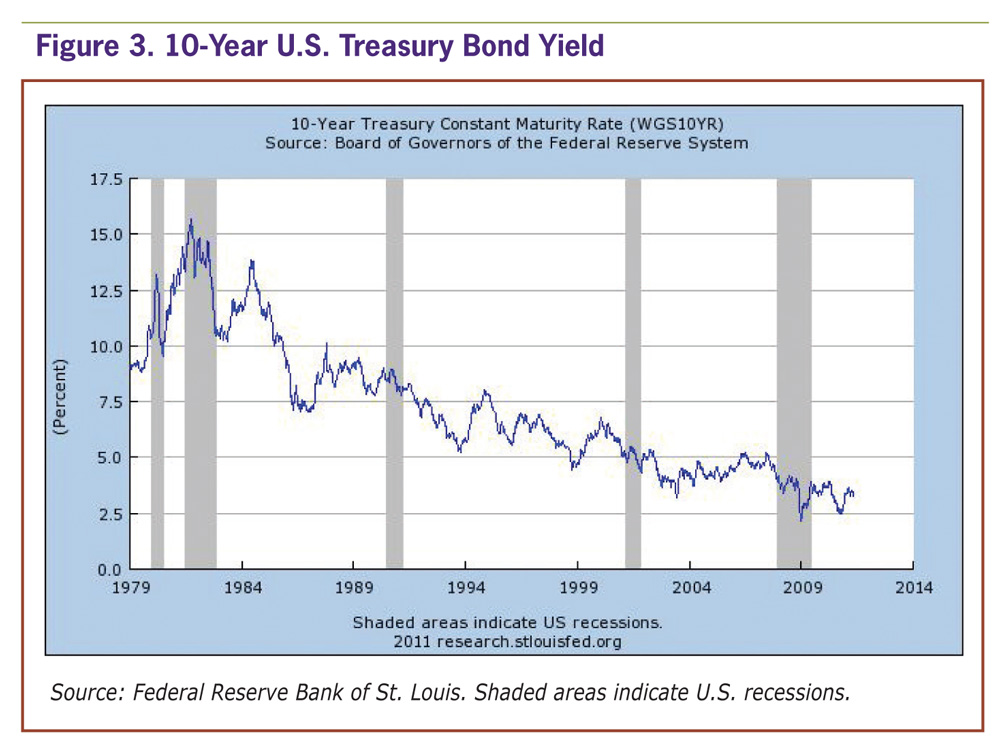
If you are worried about the direction of interest rates, history lends support to your view. We’ve had 30 glorious years of a bull market in bonds. Granted, there have been some near-death experiences like the bond bear markets of the early 1980s, 1987, 1989–1990, 1994 and 2000. Figure 3, from the Federal Reserve Bank of St. Louis, shows the 10-year U.S. Treasury bond interpolated yield going back to January 1979. (An interpolated yield curve uses mathematical models to smooth out gaps from bonds with different maturity dates and yields.)
Do you think the tug of war will end in a depressionary implosion where massive amounts of U.S. debt of all kinds are repudiated? Or do you think it will end with higher interest rates, reflation and a weaker dollar? Or you might think we will muddle along accepting the kindness of others (China, for example) who will continually buy U.S. Treasury debt.
Rather than sit and worry, there are ways to rebalance your bond holdings so that no matter what the ultimate outcome is, you will benefit or achieve good results.
Strategies for Individual Bonds
A great place to start is with variable-rate bonds. This includes fixed-to-float individual bonds and Consumer Price Index (CPI)–based bonds. I don’t mean TIPS (Treasury Inflation-Protected Securities), which most do-it-yourself investors flock to—I mean corporate inflation-protected securities, or CIPS.
Fixed-to-float bonds simply begin with a coupon that is fixed for a specific period of time, typically one to two years, and then floats based on a variety of options. These options include LIBOR (London Interbank Offered Rate) three-month rate, 10-year constant maturity Treasury (CMT), LIBOR plus a fixed rate, or a fixed rate plus a monthly CPI component. There’s something for every investor.
Many of the fixed-to-float bonds are issued by financial institutions. Many of these are also backed with derivatives. As is the case with all derivative-style securities, make sure you understand what you are buying, including the structure and its terms.
CIPS are the corporate twin of TIPS, but their nominal yields leave TIPS in the dust. Now, don’t misunderstand: CIPS and TIPS are not identical twins. With the corporate version, the coupon can have a ceiling or not. CIPS can go from a fixed coupon (the income stream from the bond does not change) to a floating one (the income stream changes, resulting in larger or smaller payments). They can also be 100% floating or any variation thereof.
Buy the structure that helps you define your inflation stance. Are you thinking that inflation will be short-lived, lasting only two years? Or do you think we are in for a long, long spiral that lasts 10 years? Or perhaps something in between?
Here’s the catch: The majority of CIPS that I’ve seen in the primary and secondary markets are issued by financial institutions. So don’t get over-zealous. Have a maximum 15% allocation to debt securities issued by financial companies. Don’t forget to include straight coupon bonds and CIPS in that 15% allocation to avoid an inadvertent overconcentration.
High-quality corporate bonds should be favored over their lower-quality peers. The logic is that no matter how bad things get in the bond market, the large, stable companies that have high credit ratings will be more likely to ride out turbulence in the debt markets. Look for companies with solid balance sheets, good management and an abundance of cash.
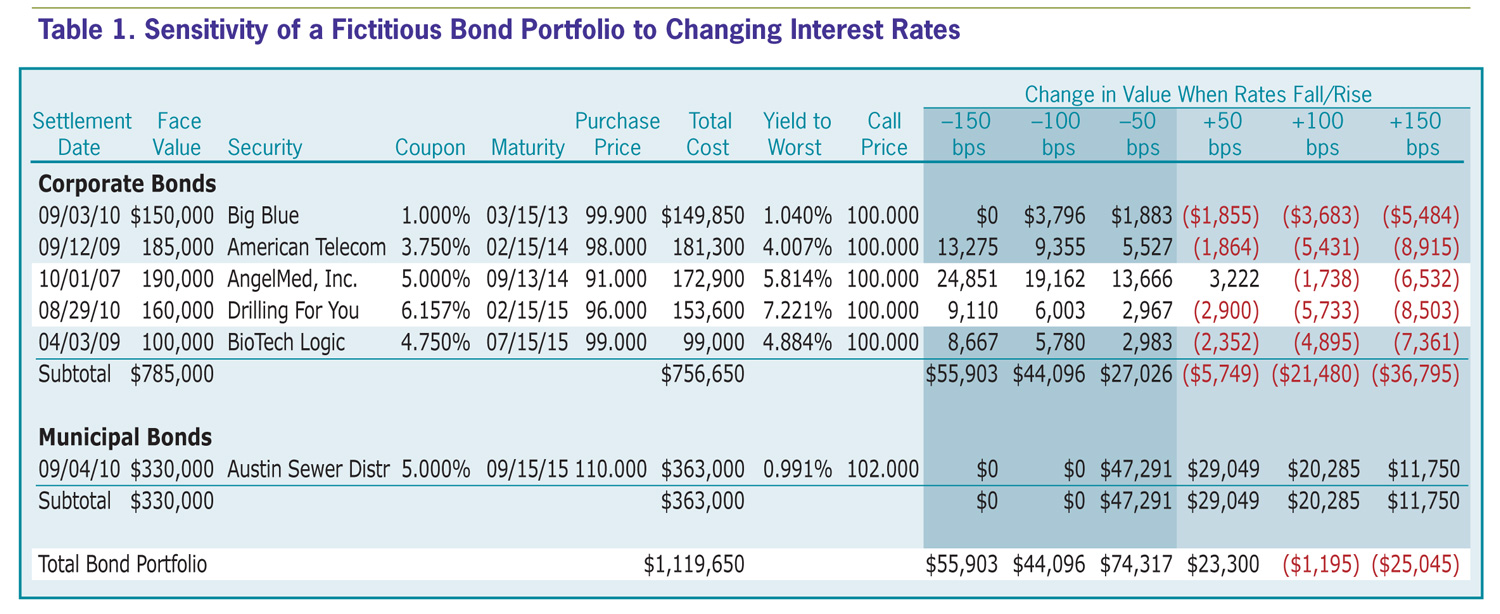
If you have individual bonds and are worried about higher rates, then shorten your duration. Duration tells you the price changes of an individual bond or portfolio of bonds assuming a specific shift in interest rates. In other words, it measures how sensitive a bond or portfolio of bonds is to changing interest rates.
Take a look at my fictitious portfolio containing a meager six bonds in Table 1. The “what if” scenario spells out the bond math. What if interest rates decline 150 basis points? What will that shift in rates do to the value of your portfolio? The six columns on the right side of the table show the effect various changes in interest rates, both down and up, will have on the portfolio.
Bond Fund Strategies
If you are a bond fund investor, here’s the important question you need to ask: What is the average-weighted duration of each bond fund you hold? If the average-weighted duration of your municipal bond fund is 14 years and interest rates rise 1% (100 basis points), the value of your holdings will decline by approximately 14%. If the average-weighted duration of your corporate bond fund is 10 years and rates rise or fall 1%, then the value of your portfolio changes either way by 10%.
We have had such a blissful bond run from January 2009 until the present that it is hard to fathom how much more juice is left. High-yield, emerging market, investment-grade and, to a lesser extent, municipal bonds have been on a tear—high prices, lower yields. We are back to the skinny spreads (the differences in yield between what you earn on Treasuries versus corporates, Treasuries versus high yield, Treasuries versus emerging market bonds, etc.) last seen before Lehman Brothers collapsed.
Be Preemptive
Even though the tug of war between bond bulls and bond bears continues, be preemptive if you are worried about higher rates. Shorten your duration; buy fixed-to-float or CPI-based individual bonds. Bond fund investors should rebalance from long-term funds to intermediate funds. If you cannot stand taking your profits from long-term funds, then buy an equal amount of ultra-short-term bond funds to barbell your long-term bond fund portfolio, thereby shortening your duration.
Floating-rate bond funds have a place in your portfolio, but the pile into them has been breathtaking; buy only on a pullback. Remember, these are bonds with call dates and final maturity dates. These are not some high-tech or biotech shares whose next big product will appear to make price appreciation limitless.
There are multiple strong cross currents and undertows in the bond market tug of war taking place. Don’t let your portfolio be a casualty. Be a proactive bond investor.
Discussion
FREE REPORT

Louis from FL posted over 15 years ago:
A from HI posted over 15 years ago:
J c from TN posted over 15 years ago:
Judith from UT posted over 15 years ago:
Larry from FL posted over 15 years ago:
Ingemar from CA posted over 15 years ago:
Charles Rotblut from IL posted over 15 years ago:
James from PA posted over 15 years ago:
Reginald from GA posted over 15 years ago:
Bruce from TN posted over 14 years ago:
Dom from WA posted over 14 years ago:
Dom from WA posted over 14 years ago:
Rob from CA posted over 12 years ago:
SD from TX posted over 12 years ago:
Nancy & Barry Kronman from FL posted over 12 years ago:
Mark from NJ posted over 12 years ago:
You need to log in as a registered AAII user before commenting.
Log InCreate an account