


Blooom is an online service that manages the allocation of 401(k) accounts for individuals. The tool is designed to help those who may be confused by their 401(k) plan and do not understand the ins and outs of choosing funds, managing funds and maintaining a certain level of diversification. Blooom links to users’ existing 401(k)s and then analyzes the holdings to determine if there are better alternative funds with lower fees. The company doesn’t work with a bank or an investment firm and has a “fiduciary” duty to give its users sound financial advice.
According to blooom, their method was developed by a certified financial planner. Based on decades of market data, blooom created algorithms to optimize almost any 401(a), 401(k), 403(b) or 457 account.
According to the company, as far as allocation is concerned, they focus on three things:
- A stock/bond ratio appropriate for your time frame to retirement,
- Exposure to every appropriate asset class possible within your 401(k) fund lineup and
- The lowest cost funds for each asset class.
In correspondence with me, blooom stated, “Risk tolerance is addressed by giving the client the ability to see the mix of stocks and bonds we recommend as most appropriate for them, and then allowing them to adjust the slider to be more conservative or more aggressive than our recommendation. However, as a fiduciary and their hired adviser, we do have limitations on how far they can adjust away from our recommended optimal stock/bond ratio.”
My experience was a little different, and you can read about that below.
Blooom’s Process
Not every investor is confident when selecting their retirement funds. Blooom offers a quiz, after starting the free portfolio analysis process, for those who aren’t sure if they’re confident in their retirement fund selection.
Users have the option to go through a free analysis without inputting their credit card information.
The first couple of things users need to input are their name, birth date and desired age of retirement.
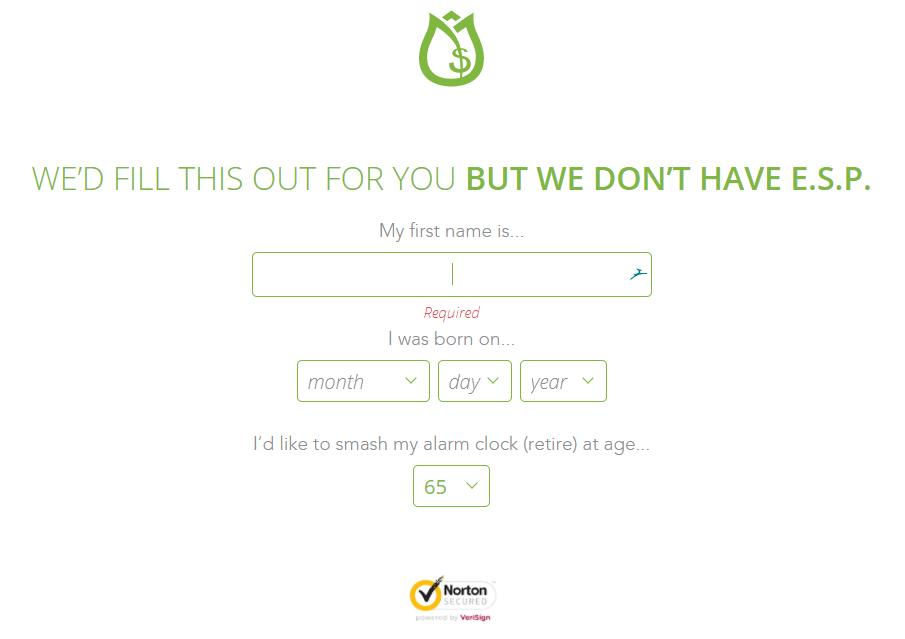
Next blooom asks for an email address and password.

The next step is to link your current retirement account.
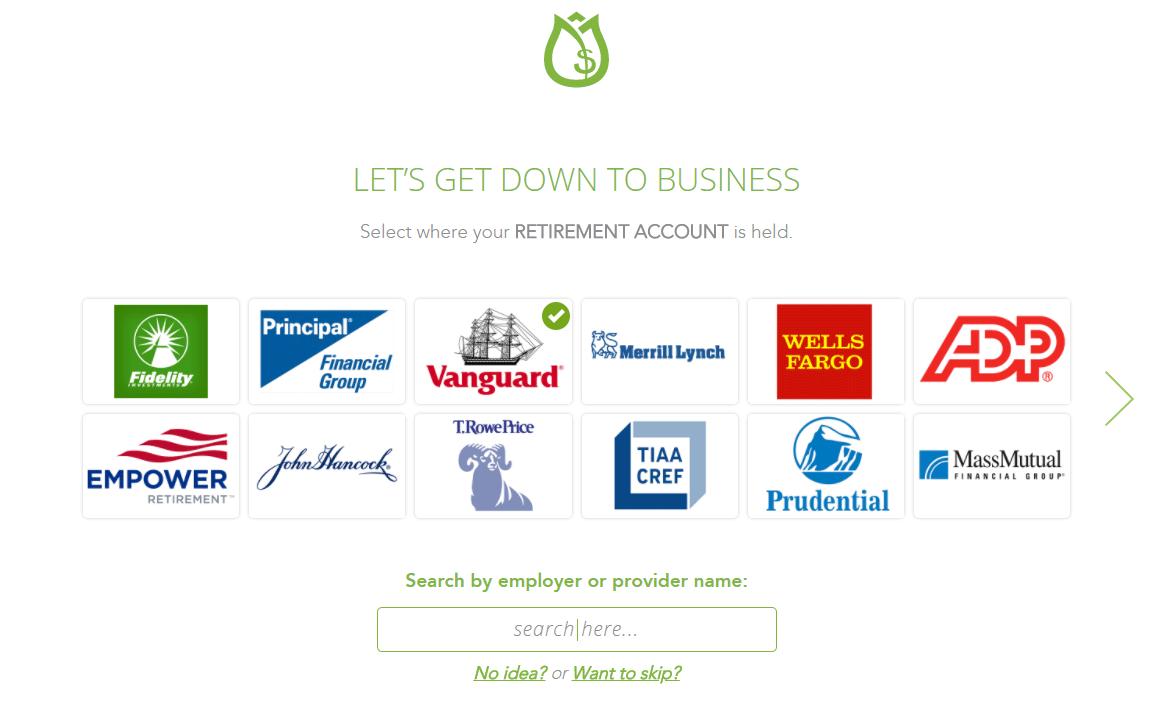
Since I have a Vanguard account it was easy to link, but I would be interested in learning more about the other options they offer if users have different brokerages than what is displayed.
Now, we can see how they rate my retirement account. According to blooom, I am not doing so well in terms of fees or diversification but seem to have risk under control.
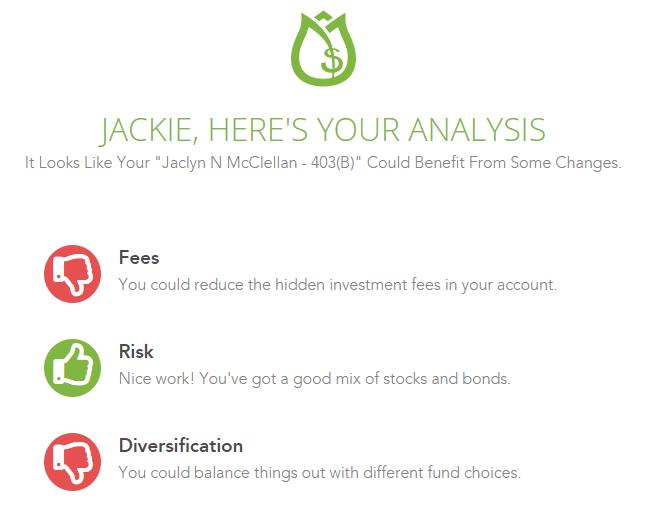
Let’s take a closer look.
Fees
Figure 5 shows what blooom has to say about my fees, which were originally marked in red as not being up to par. Interestingly, the tool was telling me that my fees were too high at 0.20%, while suggesting the optimal aggregate fee to be 0.20%. Confused? Me too. My guess is that there was some type of rounding error in their algorithm.

Nevertheless, blooom estimates that they could save me $299 over the next 34 years.
If the calculations had been correct, I think this type of presentation is easy to understand for those who may not know how mutual fund fees can affect their long-term performance. In the small print, blooom said, “When you hire blooom, the first thing we do is identify the fees in every fund in your account and put you in the lowest-cost options that meet your allocation needs to get as close to achieving your recommended fee percentage as possible. Every time we rebalance your account we make sure you stay in the lowest-cost funds available.”
Risk
Look at that! I am good on the risk spectrum.
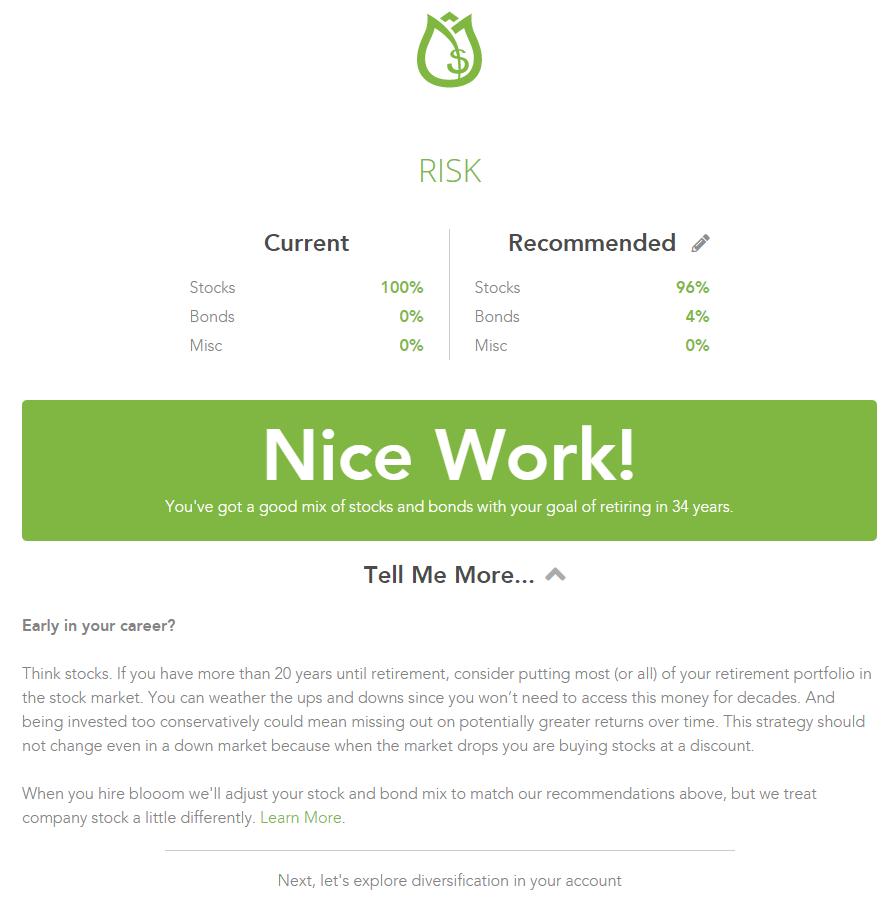
According to blooom, I should have 4% invested in bonds and 96% of my retirement invested in stocks. I personally don’t see the need for any allocation to bonds at a young age (yes, I’m young!), but that is a personal choice.
I do wish that blooom would give a little bit more detail here like some of the other robo-advisers do. Stocks could include a wide array of investments, and the same goes for bonds. However, they do dive a little deeper in the diversification section coming up.
According to blooom, “If you have more than 20 years until retirement, consider putting most (or all) of your retirement portfolio in the stock market. You can weather the ups and downs since you won’t need to access this money for decades. And being invested too conservatively could mean missing out on potentially greater returns over time. This strategy should not change even in a down market because when the market drops you are buying stocks at a discount. When you hire blooom we’ll adjust your stock and bond mix to match our recommendations above, but we treat company stock a little differently.” Then they provide a link to learn more about company stock.
While I agree with what they said, and it is a good explanation, this doesn’t really define what risk is or how it is measured. There are many different ways to measure or determine risk.
On to diversification.
Diversification
According to blooom, my diversification is a little off. I am aware that in this particular account (I only linked one of my retirement accounts) it appears that I suffer from a “home bias,” meaning I invest in mostly U.S. securities, as opposed to being fully diversified through allocation to other developed markets and emerging markets. Again, it’s a personal preference in this particular account, but I do see how this tool would be helpful for those who don’t fully understand what diversification means or how they should properly allocate.
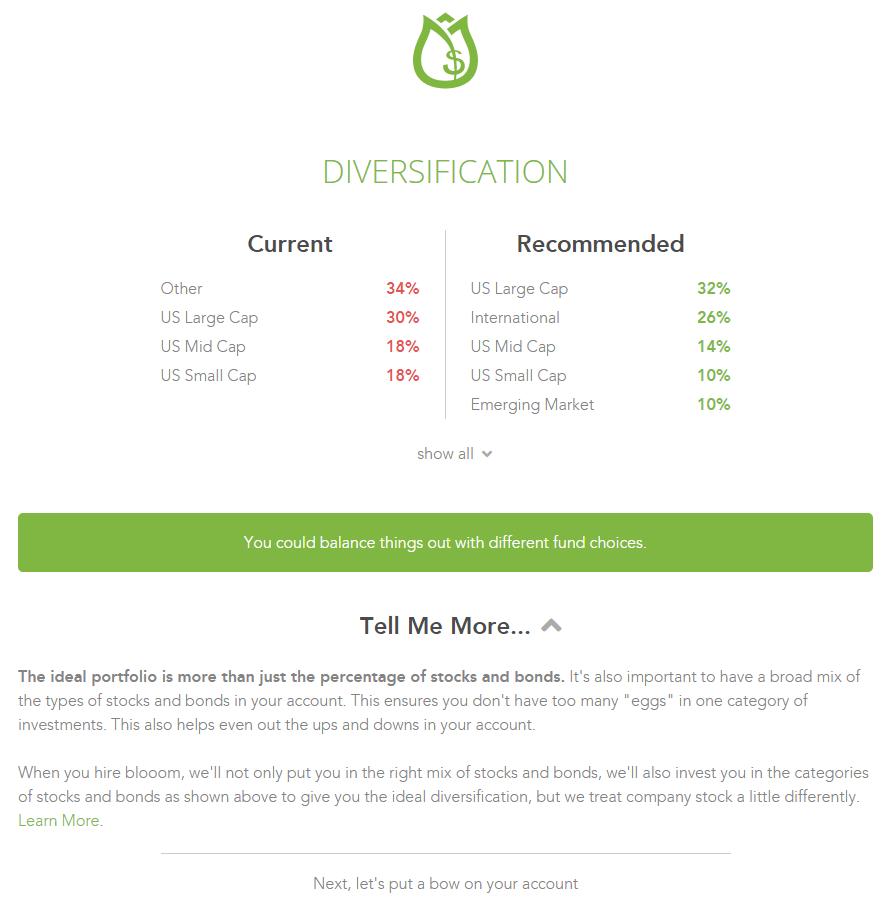
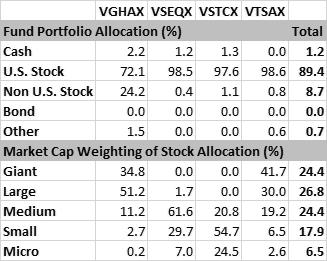
My recommended asset allocation is shown in Figure 7. What is intriguing to me is the large allocation in my current account that they categorize as “other.” The current funds in this account are: Vanguard Health Care Fund Admiral Shares (VGHAX), Vanguard Strategic Equity Fund Investor Shares (VSEQX), Vanguard Strategic Small-Cap Equity Fund Investor Shares (VSTCX) and Vanguard Total Stock Market Index Fund Admiral Shares (VTSAX).
Using Morningstar.com, I searched for each of my mutual funds and then looked at the allocation/portfolio information that Vanguard provided for them. According to some quick calculations (show in Table 1), my allocation breakdown differs significantly from what blooom calculated. For example, they said I have 30% allocated to large-cap, but often this type of simplification bundles giant- and large-cap companies into the large-cap category. My calculations show that I actually have 51.2% of this account’s assets in large-cap companies. Additionally, blooom says I have no allocation to foreign stocks; however, the Vanguard Health Care Fund has 24.2% of its assets invested in foreign companies. Although as a percentage of this total portfolio the foreign stock allocation is 8.7%, it is a little concerning that blooom didn’t recognize any foreign stock allocation. They may have this information on the “back end” of the platform, but I wonder how much that affects my recommended allocation.
Conclusion
This article ends a little short from the analysis I would have liked to have done because blooom wouldn’t recommend an allocation or show which funds I should invest in without me giving them discretionary control of my account. This differs slightly from what I was told when I was originally corresponding with the company.
I would have liked to have seen the recommendation before “approving” any changes to my allocation. Full discretion means that blooom users don’t get the option to approve changes: blooom has control over the account. This is actually a fairly standard practice with many robo-advisers—once you sign up, they don’t need to ask you in order to place trades for you. However, many other robo-advisers (though not all) are more transparent with what they are doing behind the scenes and what your recommended allocation is. Some robo-advisers even allow you to see which funds they are selecting for you before trades are placed. I do understand why blooom is set up this way; they are catering to users who may not know or care to know what their allocation is or which funds are being selected (being a finance professional, that’s not the case with me).
Blooom generally allows clients to adjust allocations above or below what the company recommends (but details on how much of a variance is allowed was not provided). They select the funds without any input from account holders. However, the company did mention that they are more than happy to explain the rationale behind their selected allocation and address any questions or concerns that users may have.
You can check out blooom’s FAQ page here.
One question and answer that was a little concerning to me was “How often will blooom adjust my 401(k)?” The answer displayed is, “We will take a peek under the hood and see if we need to make any adjustments. If we need to tweak something we’ll do it for you.”
A lot of other robo-advisers go into much more detail about rebalancing bands, how often accounts are rebalanced on average, etc.
Blooom will give you a quick analysis of your portfolio for free (the process shown in this article), but you will not get to see any allocation recommendations without signing up. Blooom costs $10 per month, and $7.50 per month for each additional 401(k).
Blooom’s service is best suited for individuals who want more of a hands-off approach with their retirement account(s). This may include those who do not know what they are doing, have no interest in doing it themselves, or simply do not have the time to worry about it. I think it’s a great resource for exactly those groups of people.
Those who want a little bit more detail about what’s going on behind the scenes may not find blooom useful.
Discussion
FREE REPORT

bruce borkosky from FL posted over 7 years ago:
You need to log in as a registered AAII user before commenting.
Log InCreate an account