


Article Highlights:
- Individuals and married couples of all income levels can make contributions to a 529 plan up to the gift tax limit without triggering the gift tax. Grandparents can contribute as well.
- Contributions are not tax-deductible at the federal level, but some states offer a deduction or credit. Investment earnings and qualified withdrawals are tax-free.
- Age-based 529 plans are the most popular and adjust their allocations as the beneficiary gets progressively closer to college age.
There are lots of benefits to using 529 plans to save for future college costs.
A 529 savings plan, also called a qualified tuition program, allows you to build up savings to pay for qualified higher education at eligible institutions using tax-free dollars. These plans were named after section 529 of the tax code and are offered through states. They are funded with aftertax dollars, which then grow tax-free. Withdrawals for qualified education expenses are also tax-free. On top of that, some states offer tax deductions or credits for contributions.
Because of these money-saving tax benefits, 529s are becoming increasingly popular: According to data from the College Savings Plan Network, U.S. families invested $319.1 billion in 529 accounts as of year-end 2017, a 16% increase over 2016 levels.
But not all 529 plans are created equal. Some plans are saddled with high fees and poor investment choices, which can hamper your savings progress and erode your returns. Morningstar analysts carefully evaluate 529 plans and assign medalist ratings based on their scores in five key areas: process, people, parent, price and performance (discussed below).
If your state’s plan leaves much to be desired, you have no obligation to invest in it. Investors are free to choose any state’s plan. If you reside in a state that doesn’t offer any tax benefits for 529 contributions or in a state that offers tax benefits regardless of the 529 plan used (these are commonly referred to as tax-parity states), you may want to take a look at the 34 plans Morningstar analysts have awarded gold, silver or bronze medals listed in Figures 1, 2 and 3.
If you live in a state that does offer tax benefits, though, they should factor into your decision-making. Morningstar researchers have calculated that a 5% state tax benefit is a generous enough incentive to stay in state regardless of fees. (In other words, a tax benefit level of 5% or greater can make up for less-than-compelling investment options and high fees.)
Who Can Contribute and How Much?
When you’re saving for college, you have an expensive goal and a limited period of time—less than two decades—to achieve it.
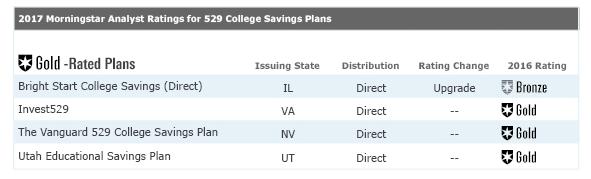
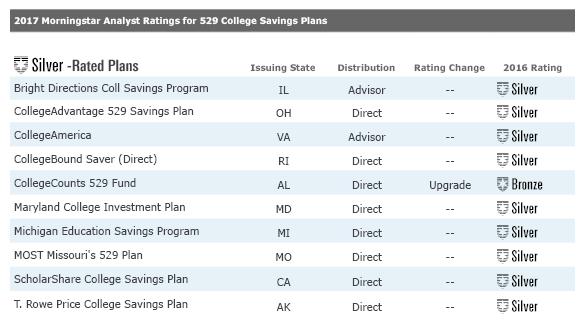
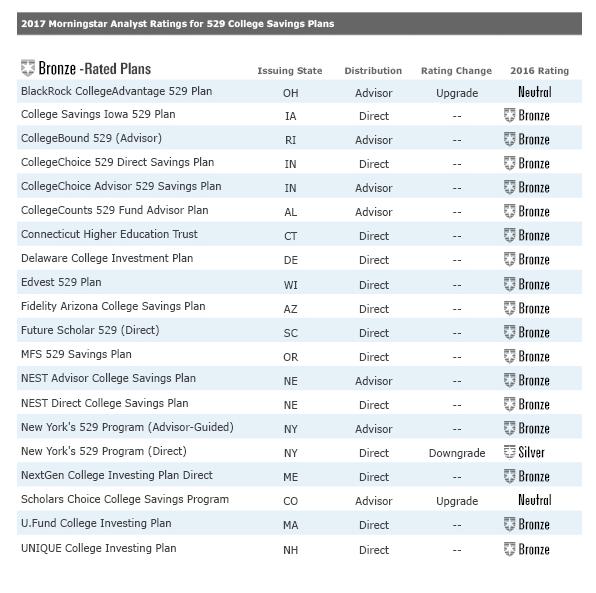
Source: Morningstar.com.
Unlike some other types of savings accounts like Coverdells and Roth IRAs, there is no income threshold for contributing to 529 plans. Also, 529s allow higher annual contribution amounts than other college-savings vehicles. Individuals can contribute $15,000 per year without triggering the gift tax; married couples can contribute $30,000 per year free of the gift tax, based on 2018 tax limits. There is also an option to “superfund” a 529, which means you make an upfront contribution of up to $75,000 (or up to $150,000 for a married couple) to a beneficiary’s plan, then treat the contribution as having been made over a five-calendar-year period for gift tax purposes (by filing IRS form 709 with your federal tax return in each of those five years). You cannot make further excluded gifts during those five years, as these contributions apply to the gift tax limits. [Editor’s note: The gift tax limitations are indexed to inflation and may be adjusted at the start of each calendar year. Each December, AAII will list the new gift tax limitations in our annual tax guide, which can be found at www.aaii.com/guides/taxguide.]
Grandparents and others can also contribute to a beneficiary’s 529 account in the same year, and a beneficiary can have multiple 529 plans in their name.
(This is different than ABLE accounts—tax-advantaged savings accounts for those with disabilities and their families—where a beneficiary can only have one account and contributions from all sources can total no more than $15,000.)
Per IRS guidelines, lifetime contributions cannot exceed the amount necessary to provide education for a beneficiary. What this actually means varies widely by state and by plan—anywhere from $235,000 to over $500,000. Deduction amounts vary by state, and gift taxes may apply to very high contribution amounts.
Tax Advantages
Though contributions are not deductible on federal income tax, you may receive a state tax break (either a deduction or a credit). Your investment earnings compound on a tax-free basis and withdrawals to pay for qualified college expenses are not taxed either.
In addition, saving for college in a 529 plan helps to reduce the impact that parent and student wealth has on financial aid relative to savings held in other types of accounts.
Here’s how: The amount of financial aid you are eligible to receive is based on your “financial need,” which is the difference between the cost of attendance (determined by each school) and the expected family contribution (a measure of the family’s financial strength, calculated according to a formula established by law). So, the lower your expected family contribution and/or the higher the cost of attendance at the school are, the greater your calculated financial need will be.
Note that the custodial parent’s Roth IRA assets, as well as any 529 accounts in the beneficiary’s name that are owned by a grandparent, aunt/uncle, noncustodial parent, etc., are not counted in the expected family contribution (EFC) calculation at all, until two years after they are used. The Department of Education describes the EFC as an index number that college financial aid staff use to determine how much financial aid you would receive if you were to attend their school. A guide including worksheets and tables for calculating the EFC is available on the Federal Student Aid website at https://studentaid.ed.gov/sa/fafsa/next-steps/how-calculated.
As the money is withdrawn from these noncustodial-parent accounts and used to pay for college, it appears as student income, and that figures much more heavily into the expected family contribution calculation (as much as 50%, as opposed to 5.64%). This difference is significant because a higher expected family contribution means less financial aid.
To reduce the negative impact that these assets can have on financial aid eligibility, plan to tap these resources after you file the Department of Education’s Free Application for Federal Student Aid (FAFSA) for the student’s second year of college. Because you use prior-prior year income tax information, waiting until you’ve filed the FAFSA for the first two years can help ensure that the additional income from these sources won’t penalize the student in terms of how much aid they are eligible for.
How Do 529s Work?
When it comes to successful investing for college, or for any future goal, there are some important considerations. The first is investment selection and diversification. Selecting good investments is only one part: Investors must also pay attention to overall portfolio diversification and not take on too much risk by being concentrated too heavily in any one area.
How the investments correlate with one another is another consideration: Modern portfolio theory posits that an investor can optimize their portfolio’s risk/return simply by selecting combinations of investments and asset classes that are not perfectly positively correlated; such a combination of assets is likely to do reasonably well in a variety of environments, because as one asset is falling, another is likely rising.
Once an optimal portfolio allocation is established, it’s often advisable to rebalance back to the target allocations every year or so. It’s also suggested to reduce exposure to risky assets as the beneficiary approaches college age. Whereas college savers with young beneficiaries are focused on amassing wealth, in the later stages the focus shifts to preserving it.
Age-based options represent the most popular choice among 529 investors, and they can help with all of these tasks—portfolio assembly/asset allocation, rebalancing and gradually making the asset allocations more conservative.
Like target-date retirement funds, age-based portfolios aim to provide a well-diversified investment in one package. They do so by gradually reducing equities in favor of fixed income as the beneficiary ages. These age-based portfolios follow either static or progressive (commonly referred to as stepped or smoothed) approaches as they rebalance along the glide path.
Answers to Common Questions About 529 Plans
Saving for college comes with its own challenges. To help, we asked Karen Wallace to clarify a few key concepts regarding 529 plans.
What characteristics should be considered when looking at a 529 plan?
The first thing to consider is whether you will receive a state tax benefit for contributing. If you have a state tax benefit of at least 5%, and your state plan has reasonable investment choices and reasonable fees, your work is probably done.
When should parents start contributing to the 529 plan?
As early as they can! The longer your contributed principal compounds at its earnings rate, the better. Plus, the more earnings you accumulate, the bigger your tax benefit from using a 529 since distributions are non-taxable.
How does one determine whether their savings are on track? Are there benchmarks?
There is an oft-cited financial planning rule of thumb, reiterated by Mark Kantrowitz (Savingforcollege.com), that says: “To tell if you’re on track for a child’s college savings plan, multiply the child’s age by $3,000 for an in-state public four-year college, $5,000 for an out-of-state public four-year college and $7,000 for a private four-year college. You should have saved at least this much money.”
When should one become more conservative with their 529 allocations?
The majority of 529 assets are in age-based plans. The tracks follow a glide path that moves the assets away from equities and into safer assets like fixed income and cash.
There are different tracks, but generally you see age zero to six plans starting out with an 80% to 100% allocation to equities, tapering down to about 60% to 80% by age six, 40% to 60% by age 12, 20% to 40% by age 16 and 10% to 30% equities by age 18. You still have a bit of earning power while the student is enrolled in college. We at Morningstar tend to prefer glide paths that are smoother in their allocation shifts.
Any guidelines you can share regarding withdrawals?
If you don’t carefully right-size your 529 plan distributions, you could owe both a penalty and extra taxes. Just make sure you don’t withdraw an amount that exceeds your qualified educational expenses during the tax year (NOT the academic year) and you should be okay.
How to Evaluate 529s
The glide path is an important consideration in assessing a 529 plan. At Morningstar, we prefer smoother glide paths to stepped ones. The latter makes abrupt shifts from stocks to bonds at predetermined dates, often every few years close to a beneficiary’s date of birth. Meanwhile, a progressive glide path uses smaller, more frequent asset allocation adjustments, providing a smoother ride. The large steps can introduce meaningful market risk if the portfolio makes a large asset allocation change in one day, but our research has indicated that steps of roughly 10% or less largely mitigate this risk.
We also look for 529 plans that follow industry best practices, offering some combination of the following attractive features: a strong set of underlying investments, a solid manager selection process, a well-researched asset allocation approach, an appropriate set of investment options to meet investor needs, low fees and strong oversight from the state and program manager. These features improve the odds that the plan will continue to represent a strong option for investors.
Specifically, Morningstar investment researchers focus on the following five pillars when assigning ratings to 529 plans:
-
Process: Did the plan hire an experienced asset allocator to design a thoughtful, well-diversified glide path for the age-based portfolios? What suite of investment options is offered?
-
People: What is Morningstar’s assessment of the underlying money managers’ talent, tenure and resources?
-
Parent: Is the program manager a good caretaker of college savers’ capital? Is the state managing the plan professionally?
-
Performance: Have the plan’s options earned their keep with solid risk-adjusted returns over relevant time periods? How is the plan expected to perform going forward?
-
Price: Are the investment options a good value?
In 2017, Morningstar identified 34 plans that it believes to be best-in-class options, assigning these programs analyst ratings of gold, silver and bronze. Gold-rated plans have all or a majority of these attributes. Silver- and bronze-rated plans embody most of these qualities but often have some room for improvement.
Neutral-rated plans, of which we have identified 26, are unexceptional, because either weaker aspects offset stronger ones or an element of uncertainty, such as an investment team change, clouds their prospects. Some neutral-rated programs may hold appeal for in-state residents because of meaningful added benefits, such as local tax breaks, so investors should research their state’s particular benefits.
Two plans received negative ratings in 2017. These plans generally lack compelling traits and have at least one major flaw that makes them worth avoiding. Nationwide, there are 84 529 college savings plans, and these 62 ratings represent more than 95% of assets invested in 529 plans. Figure 4 below lists the neutral- and negative-rated 529 plans.
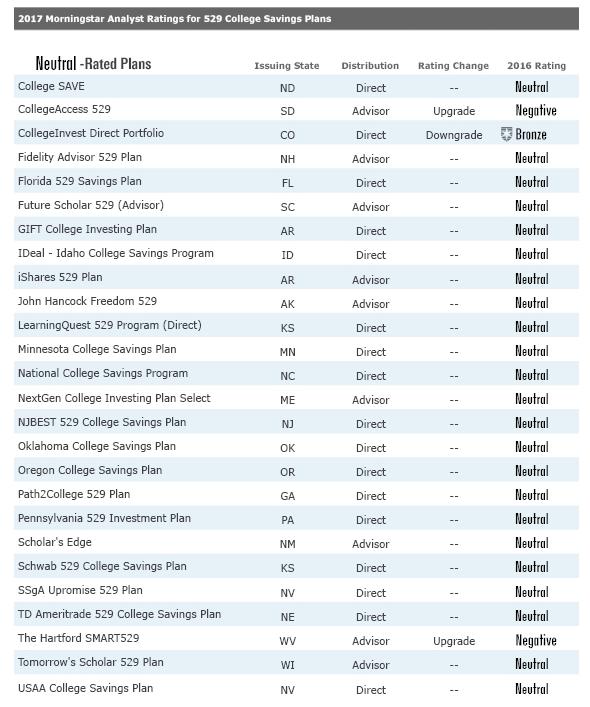
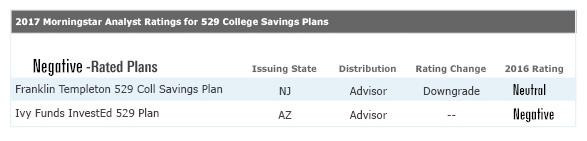
Source: Morningstar.com.
Discussion
FREE REPORT

Richard Shaw from AZ posted over 7 years ago:
GEORGE C from VA posted about 1 year ago:
JEAN H from IL posted about 1 year ago:
You need to log in as a registered AAII user before commenting.
Log InCreate an account