

AAII Survey: It’s More Uncomfortable Talking About Money Than Weight
by Wayne A. Thorp | March 11, 2019
Wayne Thorp recently spoke at the AAII Investor Conference 360. Video replays of all sessions are available for purchase. Go to www.aaii.com/investorconference for more details.

For many Americans, money is not a topic that’s openly talked about. Many were brought up to believe that openly discussing money matters isn’t something that’s done in “polite society.” In fact, some are so willing to avoid the uncomfortable discussion of money that they’d prefer another awkward subject: Their weight.
In its 2017 Money Matters report, investing app Acorns surveyed more than 3,000 Americans between the ages of 18 and 44. When asked, “Would you rather talk about how much you weigh or how much you have in savings?” Sixty-eight percent (68%) chose their weight.
AAII Weekly Survey Question
After reading about this survey, I was curious to see if the opinion of our readers differed. So last week’s survey question asked:
When talking with friends, would you rather share how much you weigh or how much money you have saved?
Here are the results:
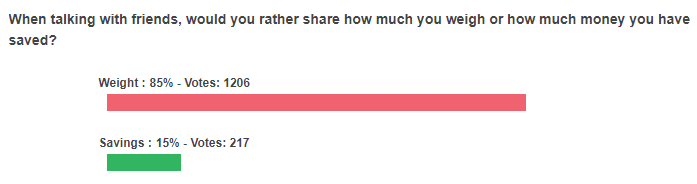
In all, 1,423 votes were cast.
By more than a five-to-one margin, our readers would rather talk about their weight with friends than how much they have in their savings (85% versus 15%).
Weekly Special Question
If you were to walk into my office, you would find bookshelves overflowing with investing texts. For me, two books that have had a significant impact on my investment style are “The Intelligent Investor” by Benjamin Graham and “Investing at Level3” by James Cloonan, the founder of AAII. Graham’s teachings helped mold me into the value-oriented investor I am today, while Jim added to my faith in the value philosophy with the AAII Model Shadow Stock Portfolio. Jim also provided a practical investment framework in Level3 that can be used by beginning and seasoned investors and offered a unique definition of risk that is missing in today’s investment curriculum.
Almost every investor I have met over the last 20-plus years has one or two investment texts that have played a key role in shaping the type of investor they are. To drill deeper into this topic, last week’s special follow-up question asked:
Which one investment text has had the biggest impact on your investment philosophy and why?
In all, we received 141 responses.
I was very happy to see that the book that was referenced the most was Dr. Cloonan’s “Investing at Level3.” It is a testament to Jim’s straightforward, no-nonsense approach to investing and his ability to distill complex topics into actional investment techniques.
In close second place is “anything by John Bogle,” the founder of The Vanguard Group who passed away earlier this year. As an active investor, I don’t agree with Jack’s belief that active investing is a “fool’s errand,” but I wholeheartedly agree with his stance on low-cost investing and the importance of knowing how much you are paying in fees and expenses.
Rounding out the top three, it was also encouraging to see that our members rate the AAII Journal as an investment text that has had the biggest impact on their investment philosophy.
Some of the other top vote-getters include:
-
“The Intelligent Investor,” Benjamin Graham
-
“A Random Walk Down Wall Street,” Burton Malkiel
-
“One Up on Wall Street,” Peter Lynch
-
Warren Buffett’s Annual Shareholder Letters
Here is a sampling of what our readers have to say about the texts that have had the biggest impact on their investment philosophy:
- “‘The trick is not to learn to trust your gut feelings, but rather to discipline yourself to ignore them. Stand by your stocks as long as the fundamental story of the company hasn’t changed.’ ~Peter Lynch. The first book on investing I ever read was Peter Lynch; this quote has just resonated with me. Keeps me from the FOMO (fear of missing out) aspect of investing and [helps me handle] the dips that happen to most every stock at some point.”
- “‘Dividends Don’t Lie: Finding Value in Blue-Chip Stocks’ by Geraldine Weiss and Janet Lowe. It’s a strategy that I can do while I am working because it is slow moving. It’s also a strategy that yields cash and helps monetize my portfolio for retirement income. It also works, as 50 years of history shows.”
- “James Cloonan’s ‘Investing at Level3.’ I have been an active investor for over 40 years. While I believe (and have succeeded) that I can beat the market, the result has not been that great. Now that I am retired and have the financial means to cover living expenses, there are other higher priorities competing for my time. Cloonan’s definition of risk is a game changer: Risk should not be equated with volatility. Risk is the possibility that the assets we expected to have for consumption will not be there when we need them.”
- “‘Thinking Fast and Slow’ by Kahneman & Tversky. Not typically thought of as an ‘investment text,’ perhaps, but it is all about human thought processes and human errors. To invest ‘correctly’ requires defining MY goals (the measure of success) and then performing over the investment time horizon the actions and non-actions that have the highest probability of getting closest to the defined measure of success. Knowing how to identify, account for and correct or short-stop my flaws and errors allows me the best control for the ‘dependent variable’ I can most affect: my own judgment and actions.”
- “‘How to Buy Stocks’ by Louis Engel. It was the first book about investing that I ever read, and he explained exactly what each type of stock and bond was and why they are used.”
Everybody has an opinion! Why not give us yours? Participate in our weekly member poll, updated every Monday, and see the results online at www.aaii.com/memberquestion.
Discussion
No comments have been added yet. Add your thoughts to the discussion!
You need to log in as a registered AAII user before commenting.
Create an account