

AAII Survey: Did Your Career Match Your College Degree?
by Wayne A. Thorp | April 01, 2019
Wayne Thorp recently spoke at the AAII Investor Conference 360. Video replays of all sessions are available for purchase. Go to www.aaii.com/investorconference for more details.

My entire 22-year professional career has been in finance, which is what I studied at DePaul University here in Chicago. However, over the years I have met a lot of people whose career has very little to do with what they studied in college. I have a friend who went to college to study performing arts and ended up in education and couldn’t be happier. I’ve known others who have pivoted to real estate from such diverse backgrounds as engineering and literature.
AAII Weekly Survey Question
Just because you study something doesn’t automatically mean that is what your career with be in. To get an idea of the paths our readers took to their careers, last week’s survey question asked:
Is/was your college major related to your career?
Here are the results:
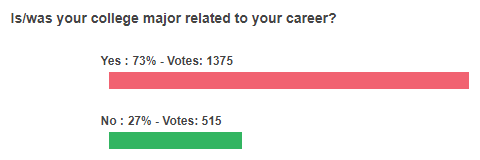
In all, 1,890 readers participated.
Nearly three-quarters of those participating (73%) say that their career is related to what they studied in college with 27% saying that their college education is unrelated to their career.
Weekly Special Question
While the vast majority of those participating in last week’s survey went into a career related to what they studied in college, more than one-quarter ended up working in a field unrelated to their college major.
To learn more about what led them down that career path, last week’s special question asked:
If you ended up in a career you believe is considerably different from what you studied in college, what led you down that path?
In all, we received 176 responses.
The main reason for our readers to end up in a career that was different than what they studied in college was for better or higher-paying job opportunities, limited employment options in their original field of study or better job security or quality of life in a different field (35%).
Ten percent of our readers say they either started in a field that was different from their area of study and stayed with it because they enjoyed it, or they changed careers after discovering they didn’t enjoy working in the field in which they studied.
Another 8% of respondents say that the military ultimately led them to their career choice.
Here is a sampling of the responses as to why our readers ended up in a career that was different from what they studied at college:
- “I began my career in IT and then graduated college attending night and weekend classes in business management. The company where I began my career had an aptitude test and an open position, which I filled following the testing.”
- “Limited employment options steered me into a different field and I ultimately went back to school to earn a master’s degree in that field.”
- “While I have a degree in mechanical engineering, my 40-year career was as an insurance agent. My immature reason at the time was that the first job provided a new car as part of the job. But, no regrets.”
- “I needed a job! The one I was offered was not in my field of study. It turned into a career path and was much more interesting than the one that I studied for my degree.”
- “I was going to college for for mechanical engineering and working in retail. I ended up going into retail management and did not finish college. It was a choice to start earning versus going into debt by going to school. I am retired now and do not regret anything.”
- “Majoring in art seemed like a great thing to do in 1970—follow your passion and all that. Several years later, the whole starving artist idea wasn’t as appealing. My wife and I both changed our professions. She went back to school and became a physical therapist assistant and I apprenticed as a commercial electrician.”
Everybody has an opinion! Why not give us yours? Participate in our weekly member poll, updated every Monday, and see the results online at www.aaii.com/memberquestion.
Discussion
No comments have been added yet. Add your thoughts to the discussion!
You need to log in as a registered AAII user before commenting.
Create an account