

AAII Survey: How Are Investors Preparing for Cognitive Decline?
by Wayne A. Thorp | July 29, 2019
Wayne Thorp recently spoke at the AAII Investor Conference 360. Video replays of all sessions are available for purchase. Go to www.aaii.com/investorconference for more details.

Cognitive decline is becoming an increasingly significant part of Americans’ lives, along with the massive impact it can have on families’ finances. According to the Alzheimer’s Association, 5.7 million Americans are living with Alzheimer’s disease, a figure that is expected to reach 14 million by 2050.
The impact on families’ finances is not only due to increased medical expenses but also because those with dementia may make financial missteps and are at increased risk of becoming targets of fraud and abuse. A recent survey from RBC Wealth Management found that one in 10 (11%) either knows or suspects that their loved one has been a victim of financial abuse. This figure rises to 30% among those with a family member they care for who has been diagnosed with dementia. In addition, 45% of total respondents cite “being taken advantage of” as a concern for their own retirement.
AAII Weekly Survey Question
Given the numbers from the RBC survey, we were curious if our members were taking steps to safeguard themselves and their finances from possible cognitive decline.
So last week’s member question asked:
Do you have a plan in place to protect your finances for if or when your decision-making becomes dinished due to cognitive decline?
Here are the results:
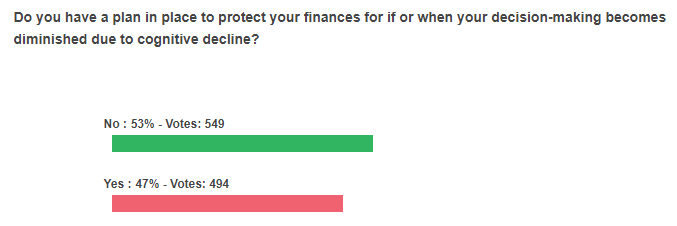
In all, 1,043 readers participated. The relatively low number of respondents makes us wonder if this is an uncomfortable topic for many to consider or discuss.
Slightly more than half of those answering (53%) say they do not have a plan in place to protect their finances if they experience cognitive decline. This means that a large number of our readers are open to losses related to financial missteps or elder abuse.
Weekly Special Question
While the majority of readers do not have a plan in place to protect their finances in the event thatthey experience cognitive decline, we were curious to know what steps those with a plan have taken.
So last week’s special question asked:
What steps have you taken to protect your finances in the event of your cognitive decline?
In all, we received 208 responses.
Of those responding to the special question, roughly 15% say they have not taken any steps to protect their finances from cognitive decline.
Among those who stated they do have a plan, more than one-quarter (28%) say they have spoken with their family or spouse and have made arrangements.
Another 24% say they have granted someone power of attorney over their finances in the event that they experience cognitive decline.
Slightly more than 16% of those with a plan say that they have hired a professional financial planner or investment firm to oversee their finances and almost 15% say that they have set up a trust.
Here is a sampling of the responses from our readers as to what steps they have taken to protect their finances in the event of their cognitive decline:
- “I’ve written down my objectives, my strategy and my decision-making process for my investments—and shared these with my most likely heir (my spouse).”
- “I’ve begun studying this future probability of cognitive decline and reviewing possible proactive paths.”
- “I’ve realized that I need to begin evaluating younger and healthier potential financial custodians, as none of the major institutional ones appear to be better than marginally competent.”
- “Assets placed in a revocable trust with me as trustee. Follow-on trustee is given power of attorney to determine my mental competency to manage funds and take over if necessary before my demise.”
- “Review our monthly financial position with spouse to insure detailed knowledge transfer.”
Everybody has an opinion! Why not give us yours? Participate in our weekly member poll, updated every Monday, and see the results online at www.aaii.com/memberquestion.
Discussion
No comments have been added yet. Add your thoughts to the discussion!
You need to log in as a registered AAII user before commenting.
Create an account