

AAII Survey: Majority of Members Opposed to Recent Interest Rate Cut
by AAII Staff | August 13, 2019

The long-anticipated interest rate cut occurred recently. Federal Reserve chairman Jerome Powell announced a 25-basis-point reduction in the federal interest rate benchmark. The federal funds rate is down to 2.00% – 2.25% now, and the Fed announced that it will be reducing its balance sheet starting in August, two months earlier than anticipated.
We have seen much volatility in the market lately. Tariffs, currency devaluations and rate cuts spurred sell-offs market wide. There is no telling where the consensus of the market is heading. Last week, we polled our members on what they thought of the recent cuts by asking:
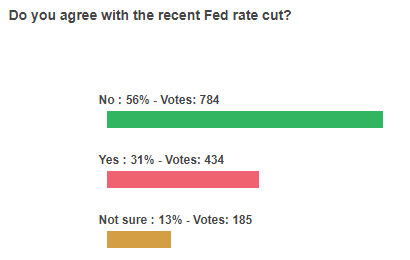
Here are the results:
In total, 1,403 members participated in the survey.
A bit more than half of the participants stated that they did not agree with the recent Fed rate cut. On the opposite side of the spectrum, 31% of participants sided in favor of the recent cut. In the middle, we found that 13% of participants were indifferent or unsure with what they thought about the Fed lowering interest rates.
Weekly Special Question
For much of 2019, stocks have rallied on expectations that the Federal Reserve would cut interest rates. The Dow hit a record high in July but lost its streak after the rate cut; in addition, U.S. and China trade disputes worsened.
Looking at trends, the market volatility that we are seeing may be an indication of where the economy is heading. Some believe that a sell-off such as the one that we are seeing after recent news will help sustain our bull market for a longer period of time. However, speculators see the recent cut as a triggering effect for a recession or larger correction that is to come.
Interest rate cuts did not solely cause volatility in the market. Rate cuts play a large part in the way we spend our money, invest our money, and even how we refinance the mortgages on our houses. Interest rates affect us all, whether we like it or not. With such a controversial topic, it only made sense to ask our members what they thought of the rate cut in more detail:
Why do you agree or disagree with the cut?
In total, we received 310 responses. Responses came in all different shapes and sizes.
Political pressure and influence were mentioned by 25% of our responses. Many members stated that they disagree with the rate cut because President Trump along with other political powers had constantly berated the Fed and chairman Powell for not providing additional juice to the economy.
Twenty percent of responses stated that they disagree with the cut as the economy was fine without lowering interest rates. Coinciding with that, 15% of responses believed the Fed should not have cut interest rates in the current bull market as the they will have less power/leverage in the future if the economy takes a turn.
Twelve percent of members believe that the Fed rate cut was to ease the trade war with China and dampen the effect of tariffs on the U.S.
Some other stances that our members took on the interest rate cut include:
- Geopolitical/global economic competition pressure
- Cuts leading to the next recession
- Providing a stimulus for the economy
Below you will find a sampling of some of the unique responses that our members left us regarding the interest rate cut:
- “It was wrong and Powell knows it but apparently, he is afraid of Trump.”
- “The economy is doing just fine without the rate cut, it should be saved for when it is really needed.”
- “The root of our economic woes is our trade war with China. We need to address this problem directly and stop the trade war.”
- “The economy remains strong. No need to panic.”
What should we ask our members next week? Send suggestions to mrejdak@aaii.com if you have a relevant topic for our members.
Discussion
Steven Turiano from NY posted over 7 years ago:
Isn't the bond inversion a result of simple forces of supply and demand? Too much money chasing too few assets, desperate for a relatively safe place where one can earn at least some return on investment. If the Fed cuts short-term rates yet again, the problem will become worse, not better: lower short term rates won't magically make long term bonds less attractive. We are heading for negative rates, just like Europe, a morass from which it will be difficult to extricate ourselves without a major crash across all asset levels: a drop in demand will be necessary to raise bond prices. Bonds, stocks, real estate ... all are overpriced. Making money for investment even cheaper will pour fuel on the fire, not put it out.
You need to log in as a registered AAII user before commenting.
Create an account