

AAII Survey: How Long Will Social Security Be Available in Retirement?
by AAII Staff | August 26, 2019

Living in the U.S. for most adults means having to be employed. We work in order to sustain ourselves and our families and to enjoy ourselves in the proper work-life balance. What we do not always think about in the background is that a portion of our paychecks goes to the Social Security fund to provide retirement benefits.
A demographical problem is facing Social Security. Americans are having fewer children and living longer, which contributes to an aging population. As we age, there will be fewer people putting money into the Social Security system and more people taking money out. In essence, the worker-to-beneficiary ratio is shrinking.
Most of us will retire one day. However, there is uncertainty as to whether the funds that we have contributed to Social Security will be available when it is our turn to cash out benefits. We asked our members what they thought:
Do you expect Social Security to be a source of income for your entire retirement?
Here were the results:
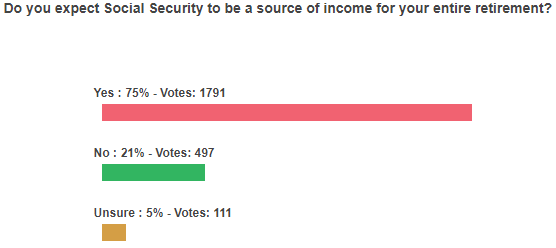
In total, 2,399 members participated in the survey.
Three-quarters (75%) of participants stated that they believe the Social Security program will be a source of income for their entire retirement. Twenty-one percent of participants believe Social Security will be unable to provide them a source of income for their entire retirement. Five percent of participants were unsure.
Weekly Special Question
The Social Security program is funded through the Federal Insurance Contributions Act (FICA) tax, a dedicated payroll tax. You and your employer each pay 6.2% of your wages, up to a taxable maximum of $132,900 (in 2019). Social Security is financed through this activity and any surplus that is not paid out in benefits is used to buy U.S. government bonds held in the Social Security Trust Fund.
Because of factors such as the worker-to-beneficiary ratio shrinking, it has been estimated that all of the money in the Social Security fund will be exhausted by 2035. At that point, it would only have 77% of what it should pay out that year. If you’re in your 40s or 50s today, you may not be able to receive Social Security benefits during retirement.
This is the worst-case scenario. The fund is nowhere near bankruptcy and has roughly 15 years to act before funds are completely depleted. Increased taxes, benefit cuts and upping the age at which people can start collecting benefits are all changes that could be implemented to make up any future shortfalls.
We followed our poll by asking our members what they thought should be done in order to ensure the sustainability of Social Security:
What kind of changes, if necessary, do you think should be made to ensure the sustainability of Social Security?
In total, we received 566 responses. Most responses were in the same pool.
Thirty-three percent of responders agreed that the eligibility age for Social Security benefits should be increased. Twenty-four percent believe that the income subject to Social Security taxes should be increased. Additionally, 18% believe that the cap on income subject to Social Security taxing should be removed completely and that all income should be taxed.
Some other stances that our members took included:
- More government regulation and laws for adequate funding
- Less government involvement in Social Security program
- Find different means of funding than just payroll
Below is a palette of responses that our members left us:
- “Remove the Social Security tax cap completely—or at a minimum, raise it to $250,000 to keep pace with inflation.”
- “Extend starting age to 70.”
- “Quit stealing the money.”
- “Increase retirement age, clamp down and prosecute those that are collecting Supplemental Security Income (SSI) and are perfectly able to work but just choose not to.”
What should we ask our members next week? Send suggestions to mrejdak@aaii.com if you believe you have a relevant topic for our members.
Discussion
Donald Myers from Arizona posted over 7 years ago:
There shouldn't be any question of whether SS benefits will continue in full. There should not be any discussion of cutting benefits nor further increases in the eligibility age. The gap between the maximum salary for paying SS taxes and the compensation packages for CEO's (ranging from $20 million/yr to $60 million is simply too great. As for a decrease in the number of workers contributing to SS it is necessary to ask why that is; difficulty of raising a family on one income, cost of medical care, cost of child care, loss of good paying jobs, far too many families living below the poverty line. As for the benefits, the minimum benefit is too low.
Charlie from Confusion posted over 7 years ago:
Social Security ought to be run like an insurance policy NOT an entitlement. When you pay your home owner's policy, you don't expect to get back your premium. It goes into a "risk pool" to pay for when someone else's (or your) house burns down. This is how insurance works, it pays out when people have something bad happen. Social Security ought to be a SAFETY NET to make sure nobody is destitute upon retirement, old age, inability to work, etc. No one should assume that it will take care of them in retirement and not save and invest for their own retirement. We also need to teach basic budgeting and investing in school. Taxes are bad enough but instead of helping us manage money government runs numbers games and takes even more of our money in lotteries promising hopes of millions. The FICA tax now is regressive, it hurts lower wage earners and is capped at a ridiculously low top. There should be NO CAP for the high wage earners - period and it doesn't make sense to tax people at below poverty level who are trying to work, make ends meet, and save. We should not encourage people to rely on SS, we should do the opposite, tell them they should prepare for their own retirement EARLY. There should be a benefit CAP on the wealthy. If, after retirement, your income exceeds some threshold, you should not be allowed to receive ANY SS. Or it could be graduated, based on your other sources of income, up to a limit. Finally, the government should not be allowed to use the trust fund as its piggy bank. All the payroll taxes should be invested so that it grows (this is what insurance companies do). Perhaps there should be some agency or private organization that is trusted to invest the funds rather than how it is managed now. Remember, the money you paid in is long gone. Any benefits being paid out now are being funded by younger people still working. If SS was no longer seen as an entitlement. If people didn't feel compelled to "get their money back" and instead looked at SS as a Safety Net, government could then start doing a better job of designing additional programs for workers to have an incentive to save and invest for their own future. Most people are not looking for handouts and most want to be successful. Why should someone with investments earning them $200,000/year with a $10 million portfolio still be receiving a $40,000 Social Security Benefit? Why should someone in their 20s, making $25,000/year have to pay FICA? Maybe the government ought to give them the option of investing the FICA tax money into their own retirement program. And the employer amount go to SS. Anyone making below this (or some) $25,000 would pay no tax at all. As for retirement age, it's true people are living longer, but not everyone will reach age 70, do they have dependents? If not, those people do not receive any benefit and the pool of people living benefit. There's no free lunch. Even Amazon Prime is not really free shipping, you end up paying for it one way or another. The UPS delivery person does not work for free. Free healthcare, free college, Social Security, Tax Deductible Mortgage Interest - it has to be funded in some way. We need to rid ourselves of the entitlement mentality, whether it be Food Stamps or Social Security. Think about this: IF SS were not an entitlement and more people had incentives to prepare for their own retirement - fewer people would need SS. If fewer people needed it and there were no cap on high earners - it might be possible to actually REDUCE the FICA tax or allow anyone to "opt out" of it as long as they put the money into their own retirement.
Bob from California posted over 7 years ago:
When social security was created in the 1930s the average age that people lived to was 63. That’s a fact. Social security was set up so most people would die before they received it at age 65. People are living a lot longer today. At a minimum the social security age should be raised to 70 or higher based upon the average that people are living to plus a few years.
Bob from California posted over 7 years ago:
When social security was created in the 1930s the average age that people lived to was 63. That’s a fact. Social security was set up so most people would die before they received it at age 65. People are living a lot longer today. At a minimum the social security age should be raised to 70 or higher based upon the average that people are living to plus a few years.
Acarolinensis from Florida posted over 7 years ago:
@Charles from CA: If you have to call SS an entitlement, then SS is not insurance for a loss but an annuity that everyone that paid into it collects on. Also it should not be means tested. Everyone should have skin in the game. Benefits that are means tested are easy to cut to the misery of the poor. Medicaid, food stamps & school lunches are great examples.
Acarolinensis from Florida posted over 7 years ago:
@Bob from California: You are correct about the average. But lately it's rise is slowing and actually falling for the poor. When you are working in agriculture exposed to chemicals or in other low wage, high risk jobs, you life expectancy is significantly reduced. I've personally seen a number of males with stable long-term jobs e.g., mail hauling truck driver for the USPS, die of a heart attack not long after retiring. And I'd bet his life style was very similar to a majority of readers here. So lets not raise the minimum retirement age and punish those who are just barely making it to age 62.
Dick Weber from IA posted over 7 years ago:
Index normal retirement age to longevity. Adjust every five years. When social security started contributions covered 90% of wages. Because higher wages have rising faster than lower income wages it now is in the lower 80% range. Increasing it back to 90% would increase the maximum amount subject to contributions. It would restore the original intent of the program. Adjust the inflation increase. Cap the increase at the median amount and all above the median receive that amount.
Mike from CT posted over 7 years ago:
FYI, I'm 67 years old. If my SS withholdings had been placed in an account invested in equities, my account would be worth about $1.3 million when I turn 70. This would be more than enough to cover my $3,713 monthly benefit that I should get from SS then. I don't appreciate my SS payment called an "entitlement". It is a retirement income fully paid for by me. The government never should have been allowed to rob the SS Trust Fund to finance annual operations.
You need to log in as a registered AAII user before commenting.
Create an account