

AAII Survey: What Makes Stock Buybacks Good/Bad for the Economy?
by AAII Staff | September 10, 2019

Stock buybacks refer to the repurchasing of shares of stock by the company that issued them. A buyback occurs when the issuing company pays shareholders the market value per share and reabsorbs that portion of its ownership that was previously distributed among public and private investors. In other words, stock buybacks represent a flexible way of returning money to shareholders. However, does reducing the number of outstanding shares always prove to be beneficial?
We asked our members what they thought of corporate stock buybacks in terms of the economy by asking:
Are corporate stock buybacks good for the economy?
Here are the results:
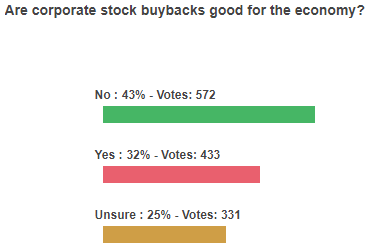
1,336 members participated in this survey.
For the most part, the results were evenly distributed. Forty-three percent of those who participated believe that stock buybacks are not a good thing for the economy. Thirty-two percent said they are good for the economy. Twenty-five percent of readers were unsure how they felt about corporate stock buybacks.
Follow-Up Special Question
One school of thought is that stock buybacks are a positive because reducing the number of shares in the market will increase earnings per share (EPS) on the remaining shares, which benefits shareholders. Most of the time, corporations buy back shares when they believe their stock is undervalued. This creates a level of support for the stock that can be highly beneficial during recessionary periods or during market corrections.
On the other hand, stock buybacks could be viewed as a negative. For example, a corporation may repurchase shares in order to boost its earnings per share without increasing its earnings or doing anything to becoming financially stronger. This could give an artificial lift to the stock and mask financial problems. Another controversial aspect of buybacks is that company executives might take advantage of the practice in order to benefit themselves with stock option programs.
With two ways of looking at the matter, we followed up our poll with:
What makes stock buybacks good/bad for the economy?
We received 232 responses. The majority sees buybacks as a negative for the economy, but the reasons were diverse.
Thirty-six percent of members believe that stock buybacks have a negative effect on the economy because the practice only benefits C-Suite executives and not shareholders.
Twenty-six percent of members see buybacks as bad for the economy as they ultimately lead to an economic slowdown but feel that these repurchases are good for investors—both executives and shareholders.
Seventeen percent of respondents indicated that there is no relationship between corporate stock buybacks and the economy.
Some of the main reasons cited by our members for why stock corporate buybacks are a negative include:
- Inflationary effect on economy
- Cash on-hand could be used better
- Mask poor performance
Here is a sampling of the responses we received to the follow-up special question:
- “It has nothing to do with the economy. A buyback merely concentrates the worth of a company into fewer shares.”
- “It is only helping the corporate executives. I would rather see the dividends increased.”
- “Creating value for shareholders is ultimately positive for the economy. If a company wishes to buyback its own stock, it is doing so because it believes that it’s the best way to allocate capital.”
- “Stock buybacks are good for the investor, not the economy.”
What should we ask our members next? Send suggestions to jsherman@aaii.com if you believe you have a relevant topic for our members.
Discussion
No comments have been added yet. Add your thoughts to the discussion!
You need to log in as a registered AAII user before commenting.
Create an account