

AAII Survey: How Do Members Diversify?
by AAII Staff | September 24, 2019

Diversification is spreading your risk across different types of investments, the goal being to increase your odds of investment success. Most investment professionals agree that, although it does not guarantee against loss, diversification is one of the most important components of reaching long-range financial goals while minimizing risk. While everyone has a goal of less portfolio volatility, the approaches to diversifying vary far and wide. With few people having the same strategy, we wanted to gauge the range of diversification and what approaches are being taking.
We asked our members how much diversification is considered in their portfolio by asking:
How many different asset classes are you currently invested in?
Here are the results:
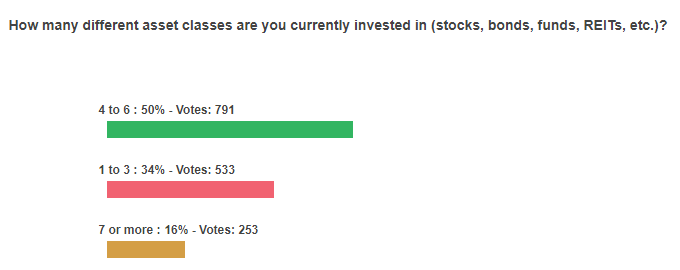
1,577 members participated in this survey.
Fifty percent of those who participated said they are invested in four to six different asset classes. Thirty-four percent said they are invested in only one to three different asset classes. Only 16% of respondents said that they hold seven or more asset classes.
Follow-Up Special Question
Although a fair percentage of people said that they invest in multiple asset classes, there is no fool-proof approach to perfect diversification. Factors like age, occupation, marital status and investment experience are just some of the considerations that lead to differences among diversification strategies.
While diversification can limit exposure to any one type of asset, more diversification does not equate to better portfolio performance. For many nearing retirement age, diversification can take a back seat to short-term profitability as their needs change. Investing in a wide variety of asset classes isn’t for everyone, and just because your portfolio may not follow a certain approach to diversify does not mean that your portfolio won’t perform well.
If you follow a specific diversification approach, the chances are slim that your strategy mirrors someone you know. We aimed to find out what strategy, if any, investors use to diversify.
We followed up our poll with:
What specific approach, if any, do you take to diversify among asset classes?
We received 155 responses. A majority (46% percent) said that they developed a personal strategy over time and follow a percentage allocation approach that is periodically updated. Among this group of respondents, answers with specific percentage allocations were extremely mixed, showing that even though a majority have a diversification plan, their definitions of what the correct approach is for them was far from a consensus.
Twenty-four percent of members said that they follow no specific approach to diversification and rather choose to focus on the market.
Fourteen percent of members said that diversification was considered at times in their portfolio. However, these respondents stated that profitability was more important to them in the short term.
Finally, 15% of respondents indicated that they consulted with their advisers to develop a diversification approach that was right for them.
Here is a sampling of the responses we received to the follow-up special question:
- “I don’t have a predetermined formula for diversification among asset classes. I follow the markets and adjust my positions to maximize my returns.”
- “I have four buckets based on risk. Large percentage in low-risk index funds, smaller percentage in dividend stocks and real estate and smallest allocation in high-risk growth stocks with potential for outsized gains.”
- “Being a senior, I take a cautious approach to investing and prefer to diversify with the help of my adviser; it has worked out well.”
- “None really. Just try to watch what is happening and try to stay informed on current events and issues.”
What should we ask our members next? Send suggestions to jsherman@aaii.com if you believe you have a relevant topic for our members.
Discussion
No comments have been added yet. Add your thoughts to the discussion!
You need to log in as a registered AAII user before commenting.
Create an account