

AAII Survey: How Do Members Decide When to Start Taking Social Security?
by AAII Staff | October 08, 2019

When to start receiving Social Security retirement benefits is a key question for your retirement plan. You can elect to take benefits as early as age 62 (or earlier if you are a survivor of another Social Security claimant or on disability), or wait until as late as age 70. While there’s no “correct” claiming age for everyone, many believe that if you can afford to wait, starting Social Security later than age 62 can pay off over a long retirement. Those who choose to wait longer than 62 argue the longer you wait, the higher your monthly checks will be. The trade-off, though, is that the longer you delay, the fewer checks you’ll receive over your lifetime. On the other hand, those who choose to claim their Social Security sooner rather than later argue that they are looking to collect for as long as possible. With everyone having different opinions on what the “right” age is to start collecting benefits, we looked to gauge what approach our members use and why.
We asked our members about their approach on retirement and applying for Social Security benefits by asking:
At what age did you start taking Social Security benefits, or plan to start?
Here are the results:
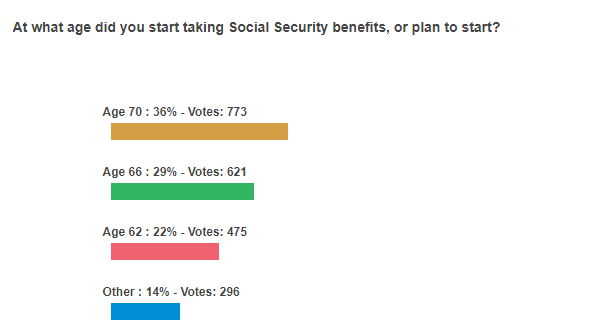
2,165 members participated in this survey.
The results were divided. Thirty-six percent said they started or plan to start taking Social Security benefits at age 70. Twenty-nine percent of those who participated said they waited until age 66, and 22% said that they started claiming benefits as soon as possible at age 62. Additionally, 14% of respondents said that they claimed benefits before 62 or after 70.
Follow-Up Special Question
As we can see, the answer is not the same for everyone and deciding when to start collecting Social Security is ultimately a personal decision based on your individual and family circumstances. There are advantages and drawbacks to claiming at various ages, so determining when to take benefits can be challenging.
If you claim early, you’ll get your money sooner, but your monthly payments will be smaller as a result. If you claim at “full retirement age” (age 65 for those born before 1938, gradually rising to 67 for those born in 1960 or later), you won’t face a reduction in benefits, but you have to be prepared to wait. And if you file after full retirement age, you’ll boost your benefits, but you’ll wait even longer to see them hit your bank account.
Factors like Medicare eligibility, amount of savings you have, health or whether you plan to work in retirement are all major influencers on when you decide to claim your benefits. It’s important to consider your own situation and how claiming those benefits earlier or later will affect your income in retirement. With this poll, we aimed to find out what influenced our members’ decisions as to what age they started or intend to start claiming Social Security.
We followed up our poll with:
What factors led/will lead to your decision as to when to start receiving Social Security benefits?
We received over 500 responses. The results, as expected, were extremely split. We narrow the results down to five major factors that impacted when members decided to start claiming Social Security. The largest influencing factor (26%) said that they wanted to maximize the tax benefits and increased monthly payments by claiming later in life; a majority within this group also stated that they had enough saved to delay claiming benefits. Additionally, 17% of respondents said that they wanted to ensure spousal benefit maximization.
Health and longevity risk were also commonly named as influencing factors, with 24% of respondents naming health as a major deciding factor. Twenty percent of respondents said that their ability or desire to work was important in their decision-making.
Finally, 13% of members surveyed stated that the uncertainty of future Social Security funding influenced their decision on when to start claiming benefits.
Here is a sampling of the responses we received to the follow-up special question:
- “I was working until 69½, so it made sense to hold off until 70. Furthermore, the advantage of an additional 8% in benefits for each year of waiting was a strong incentive.”
- “I started collecting Social Security at 62, I didn’t need the money for expenses, so every month I invested all of it in stocks. Now at 71 I have a fabulous portfolio generating about $2,000 per month in dividends. I am very happy with my outcome!”
- “Family history and two heart attacks at ages 54 and 55, led me to believe that I would not make it to 65. Well I am now 81, but I still think the decision was the right on.”
- “Fear that my benefits would be reduced due to budget constraints or asset tests.”
- “One of the most important factors for me was the fact that by waiting until age 70, my wife’s survivor benefits would be the highest possible.”
What should we ask our members next? Send suggestions to jsherman@aaii.com if you believe you have a relevant topic for our members.
Discussion
Jerry from NV posted over 6 years ago:
I took SS at age 64. My calculations showed I would need to live to age 84 before I would start recovering the money I passed up between age 64 and 70.
Mary from TX posted over 6 years ago:
It is difficult to find info re. how to coordinate benefit taking time when you are married and of different ages. I have been getting bits and pieces from different commentators on this issue. Of course, there is a bright line if you were born after 1/1/54, that threw a monkey wrench into many married persons' retirement plans. The other issue is that if you are married to someone who is the same age or close in age or younger who is the higher earner but has not filed for SS because he/she is waiting for 70, and you were born after 1/1/54, you cannot claim spousal benefits, let alone claim your own and switch later. Also, by claiming earlier than your FRA, you will lessen spousal benefits, even if your spouse has already claimed his/hers. I wish someone would address the various permutations and combinations, assuming everything else is equal (decent health, etc.) Supposedly there is some sort of non-SSA benefit calculator online that is supposed to help, but if that calculator requires entering personal info, I would be wary. Would love for AAII to tackle this issue.
Mike from WI posted over 6 years ago:
Our financial advisor determined that my wife and I were in a position to retire at age 66 (our birthdates are 3-months apart). She recommended that my wife take her full Social Security benefits; whereas, I filed for "restricted" benefits. We're both exceedingly happy to finally have the freedom to do the things we truly enjoy (e.g.; running, weight training, inline skating, kayaking, etc.), whenever we want to, including spending quality time with our adult children and our grandchildren (ages 1-4). Our independent life is truly a godsend.
Larry from Florida posted over 6 years ago:
I turner 70 this past August, but I am still fully employed as a COBOL computer programmer. There was no reason for me to start SS until this past August and I expect much of it to be taxed away until such time as I do retire. That should be in a year or so when my younger wife becomes eligible for Medicare.
You need to log in as a registered AAII user before commenting.
Create an account