

AAII Survey: Are Members Following the Trend to Work Past 65?
by AAII Staff | October 22, 2019

As of February 2019, more than 20% of adults over age 65 are either working or looking for work, compared with 10% in 1985 (according to a report from United Income). The U.S. Census Bureau and the Bureau of Labor Statistics expects the trend of older people working to continue, estimating that 13 million Americans age 65 and older will be in the labor force by 2024. A number of factors including longevity, Social Security and higher wages impact those reaching retirement age in different ways. With expectations of this trend showing no signs of slowing down, we aimed to see how many AAII members are working past retirement age, or plan to do so, and why.
We asked our members about their approach to working past retirement age with the question:
Are you currently working, or do you plan to work, past age 65?
Here are the results:
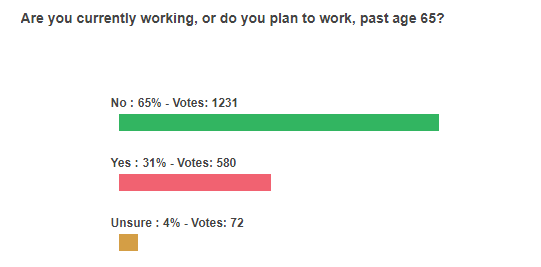
1,883 members participated in this survey.
Sixty-five percent said they are not currently working or planning to work past 65, while 31% of those who participated said they are currently working or plan to work past 65 and 4% said that they are unsure.
Follow-Up Special Question
There are advantages and drawbacks to continue or stop working once you are eligible for retirement, so making the decision can be challenging.
If you continue to work past 65 you have the advantage of more time to save for retirement, increasing Social Security benefits (if you chose to put off collecting) and more social interaction. Those who stop working at 65 have more time to spend with family, travel or pursue interests they have.
Factors like Medicare eligibility, amount of savings you have, and/or health are all major influencers on whether you plan to work in retirement. This week we aimed to find out what influenced our members to continue or stop working when they reached retirement age.
We followed up our poll with:
What factors led you to your decision to continue working, or stop working, after retirement age?
We received 350 responses. The results were very mixed. We grouped responses based on whether they continued or stopped working at 65. In the group that had stopped working before or at age 65, 41% said that they wanted more free time to pursue interests, 34% stated that generous retirement packages were the primary factor in deciding to fully retire and 21% said that unexpected illness/job loss led them to leave the workforce.
In the group of respondents that continued to work past age 65, factors like enjoying the work they do (61%), insufficient savings (24%) and desire to maximize Social Security benefits (16%) were named as motivating factors.
Here is a sampling of the responses we received to the follow-up special question:
- “I was single, had an excellent job, enjoyed the professional work atmosphere and friends, and always enjoyed working—I worked till 76, and just turned 80.”
- “I didn’t continue working at a regular job but spent most of my time volunteering for various nonprofit and/or educational support endeavors.”
- “I’m stopping work next year at age 59. Life is too short to sit at a desk all day.”
- “A desire to contribute to society. I’m 81 and contributing to research on climate.”
- “Did not want to sit at home and rust. I still enjoy my occupation.”
What should we ask our members next? Send suggestions to jsherman@aaii.com if you believe you have a relevant topic for our members.
Discussion
No comments have been added yet. Add your thoughts to the discussion!
You need to log in as a registered AAII user before commenting.
Create an account