

AAII Survey: Is the Structure of the CFPB Unconstitutional?
by AAII Staff | November 05, 2019

The U.S. Consumer Financial Protection Bureau (CFPB) was established in response to the 2008 financial crisis and created by the Dodd-Frank Wall Street Reform and Consumer Protection Act in 2011. The CFPB is an independent bureau funded by the Federal Reserve, tasked with drafting and enforcing regulations for banks, equity markets, credit unions, debt collectors, mortgage lenders, and other entities offering financial goods and services. Since its inception, the question of whether the consumer bureau is too powerful because of its independence from the White House has gained more and more traction. Over the past few weeks, the Supreme Court announced that it will hear a case challenging the constitutionality of the CFPB’s structure.
Although a decision in the case isn’t expected until the end of June 2020, we aimed this week to see what AAII members’ thoughts were on the legality of the bureau:
Do you think the Supreme Court should declare the structure of the CFPB unconstitutional?
Here are the results:
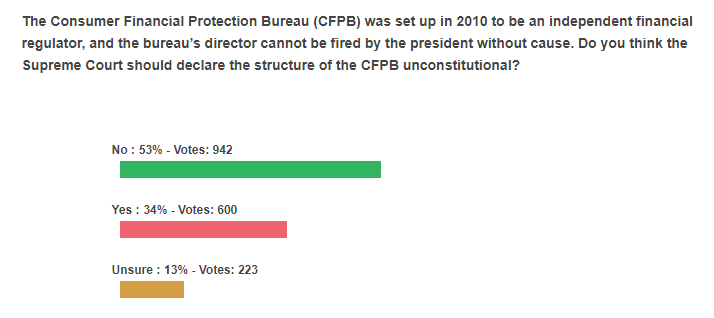
1,765 members participated in this survey.
Although a majority of participants believe that the CFPB’s structure is constitutional, the results were not overwhelming. On the other side of the argument, 34% of those who participated said they believe the Supreme Court should rule the bureau’s structure unconstitutional. Additionally, 13% said that they are unsure.
Follow-Up Special Question
Obviously, there is no clear-cut answer to this issue. Supporters and opponents have various arguments for or against the independence of the CFPB. For example, those in favor of the current structure argue that independence is critical to insulating CFPB enforcement from political influence. The contrary position believes that the CFPB structure vests too much power in an official who isn’t properly accountable to the White House and argues that a president should be able to fire a CFPB director at will. This week we aimed to hear arguments from both sides of the issue.
We followed up our poll with:
Why do you agree or disagree with the impending case before the Supreme Court that challenges the constitutionality of the CFPB’s structure?
We received nearly 300 responses. We grouped responses based on whether they agreed or disagreed with the impending case. In the group that agreed with the case, 65% said that the CFPB should not have unchecked power nor should it only have one director. Thirty-five percent said that the president should have power over the CFPB director to ensure that citizens’ best interests are being taken into consideration.
In the group of respondents that disagreed with the case, factors like independence from political influence and unbiased consumer protection were named as motivating factors.
Here is a sampling of the responses we received to the follow-up special question:
- “How can we all know that the person in this position serves the best interest of the public?”
- “The formation of the CFPB was, in part, an attempt to address the imbalances between the executive and legislative branches. Power has for years accrued to the executive. Giving the power to fire the director of the CFPB only contributes to the existing imbalance. The Constitution envisioned balanced powers.”
- “The CFPB is opposed by big business, including Wall Street.”
- “Because this has been the best effort to date to monitor and regulate dubious business practices of the banks and financial institutions. These same banks and financial parties were the cause of the recession in 2008 … we need protection from the greedy and profit as the only motivation.”
- “The CFPB violates all precedent in that it is virtually immune from oversight by the executive or congressional branches of government.”
What should we ask our members next? Send suggestions to jsherman@aaii.com if you believe you have a relevant topic for our members.
Discussion
Fred from Indiana posted over 6 years ago:
The fact that CFPB is opposed by big business and Wall Street is strong evidence that it is likely to be beneficial to the general public.
Tim from Colorado posted over 6 years ago:
I got a chuckle out of this reasoning (copied from up above): "The contrary position believes that the CFPB structure vests too much power in an official who isn’t properly accountable to the White House and argues that a president should be able to fire a CFPB director at will." Seems to me our current situation is that the White House does not consider Executive Branch folks accountable to anyone! I think the CFPB has some deterrent value re: big business misbehavior. Further, i see nothing wrong with consumers having a voice in their corner that is largely insulated from political pressure. Our democratic tradition thrives with a robust system of checks and balances. While I am a firm believer in a market economy, unbridled capitalism doesn't always get it right.
Ric from PA posted over 6 years ago:
Another government agency that provides a cushy job to unaccountable government employees who can't be fired. Remember all those fake accounts people didn't even know had been opened in their names at Wells Fargo? That happened right under the noses of CFPB agents who had offices in virtually all the branch offices. Now, tell me again why the CFPB is necessary. 'Unbridled capitalism' presumes all trans actions are a win-win because each side acts in its own interest. It is better to have consumers educate and inform themselves in order to act in their own interest rather than have the CFPB relieve them of that responsibility. Belonging to AAII is a factor in accomplishing that.
You need to log in as a registered AAII user before commenting.
Create an account