

AAII Survey: Should E-Commerce Giants Be More Regulated?
by AAII Staff | December 16, 2019

Global e-commerce is growing at an unprecedented pace. In 2017 it reached around $2.3 trillion and is expected to hit $4.5 trillion in 2021 (according to a Statista report). In the U.S. alone, e-commerce represents almost 10% of retail sales—a figure that is growing by nearly 15% each year. In 2018, three retailers represented 61.8% of total online sales. Collectively, Amazon Inc., JD.com Inc. and Vipshop Holdings Ltd. pulled in $264.04 billion in web revenue and showed no signs of slowing down. As retail evolves, the question of how e-commerce giants are changing the global economy has been raised. We aimed this week to see what AAII members’ thoughts were regarding the regulation and impact of e-commerce companies.
We asked our members about their thoughts on e-commerce regulation with the following question:
Do you think there should be stricter regulation of e-commerce giants, given their growing impact on domestic and foreign economies?
Here are the results:
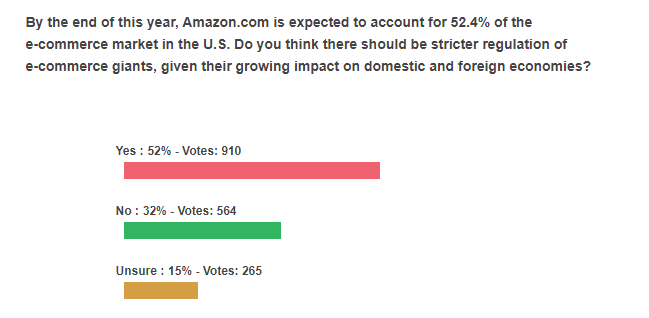
1,739 members participated in this survey.
A majority of respondents favored stricter regulation of e-commerce sites. However, considering that e-commerce giants like Amazon.com act as a platform for many businesses to enter the online marketplace, it’s unsurprising to see that over a third of respondents oppose stricter regulations on such companies. The majority argument is that large online retailers are threatening other businesses, given their control over the market and ability to offer more competitive pricing. Because online retailers have grown exponentially in the past few years, the question of how these large companies should be regulated has come to the fore.
Follow-Up Special Question
You don’t need to be a business expert to know that e-commerce has reshaped the modern marketplace in recent years. While it’s a dominant model, selling goods or services online comes with its own set of advantages and disadvantages compared to traditional brick-and-mortar businesses. We aimed to hear what rationale respondents had for their opposition or support for further regulation of the online retail market.
We followed up our poll with:
What factors led to your opinion on regulation of e-commerce giants?
We received over 350 responses, over a third (37%) stated that regulation should be implemented because of limited competition. On the other hand, 28% of respondents believe that e-commerce regulation is unneeded and that consumers should control the market, not the government. Additionally, 17% of respondents stated that they support e-commerce regulation because of growing information privacy concerns, and 10% believe that e-commerce regulation would threaten companies that create jobs and opportunities throughout the globe. Finally, 8% of respondents stated that they believe that regulation is needed, as e-commerce giants have an unfair tax advantage over competitors.
Here is a sampling of the responses we received to the follow-up special question:
- “A monopoly does not always happen out of evil intent, but when it does happen it will always cause harm. We learn this over and over, usually long after much damage is done.”
- “Don’t like government interference in the free market, but I think that online merchants do have some advantages that local retailers don’t have. And local retailers are in some cases being taxed to support online operations.”
- “One man, Jeff Bezos should not have so much power. Amazon is putting small businesses out of business. Why did the U.S. government break up AT&T but let Amazon take over?”
- “Government should ensure a level playing field but otherwise stay out of private business.”
- “They are big because people are choosing to use them. They have earned their success through a highly effective business model and well-run business. Why should we hurt them by adding additional regulations?”
- “I’m against regulations in principle. I think anti-trust laws may be appropriate though.”
Discussion
Wayne from CA posted over 6 years ago:
The online marketplace is a great example of the efficiency of the free market. Consumers have unlimited choices of what they decide to buy and who they decide to buy from. A business that doesn't satisfy its customers will eventually fail (except those that hide behind government regulations written to favor them.) Government regulation would mainly hurt the smaller businesses due to higher compliance costs relative to their annual income. A monopoly or "Trust" can only exist with the help of government.
Kurt from ID posted over 6 years ago:
I'd bet that people were saying the same things about Sears 100 years ago, and look at them today. What do you suppose the local lumber dealer thought about them shipping out ready-to-build homes? But look at them now. Markets correct their own excesses over time. Where I live, we don't have a Sears, but we do have a local lumber dealer. There's no need to invite in something as corrupt and inefficient as big government to further muck things up.
You need to log in as a registered AAII user before commenting.
Create an account