

AAII Survey: Member Reaction to Retirement Changes in the SECURE Act
by AAII Staff | January 14, 2020

With the start of the New Year come, along with many other things, changes to how Americans can save for retirement. The new Setting Every Community Up for Retirement Enhancement (SECURE) Act—signed into law by President Trump on December 20, 2019—is the broadest piece of retirement legislation passed in 13 years. Some of the changes in the new law include: increasing the age at which required minimum distributions (RMD) must start from age 70½ to age 72 for all retirement accounts subject to RMDs and repealing age-based restrictions on IRA contributions; allowing small businesses to join together to offer their employees access to a retirement plan, like a 401(k); making many part-time employees eligible to contribute to employer-sponsored retirement plans; and getting rid of so-called ‘stretch IRAs’ by requiring anyone other than a spouse or a minor child who inherits an IRA to withdraw all funds from that account within 10 years. As with most bills, opinions are mixed on whether the SECURE Act will affect retirement savers for better or worse. Because so many of these changes are complex and involve long-term financial and tax planning strategies, it is important to consider how the act will impact your overall plan.
We asked our members for their opinions on the changes being made with the following question:
Do you support or oppose the proposed changes made in the SECURE Act?
Here are the results:
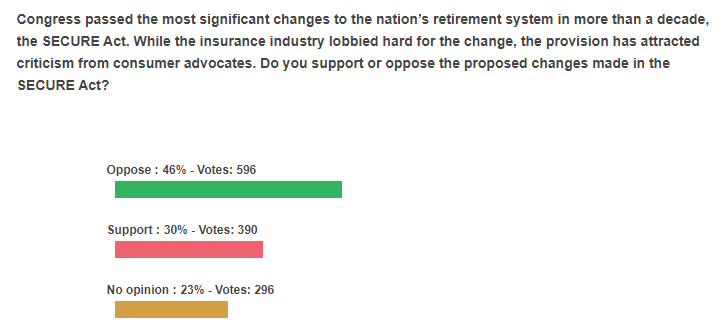
Nearly 1,300 members participated in this survey.
Whether the SECURE Act ends up being a game-changer or not remains to be seen. Nearly half of the respondents oppose the changes made in the SECURE Act. Thirty percent support it, and 23% have no opinion on the new rules. But one thing is abundantly clear: The current rules aren’t allowing nearly enough Americans to put away the nest egg they’ll ultimately need for a secure retirement. The act was passed at the end of 2019, so the changes came under the radar in comparison to other ongoing events. We encourage members to learn more about the act and consult with a trusted adviser about how the new rules might affect your retirement planning.
Follow-Up Special Question
Not all financial advisers/Americans are enamored with the new legislation, and unfortunately politics cannot please everyone. We aimed to hear what our members specifically liked or disliked about the SECURE Act.
We followed up our poll with:
What do you specifically like or dislike about the act (i.e., change to RMD age, IRA beneficiary withdrawal time, etc.)?
Of the 415 responses we received, over 61% of members stated that they are unhappy with the changes made to beneficiary withdrawal times. Many within this group also favored the RMD age being pushed back to 72. Other items that members disliked in the SECURE Act include the introduction of annuities (15%). Many in this group have the opinion that the insurance industry was overly involved in the process and believe that the introduction of annuities will make retirement planning more expensive. A majority of respondents liked select changes but also opposed a number of others. The line between support and opposition was razor thin. If you have any questions or concerns regarding the SECURE Act, we encourage you to learn more about the legislation specifics and reach out to a trusted adviser. Here is a sampling of the responses we received to the follow-up special question:
- “I like that small businesses can create a pool to lower administrative costs on 401(k)s and allow part-time employees to participate. I dislike reducing rules on annuities and allowing people to withdraw $5,000 for adoption. The SECURE Act only made minor changes and benefited insurance companies the most.”
- “Anytime Congress says they are passing a law ‘for our benefit’ look out! The regular citizen is about to be screwed. I do not like the shortened withdrawing times for beneficiaries.”
- “I dislike everything ... too pro-insurance industry and their lobby ... not pro or even neutral for people and their families.”
- “It could have been better, certainly, but the glass is half full, anyway ...”
- “None of the changes will impact me other than possibly the change in withdrawal rate. The changes to inherited IRAs I have mixed feelings about.”
- “Since many people are living longer, deferring RMDs to age 72 versus the current 70½ makes sense. Plus allowing those working to continue to contribute to their IRA past age 70½ also seems like a reasonable change along with the updated/increased IRS life expectancy table. And shortening the non-spouse beneficiary distribution rule from life expectancy table to 10 years— will benefit the incoming $$$ into U.S. Treasury. A nice change in an era of growing debt & deficit spending.”
Discussion
Robert Rogers from MA posted over 6 years ago:
I don't like the Secure act. I am past 80. I was hoping that for people already taking RMDs the life time table would be adjusted. Robert
Warren J Dassau from Florida posted over 6 years ago:
Shortening the distribution rule to 10 years is a disaster that will result in no use of the IRA for many people.
Warren J Dassau from Florida posted over 6 years ago:
Shortening the distribution rule to 10 years is a disaster that will result in no use of the IRA for many people.
Ed McGuire from PA posted over 6 years ago:
Warren, the 10yr distribution rule only applies to certain beneficiaries of IRA's. Yet, I do not like the rule either. If my children inherit my IRA they may be in their peak earning years when they do. They will pay a higher tax rate on the inherited amount no doubt. It would have been more politically correct to have set the Secure Act rules for new accounts opened after the first of this year instead of changing the rules for prior accounts, some of which have been used in wealth-planning for decades? I do like the increase from 70 1/2 to 72 to start taking one's RMD, but would be happier if they eliminated the RMD altogether.
David Caldwell from New Jersey posted over 6 years ago:
I like the change from 70.5 to 72 for my initial RMD because I do not need to withdraw funds until then (at a minimum). I was surprised to learn that the longevity actuary table was not adjusted to reflect longer life spans.
Jose C. Cunha from New Jersey posted over 6 years ago:
Delay in RMDs to 72 is a positive. Reduction of time to withdraw the balance inherited by your heirs is a big negative that completely erases the positive above. The possibility to create an annuity inside your 401K is positive but the fees should have been limited to no more than 1%. I believe this act should have included a mechanism to reduce the tax on 401K withdrawls to a mix of capital gains brackets and regular tax brackets. After all that would make it comparable to how one is taxed prior to beginning withdrawing funds from their 401K in retirement.I believe leaving the tax as is continues to be detrimental to people whom were strong savers while working.
You need to log in as a registered AAII user before commenting.
Create an account