

AAII Survey: How Members Evaluate Economic Risks
by AAII Staff | January 28, 2020

Risk is an unavoidable part of trading. People who succeed in the financial markets are those who know how to manage risks effectively. Risk management starts with understanding the types of risks associated with a security, an industry or the overall market and developing strategies accordingly. On a macro level, economic indicators and other metrics can give investors a sense of where the economy is and where it’s headed in the future, paving the way for an investment strategy that may fit future market conditions.
We asked our members about their approach to risk management with the following question:
Do you use economic indicators or other specific metrics to monitor risk levels in the economy?
Here are the results:
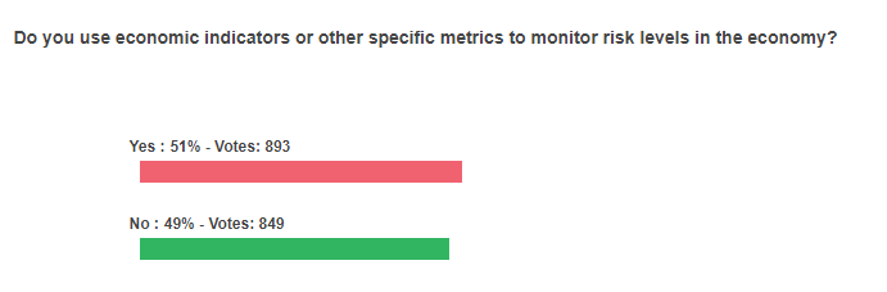
Over 1,740 members participated in this survey.
When it comes to the economic indicators/metrics available, the list is almost endless. One economic indicator follows another, filling an entire calendar with updates that are released weekly, monthly, quarterly and annually. Given this pattern, it’s not surprising that the economic-indicator game seems confusing, and perhaps even pointless. Of the 1,740+ responses we received, 51% stated that they use economic indicators or other specific metrics to monitor risk levels in the economy, while 49% stated that they do not.
Follow-Up Special Question
Interpreting economic indicators and other metrics is not always a simple process. Like picking stocks, it requires knowledge, skill, a detailed understanding of the subject matter and perhaps even a bit of luck. As economists and investors seek better information, many incorporate leading or lagging economic indicators into their investing decisions. Leading indicators often change prior to large economic adjustments and, as such, can be used to predict future trends; unfortunately, leading indicators tend to be significantly more volatile than their lagging counterparts. Unlike leading indicators, lagging indicators shift after the economy changes. Although they do not typically tell us where the economy is headed, they indicate how the economy changes over time and can help identify long-term trends. Within these two categories, there are a wide range of indicators available, so we aimed to hear what our members follow to gauge economic health.
We followed up our poll with:
What economic indicator or metric do you follow and what change in it would cause you to alter your portfolio allocation or strategy?
Of the 250 responses we received, nearly 38% stated that they follow leading economic indicators like housing sales, retail sales and/or stock market changes. A majority in this group stated if the leading indicators fall, they may take a more conservative approach. On the other hand, 35% of respondents stated that they follow lagging economic indicators like unemployment levels, consumer confidence, and/or gross domestic product in order to gauge economic risk. Other metrics that were named in the survey included bond yields (18%) and following the news (5%). Four percent of those polled stated that they do not follow any specific metrics. Although there were a variety of indicators/metrics named in this survey, the general theme of conservatism when indicators have fallen and taking a more aggressive stance when indicators have risen was overwhelmingly widespread regardless of the indicator type. Here is a sampling of the responses we received to the follow-up special question:
- “Fed Ex/USPS/Amazon package deliveries. Our economy is largely consumer based. Where consumers go, so goes the economy.”
- “I follow all reasonable ones that I am exposed to in the news. When they start all heading in the same direction, I pay attention.”
- “I particularly monitor consumer sentiment. I may not alter allocation much, but I will get more conservative in investment decisions when sentiment drops significantly.”
- “I use CNN’s fear-greed index. When it is in the greed range, I usually sell a little, and when it is in the fear range, I usually buy a little.”
- “Leading indicators like housing data/large truck sales. Decreases in these will result in a greater allocation to bonds and cash. Increases in these will result in increased allocation to equities.”
- “No, I don’t use economic indicators because the market is too emotion-driven. Stick with your plan!”
Discussion
No comments have been added yet. Add your thoughts to the discussion!
You need to log in as a registered AAII user before commenting.
Create an account