

AAII Survey: What Investing Profiles AAII Members Follow
by AAII Staff | February 11, 2020

We know that in general it’s critical to be an investor. But depending on various factors, both personal and professional, there many and varied ways in which our money should be invested. Additionally, there are a whole host of outside forces that can put our portfolio at risk, including inflation, stock market fluctuation and an ever-changing economic environment. So how can you make decisions on your portfolio? The first step is to identify what type of investor you are. Are you conservative, looking at safe options for the long run? Maybe moderate is more your style, looking for a balance between security and good returns? Or are you aggressive, focused on change and growth? Each style calls for different strategies and solutions in order to attain corresponding objectives in terms of liquidity, fixed income and growth. Making informed investment decisions entails not only researching individual securities but also understanding your own finances and risk profile. In this week’s digest we aimed to see what risk profiles AAII members fall into.
We asked our members what type of investor they are with the following question:
Which investing profile best fits your portfolio allocation approach?
Here are the results:
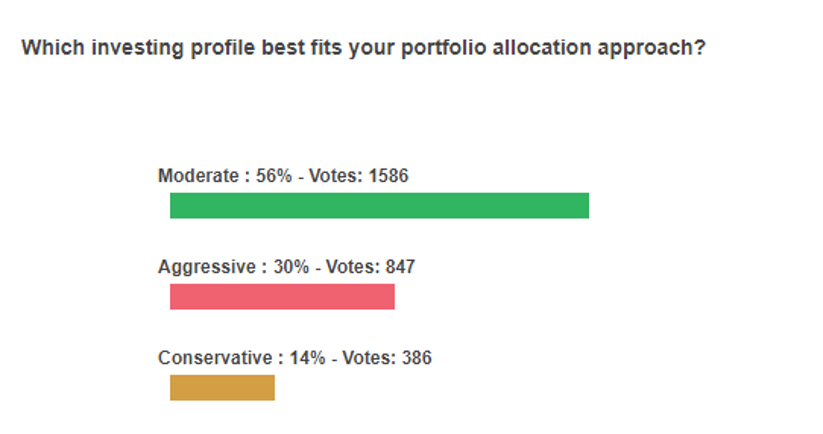
Over 2,800 members participated in this survey.
When it comes to investor profiles, there is no right or wrong. There are no better or worse applications, but rather the right combination of the appropriate application to the appropriate profile. Of the responses we received, 56% stated that they follow a moderate approach and 30% follow an aggressive investing approach. These compare to the 14% of respondents who said that they invest conservatively. Keep in mind that the profiles mentioned here are just the three basic groups; it is possible to find a good fit in between them—for example, as moderately aggressive or moderately conservative.
Follow-Up Special Question
Managing your investments is a lifelong process. The amount of money you invest and the type of investments you choose can ebb and flow as your situation changes. And when you experience a major event, such as a marriage, a divorce, or the loss of an income source, you may want to review your investments and make adjustments. We aimed to see if and how AAII members’ investing profile has changed since they started investing.
We followed up our poll with:
Has your investing profile changed over the years? If yes, how has it changed, and why?
Of the 500+ responses we received, 38% of members stated that their investing profile has become more moderate over time. Many in this group mentioned that a black swan event like the Great Recession or dot-com bust swayed them from taking an overly aggressive approach. Twenty-eight percent of respondents said that they have become more aggressive over the years. A majority in this group stated that limited returns on conservative investments and periods of low interest rates have led them to allocate a larger percentage to equities. On the opposite end, 20% of respondents stated that they have become more risk averse as they approach retirement age. Many in this group stated that they have switched to conservative income investments—like U.S. government bonds, short-term bond funds and dividend-focused stocks—in lieu of growth investments. Finally, 14% of respondents said that their investing profile has not changed over the years. Here is a sampling of the responses we received to the follow-up special question:
- “I have become more aggressive because of the low return on bonds and money instruments. Even though I am into retirement, I keep an aggressive approach, as at the end of the day, the rewards go to my children and grandchildren.”
- “I am 77 years old and I have become much more interested in conserving my money rather than trying to double it like I did when I first retired 21 years ago.”
- “I am able to take a little more risk as I better understand how market behaves after corrections. Thanks to AAII for educating me.”
- “I started very conservative but did not earn much on money invested. Some speculative buys worked out very well, so I became aggressive. Eventually I decided that the risk was not worth it, so now I am moderate, comfortable with it and often do much better than friends who are aggressive.”
- “No, we have maintained a moderate investing approach for the last 20 years, and didn’t change it at retirement.”
Discussion
Dennis Berthold from TEXAS posted over 6 years ago:
I kept my 403(B) as aggressive as possible during my entire academic career, even leaving one company for another when my adviser invested 50% of my monthly contributions without my knowledge or consent. Now that I'm retired I have a 70/30 portfolio that is still aggressive but balanced with savings, muni bonds, and real estate. I am ready to invest more in stocks when the next recession arrives.
You need to log in as a registered AAII user before commenting.
Create an account