

New Site Section Dedicated to Mutual Funds
by AAII Staff | February 24, 2020

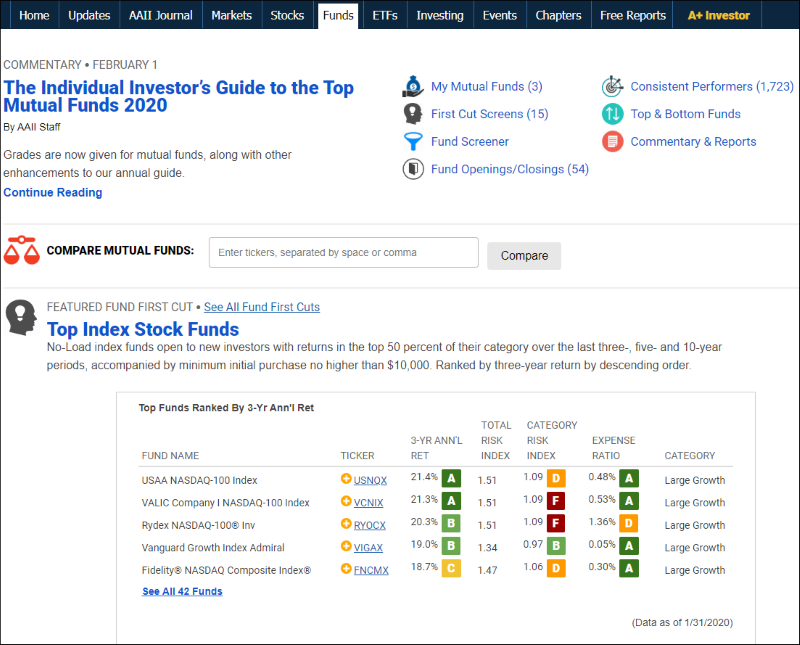
If you haven’t visited AAII.com recently, we’ve added a Funds page link on the navigation bar at the top of the page. Clicking on it takes you to a newly designed page dedicated to the mutual fund resources provided by AAII.
Some new features for mutual fund investors include:
- Featured “First Cut” fund screen
- Consistent performers listing
- Top & bottom fund lists
- Risk-adjusted returns for equity funds
- Performance benchmarks
- Fund openings & closings notices
First Cut Screens
AAII has developed a series of “first cut” screens to help you narrow down the universe of over 25,000 funds in a variety of ways. Members can access the latest passing funds for the featured mutual fund first cut screen, which rotates on the Funds home page regularly.
The First Cut screen shows our new mutual fund grades for a variety of data fields. These grades quickly show how an individual fund stacks up against other funds in the same category on a variety of metrics, including annualized returns, risk and expenses.
From this list (and any mutual fund listing on AAII.com) as well as the Fund Evaluator, you can click on the yellow “+” sign next to any ticker to add that fund to an existing or new portfolio in the new My Portfoliotool.
(If you would like access to all the First Cut screens with daily updates, consider a subscription to A+ Investor.)
Top/Bottom Performing Funds
The Top and Bottom Funds lists show the 100 best and worst-performing mutual funds over the last one, three, five and 10 years, broken down by U.S equity funds, international equity funds, sector equity funds and fixed-income funds. There is a drop-down menu on the right where you can specify a time period.
Consistent Performers
The Consistent Performers lists show mutual funds that have exceeded or fallen short of their category over the last three-, five- and 10-year periods. There is a toggle between all funds and no-load funds. Here too you will find fund grades for the different performance periods and risk, which show how a fund rates relative to others in its category.
The My Funds tab will list any mutual funds you have entered into My Portfolio that fall into high or low performer listings.
Performance Benchmarks
The performance benchmarks table shows returns for major asset and fund groups as well as specific fund categories, updated monthly. Returns cover the year to date, the last three years, five years and 10 years, plus a total risk index figure, yield and expense ratio. A page with returns for a plethora of stock and bond indexes, updated monthly, is also available at this table.
Click on See all to bring up the complete list of benchmarks. The lists are sorted on one-month return by default, but you can adjust that to sort by any of the columns.
Use this comprehensive table to compare your fund returns to appropriate peer groups and indexes.
Equity Risk-Adjusted Returns
One way to produce an easily understood marriage of risk and return for funds is to adjust the fund return for risk so that the return reported for all funds assumes risk is equal to that of the market benchmark. Funds with volatility above the market benchmark will have their returns proportionally lowered, while funds that are less risky (have lower standard deviations than their benchmark) will have their returns adjusted proportionally upward. The result is risk-adjusted return.
The Equity Risk-Adjusted Return table shows all funds sorted by risk-adjusted return. Other figures shown here: market risk index, three-year annual standard deviation and three-year annual average return.
The My Funds tab will show these stats for any mutual funds you have entered into My Portfolio.
Fund Openings and Closings
Keep track of mutual funds that have closed or reopened to investors over the past month. For each fund, see its fund category, fund family and total assets. You can also access the fund’s website from this table.
Discussion
No comments have been added yet. Add your thoughts to the discussion!
You need to log in as a registered AAII user before commenting.
Create an account