

AAII Survey: Top Financial Resolutions for 2020/2021
by AAII Staff | February 25, 2020

Making a New Year’s resolution is a great way to make a positive change in your life, whether it’s going to the gym, waking up earlier or saving your money. An estimated 164 million Americans made resolutions for 2020 at the start of the new year, with an estimated 30% of these resolutions being finance related (according to a survey by Fidelity Investments). However, research indicates that it’s rare that a majority will keep their resolutions for the whole year. According to U.S. News, approximately 80% of resolutions fail by the second week of February. As we passed the “drop-off” point for abandoned resolutions, we aimed to see how many of our members made finance-related resolutions for 2020/2021 and what their plans were for achieving their goals.
We asked our members about their financial goals with the following question:
Are you making any finance-related resolutions for 2020/2021?
Here are the results:
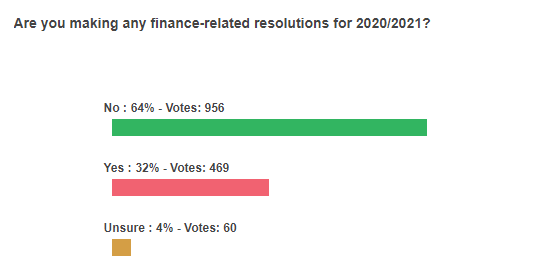
Nearly 1,500 members participated in this survey.
After a successful year, many Americans are optimistic about their finances going into the new decade. Given that the stock market was up 30.8% in 2019 and reached all-time record highs, it makes sense that many people would feel comfortable with their current financial strategies. Of the 1,485 responses we received, 64% stated that they were not planning to make any financial resolutions for this year and next year. This compares to the 32% of respondents who stated they were making finance-related resolutions.
Follow-Up Special Question
Some of the most popular financial resolutions revolve around things like padding a savings account, building a retirement nest egg, or reducing debt. But while making a resolution is one thing, keeping it is another. Regardless of the type of resolution that you set, it’s important to make sure that your goal is specific, measurable and attainable. We aimed to see what specific financial resolutions AAII members are making and how they plan to achieve their goals.
We followed up our poll with:
What specific finance resolutions have you made, and how do you plan to achieve your goals?
Of the 415 responses we received, 41% of members named rebalancing their portfolio as their top resolution for 2020/2021. A number of respondents within this group stated that they want to minimize risk in the coming years and plan to achieve their goals by conducting more thorough analysis of their holdings. The second-most-popular resolution was creating a better budget/increasing savings, which was named by nearly 26% of respondents. Plans to achieve this goal included increasing 401(k) contributions, setting up automatic transfers to a high-yield savings account and cutting back on unnecessary spending. Seventeen percent of respondents want to expand their knowledge of alternative investment options. Plans to achieve this goal included attending investment seminars, reading books/articles and talking to trusted financial advisers. Additionally, 16% of respondents named reducing debt as their top financial resolution in 2020/2021. Methods to achieve this goal included paying more than their minimum car/house payment.
Here is a sampling of the responses we received to the follow-up special question:
- “To invest in more dividend-producing stocks. I use AAII Dividend Investing (DI) as an alternative to my current dividend stocks and when I have enough cash, I purchase shares of some recommendations from DI. I look at which months they produce dividends so that I will receive a steady amount of income each month.”
- “Rearrange my portfolio more conservatively, shedding some stocks and purchasing fixed-income and alternative investments.”
- “Take more action, not just do analysis.”
- “We plan to start a 529 college account for our new grandson, probably not doing the full five-year one-time payment due to the uncertainties influencing the market this year as it hovers around record highs.”
- “Cut spending. Changing cell plans, which reduces monthly costs by 50% on family share plan. Adjusted cable plan to cut costs by 20%. Only one vacation, which overlaps a relative’s wedding.”
Discussion
No comments have been added yet. Add your thoughts to the discussion!
You need to log in as a registered AAII user before commenting.
Create an account