

A Worksheet for Determining How Your Portfolio Is Managed
by Charles Rotblut | July 23, 2020
Charles Rotblut recently spoke at the AAII Investor Conference 360. Video replays of all sessions are available for purchase. Go to www.aaii.com/investorconference for more details.

Once an allocation strategy is decided upon, the next step for an individual investor to take is to decide who is going to be responsible for implementing it and managing the portfolio. For dyed-in-the-wool do-it-yourself (DIY) investors, the answer is obvious: They want to make all of the decisions—including specifically selecting the investments they will hold. Others take comfort in having a professional manage their portfolio—be it a fund manager or even a financial planner. In between, there is a wide spectrum.
The “How Your Portfolio Is Managed” worksheet will help you think through the various considerations. You may view yourself as being a true DIYer, only to realize that your 401(k) requires you to cede some control to mutual fund managers. Alternatively, you may not need a traditional adviser but rather could be comfortable holding index funds and periodically meeting with a fee-only planner.
As you fill it out, realize that the goal is to clarify how your portfolio will be managed.

Here’s an example of how a hypothetical couple, Bob and Jane, would answer the questions. They are recently retired and have a high tolerance for risk. Bob enjoys analyzing stocks and has the time to do so. He doesn’t feel comfortable trying to analyze international or emerging stocks. He also doesn’t want to pick individual bonds and opts to use a fund for them. Jane has always been more comfortable using index funds and suggests they use them to fulfill the international stock and fixed-income portions of their overall allocation. They do not work with a financial planner.
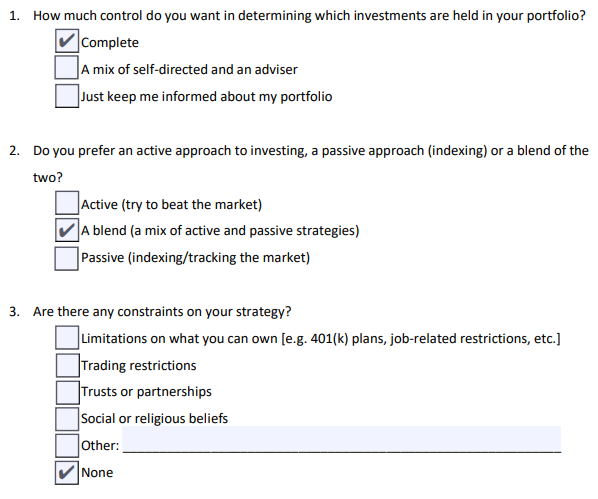
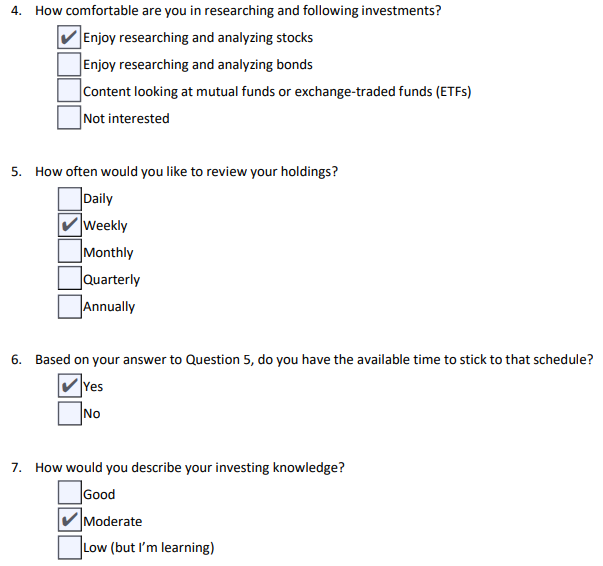
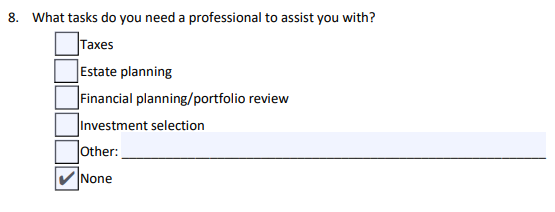
The answers classify Bob and Jane as partially hands-on investors. Bob will select some stocks himself while the couple will use index funds to fill other parts of their portfolio. Their investment plan will therefore include buy and sell rules for both stocks and index funds. It will also list rules for when and how they will review the portfolio since an investment professional is not being utilized.
Discussion
CHRISTIAN S from IN posted over 6 years ago:
I think this is a good start, even though I would probably prefer more detail, especially in the 'researching and following investments' section #4. However, to actually make it useful, the analysis and 'assignment' of investor type should be part of the functionality of the worksheet. Otherwise, you're just giving people options based on a description of type.
JAMES I from UT posted over 6 years ago:
Belated feedback while I play catch-up. I think the worksheet is a good start, but you could consider reformatting it into a Decision Tree that directs folks to particular portfolio management approaches. As a lifetime subscriber and long time investor, I've found the devil to be in the details re some of the questions in this worksheet. Most pointedly Question 6 for me varies wildly depending on what's going on in my life. I've learned that the key to being an active investor is that you CONSISTENTLY devote the committed time. Hope this helps.
RICHARD O from CA posted over 6 years ago:
Spreadsheet is flawed. I click I want complete control in #1 and automatically clicks I want to beat the market in question #2, which is NOT my goal. I want a combination or active and passive strategies which I will manage myself. Need more flexibility in your checklist. Since my wife has an MBA in Finance, if I need any advice I know exactly who I can trust and ask for advice and suggestions! She has always been spot on. After you fill the form in, one can figure out which box you fit to see the descriptions supplied. I am sure Charles recognizes that life is more complicated and this is intended to help us understand roughly where we fit. OK now that we know where we fit, what is next????
DONALD S from TX posted over 6 years ago:
I've been retired for 10 years and have always pretty much managed our investments myself, using AAII and other resources along with many years of experience. As I get older though, another consideration comes into play. I have to think about who will manage the assets for my wife and myself once I am no longer able to. Appropriate arrangements need to be set up in advance so that she and our children do not have to make important decisions with little experience when the time comes.
THOMAS G from CA posted over 5 years ago:
Im like Donald S. At 76, Investment is more of a hobby than a goal or commitment, and that's fun! I guess Im kind of like Sears Roebuck, trying to successfully liquidate an aging company and passing off to the shareholders (the grand kids) a nice dividend, hopefully the last check i write should bounce. So they only have to cover a bad check, and end up with a nice pile to build on, free and clear of these ridiculous estate taxes that penalize your heirs for your success. Im not good at fundamental analysis, but a fair trader, so i only buy and sell what i like with an eye to the charts.
You need to log in as a registered AAII user before commenting.
Create an account