

A Worksheet for Listing All of Your Investment Accounts
by Charles Rotblut | July 30, 2020
Charles Rotblut recently spoke at the AAII Investor Conference 360. Video replays of all sessions are available for purchase. Go to www.aaii.com/investorconference for more details.

This simple worksheet is designed to list all of your investment accounts. It’s pretty straightforward: List where each account is held, the types of assets included in it, any beneficiaries and/or trusted contacts and any relevant notes.

We’ve separated the types of accounts by their characteristics. Traditional IRAs, for instance, are separated from Roth IRAs and inherited IRAs. All three have different rules regarding distributions, among other differences. Plus, grouping accounts with similar characteristics will make it easier for you to identify opportunities for consolidation.
There are several benefits to filling it out. At the very basic level, it’s a very helpful list to include in your estate-planning documents. Having an overview of your accounts will help you identify opportunities for consolidation, tax optimization and expense reductions. It also gives you a broad overview of what you have as you seek to implement your allocation strategy into an actual portfolio.
Here’s an example of how Frank and Sue, a young couple with a three-year-old son, might fill it out.
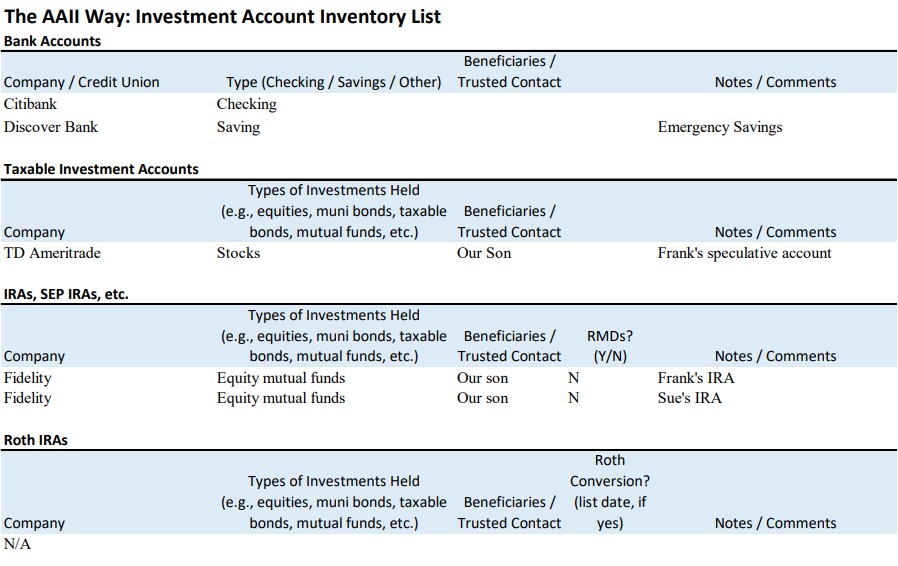
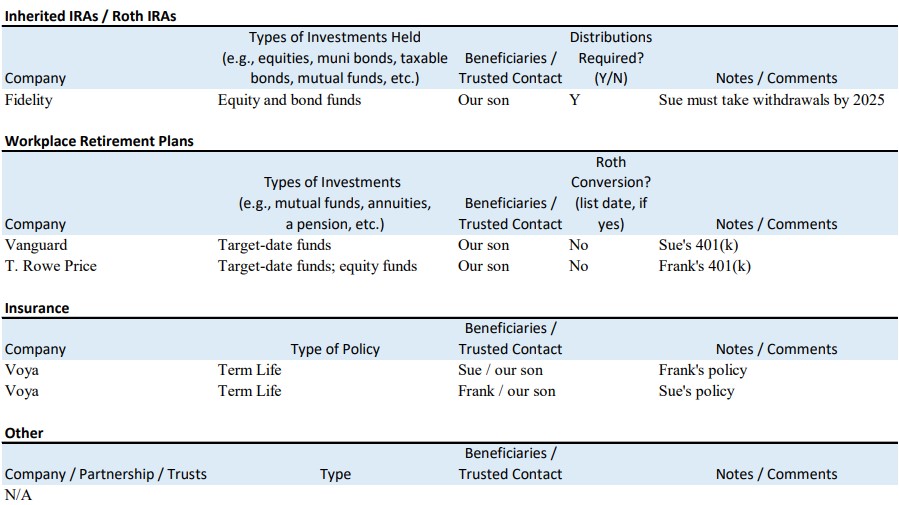
Try the worksheet out and let us know in the comments section how it works for you and what would make it more useful. You can also send us your comments directly. Be sure to download this worksheet and save it your computer. Any information you enter will not be saved on AAII’s servers.
Discussion
Nalin S from MI posted over 6 years ago:
When most of the institutions are using electronic communication in accessing account, believ it will be very useful to include columns for web address,User ID and Passwords. This information is very much needed this days and will be very handy to family members in critical time. Best, Nalin Shah
CHARLES R from IL posted over 6 years ago:
Thanks Nalin. We weren't sure how much personal information members would want to put on the list, but it is a good suggestion.
J M from NJ posted over 6 years ago:
I maintain a inventory of my financial accounts in a spreadsheet which tracks the value of my assets, liabilities, and net worth over time. This document becomes a master list of what we own and what we owe which is annually updated and shared with my spouse in the first quarter of each year. ******** The year end balance / value of each account is recorded in a separate column for each year. I also record the year end ages for each family member and my asset allocation between cash, stocks and bonds for the latest year. This allows me to calculate my overall asset allocation for groups of accounts. ********** I suppose I could group my accounts according to my investment goals but I am retired so generating sufficient retirement income while growing my portfolio is my primary goal. Given that, I subdivide the rows of data into assets, liabilities, and then calculate my net worth at the end. I subdivide the rows of my assets into tax deferred versus non-tax deferred accounts. Tax deferred accounts includes accounts subject to RMDs on which taxes have not been paid. Non-Tax Deferred's accounts include taxable bank and investment accounts and Roth IRA Accounts. Groups of accounts are further subdivided by the account owner name (Joint versus Individual) to assist in estate survivor planning by sub groups of accounts. Liabilities include amounts owed for credit card debt, car, education, family, mortgages, life insurance loans etc. Mortgages balances are recorded in a subsection for tracking the value of real estate owed. I maintain a separate section for tracking the annual retirement income from Social Security, pensions and annuities. I calculate the net present value of each retirement income source based on assumptions for life expectancy and interest rates. I consider the present value of my guaranteed retirement income sources to be part of my bonds asset allocation. However, unlike a bond, the present value of these retirement income sources will decline over time as one approaches their remaining life expectancy. ******** For each account, I record the account name, account number, financial institution where held, name(s) of account owners, beneficiaries, customer service phone number. I list the date of maturity and interest rate for each bond or CD investment.
You need to log in as a registered AAII user before commenting.
Create an account