

Life Stage Changes Checklist
by Charles Rotblut | October 15, 2020
Charles Rotblut recently spoke at the AAII Investor Conference 360. Video replays of all sessions are available for purchase. Go to www.aaii.com/investorconference for more details.

A key part of the portfolio review process is to consider whether your goals and/or tolerance for risk has changed.
Life stage events can lead to such considerations. Celebratory events such as a marriage, a birth or voluntary retirement may change your investing time horizons. Sad events such as the loss of a loved one or a deterioration in health may also impact how you invest.
Significant changes in your wealth should also be considered. A large inheritance, the sale of a business or a period of better-than-anticipated portfolio returns may enable you to financially withstand more volatility. A loss of income, large expenditures or a period of worse-than-anticipated portfolio returns may cause your tolerance for risk to decrease.
The life stage worksheet prompts you to think about what might have changed in your life. If something significant has occurred, we encourage you to go back to the beginning of the Individual Investor Wealth-Building Process and revisit the goals and risk tolerance worksheets to determine if a change in your investing strategy is warranted.

PDF worksheet available for download.

Excel worksheet available for download.
Example: Couple With Newborn
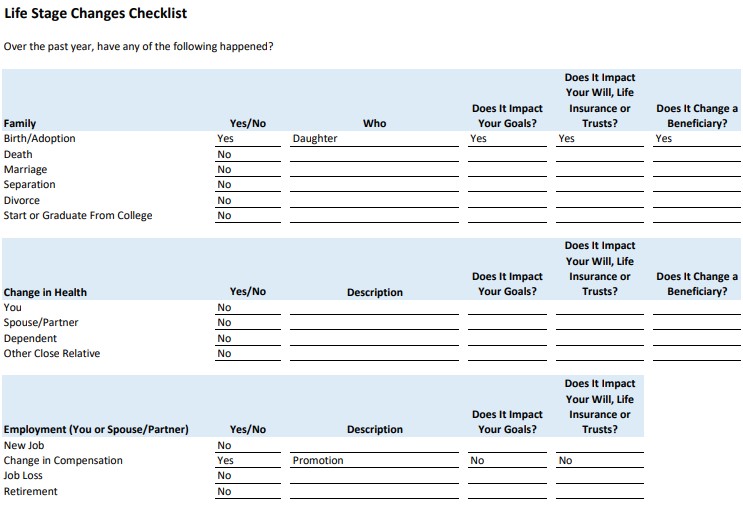
Sue recently gave birth to her second child. Sue’s husband, Frank, was also fortunate to have recently been promoted at work. Given the recent—and happy—events, they decided to go through the life stage change worksheet.
The birth of their daughter changes their investing goals. Rather than saving for one child’s future college expenses, they now must save for two. The couple also notes the need to update their life insurance policies, their wills and their beneficiary designations.
Frank makes note of his promotion. While it increases his salary, it does not impact the couple’s goals—especially because their expenses have also now risen. (Diapers aren’t cheap.)
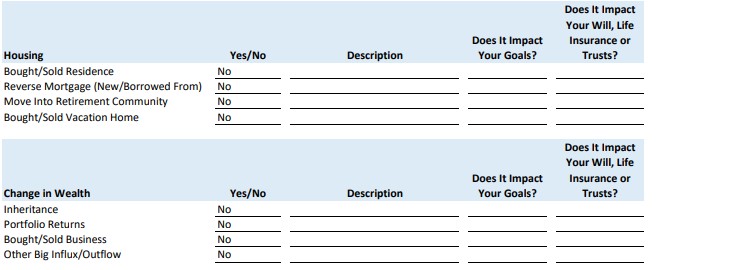
You may notice that most events are marked as “no.” This is typical. The checklist is designed to be a periodic (e.g., annual) prompt for the couple to think about what has changed in their life. Frequently, there will not be a change. But when there is a life stage event, this checklist will remind them to review their investing strategy and update their estate planning documents.
Discussion
No comments have been added yet. Add your thoughts to the discussion!
You need to log in as a registered AAII user before commenting.
Create an account