

Key Estate Planning Information Worksheet
by Charles Rotblut | October 15, 2020
Charles Rotblut recently spoke at the AAII Investor Conference 360. Video replays of all sessions are available for purchase. Go to www.aaii.com/investorconference for more details.

Estate planning is commonly thought of in terms of wills, powers of attorney and trusts. While those documents are important, there is another document everyone should have: an inventory of key estate information.
This document will be invaluable to your spouse and your heirs. It informs them what accounts you have and who the fiduciaries are on each account. It also informs them about the pensions and life insurance policies you may have and the professionals you may work with. Having this information enables them to quickly step in on your behalf.
Because we think this can be a powerful list, we’ve expanded the range of what should be included beyond just financial accounts. Fields for the location of your wills and estate documents are included so your heirs will know where to look. There is a space for doctors in case you should become incapacitated. You’ll also see spots for funeral arrangements, digital accounts, military ID and vehicle titles.
Having all of this information in a single document will be helpful to your spouse and your heirs. It tells them what you have, who they should contact and where to find key documents. In a moment when they are likely to be under duress, this document will alleviate some of their stress and assist them with making the decisions you’d want them to.

PDF worksheet available for download.

Excel worksheet available for download.
Example: Retired Couple With a Son and Daughter
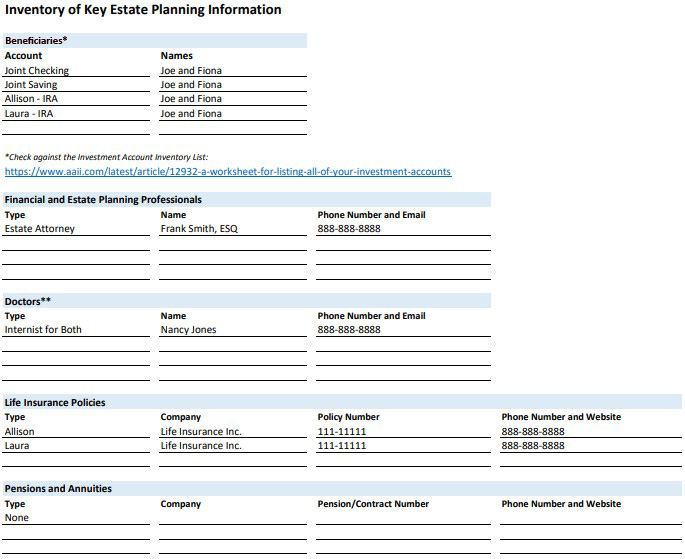
Laura and Allison are a recently retired couple with an adult son and daughter. Neither of their children are married yet. The couple’s savings are held in individual retirement accounts.
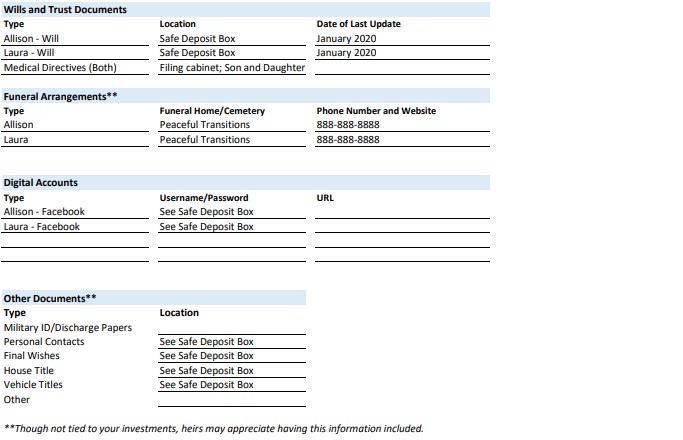
Their estate documents are simple: wills and medical directives. Both children have copies of the medical directives. Laura and Allison’s children are the only designated fiduciaries on their financial accounts and life insurance policies. Key documents are kept in a safe deposit box at a local bank, which the couple’s children can access.
They’ve made funeral arrangements and have the information listed. They’ve also listed their primary doctor and estate attorney in case either child needs to step in on their behalf. (The names and phone numbers are fictional.)
Discussion
JOHN H from TN posted over 5 years ago:
Once the first of the couple dies, the safety deposit box is the WRONG place for a will. The box might be sealed in your state, and the will then becomes unavailable for the heirs, for quite some time. Instead, a fireproof lockbox in your home might be a better solution. When this situation arises, talk over with your attorney the best place to keep your will.
RICHARD P from MD posted over 5 years ago:
Great perspectives - also invaluable to have annual discussions with the selected estate executor and to provide a framework for "letter of instructions to survivors." An internet search on those terms will provide lots of insights and may be a worthy topic for consideration for a future AAII article.
CAROLE T from NY posted over 5 years ago:
Someone mentioned safety deposit boxes being opened at death by outside agencies. To avoid this problem, register the box in the name of a business entity or a trust. The box will not be opened, because the business or trust does not die. Of course, you need to own one of these and provide a secretarial name.
You need to log in as a registered AAII user before commenting.
Create an account