Challenge 1: Establish Your Investing Goals
There is no universal answer to the question of why money is important. Your goals are your goals. Think about them and write them down using the worksheet, Identifying and Prioritizing Your Financial Goals, linked at the end of this article. It will help to organize your thoughts.
As you attempt to define your goals, think about: Why is money important to you? What do you hope to do with the money? Is it money you’re setting aside to fund retirement? Are you hoping to pay for your kids’ or your grandkids’ college education? Would you like to donate to a charity, support your congregation or perhaps buy a second home? Maybe you seek the financial independence money can bring? Alternatively, are you simply seeking to build savings and get out of debt?
For many people, there is more than one answer. A working-age couple could be investing for both their retirement and their children’s education. Retirees may seek to support their lifestyles and leave an inheritance to their family. Millennials who are just starting out may be balancing college debt with the need to start setting aside something for retirement, even though the latter is decades away.
There is no universal answer to the question of why money is important. Your goals are your goals. Think about them and write them down using the worksheet. It may even be helpful to add comments by certain goals, such as what would need to happen for you to reach them. (The comments field on the worksheet was added based on a suggestion from an AAII member.)
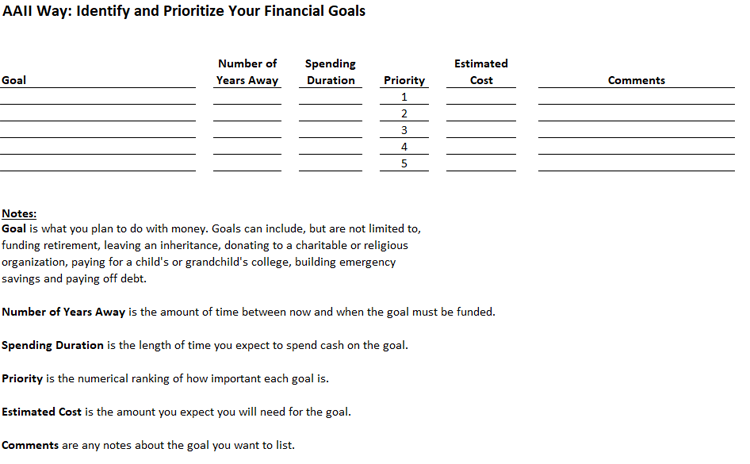
In addition to the comments field, you’ll notice a column on the worksheet labeled “number of years away.” This is the amount of time between now and when the goal must be funded. The “spending duration” column is the length of time you expect to spend cash on the goal. Priority is a numerical ranking of the importance of each goal. Only one goal can be a top priority, only one can be a second priority, etc.
Example: Retired Couple
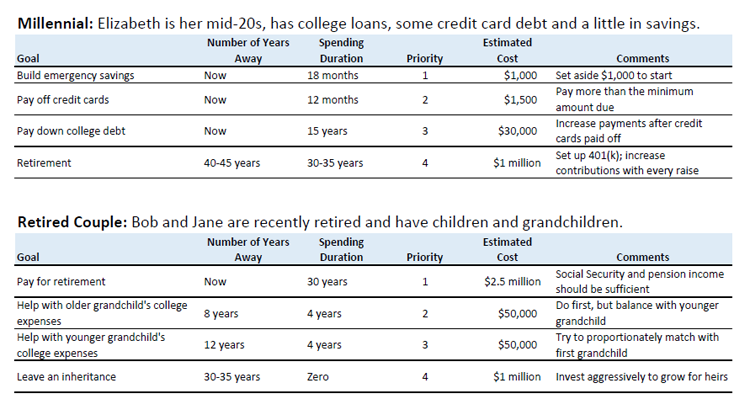
Consider a hypothetical couple, Bob and Jane. Ensuring that they have enough to live on and pay for potentially three or more decades of expenses is their top goal. So, the number of years away is “now” and the spending duration is the remainder of their estimated life-spans. (Bob and Jane should err on the side of projecting longer-than-expected life-spans when putting an estimate here.)
Though they may wish to both help out their family and leave an inheritance, these goals are a lower priority and should be ranked as such. Bob and Jane should still list their other goals separately, such as helping to pay for their grandkids’ college expenses and leaving an inheritance for their heirs. The former would have an easily definable number of years away (18 minus each grandchild’s age) and spending duration (e.g., four years). The latter, inheritance, would have an estimate for “number of years away” based on their projected life-spans and a spending duration of “zero,” unless there was a trust set up to prevent heirs from withdrawing everything at once.
Now let’s add a little additional color by assuming the couple is fortunate to be affluent and have both pension and Social Security benefits. This wouldn’t change the priority of their goals, but it may alter the comments they write by each goal. See this example worksheet filled out below.
Example: Millennial
Liz is in her mid-20s. She has college loans, some credit card debt and a little in savings. Her employer offers a match on contributions to her 401(k) retirement plan.
Her top goals would be to build up emergency savings and pay down her credit card debt. Liz would put “now” under the number of years away for both. Under spending duration, she should put the estimated time it would take to build up adequate savings ($1,000 would be a start, with a longer goal of setting aside $10,000) and, separately, the estimated time to pay off her credit card debt.
Both are high priorities. Emergency savings would prevent having to rely on credit cards for unexpected expenses. Paying down credit card debt reduces the high level of interest being charged every month. Liz should favor building up emergency savings over paying down credit card debt because the former would help her to avoid getting into even more credit card debt. Nonetheless, she should pay as much above the minimum amount on her credit cards each month as her budget allows.
The next priority for Liz would be paying off her college loans, with “now” for the number of years away and a spending duration equal to her estimated payoff period.
Saving for retirement would rank as the fourth priority. It would be 40–45 years away, with a spending duration of 30–35 years, which is an estimate of how many years she would live in retirement. Even though this is the fourth priority, Liz should still seek to start saving for it now, given the employer match and her young age. This would even be the case if her contributions aren’t as large as she’d like because of the priority given to her other goals.
Bob and Jane, as well as Liz, may find themselves balancing goals with desires. The reason for ranking goals is to define what must take priority if push comes to shove. Identifying your goals and assigning priorities to them forces you to think about why money is important and helps you to better determine your financial tolerance for risk. If Liz had no debt, she could assume a high level of market risk for any savings beyond what is set aside to cover emergencies.
Conversely, if Bob and Jane were unsure about whether their nest egg is large enough to fund their retirement, inheritance should not factor into their portfolio plans.
As you progress with the Individual Investor Wealth-Building Process, you will see how this exercise has a big influence on the investing decisions you should make.