Challenge 2: Determine Your Tolerance for Risk
A strategy is only as good as your ability to stick with it. This is why we think it is important to define what your personal tolerance for risk is.
We believe there are a few factors that determine your tolerance for risk. They are:
-
the timing of when you will need the money to spend on your goal;
-
the period in which you anticipate spending money on the goal;
-
how much money you need relative to your wealth once the goal is reached (and the first few years afterward, if the goal
-
does not require a lump-sum payment);
-
your psychological ability to cope with up and down markets; and
-
your knowledge of investing.
We’ve included investing knowledge in this list because familiarity with the characteristics of investments and market cycles helps an investor to be less reactive to shorter-term fluctuations in asset prices.
The worksheet linked at the end of this article, which incorporates feedback from AAII members, is divided into two parts. The first part addresses the timing of the goal. The second part helps you to assess your psychological and financial tolerance. The answer to each question has a score associated with it. Simply enter the appropriate score in the boxes next to each question and add up your scores for each part at the end.
You will use scores to choose an allocation that is appropriate for you and one that you are more likely to stick with whenever downside volatility strikes.
Here’s an example of how a hypothetical couple might fill it out.
Affluent but a Bit Unnerved by Volatile Markets
Bob and Jane are recently retired (both age 66) and have $1.5 million in savings. They have non-portfolio income from pensions and Social Security.
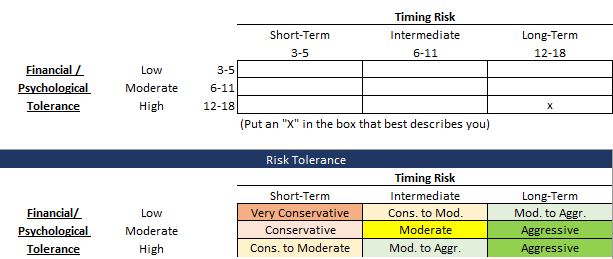
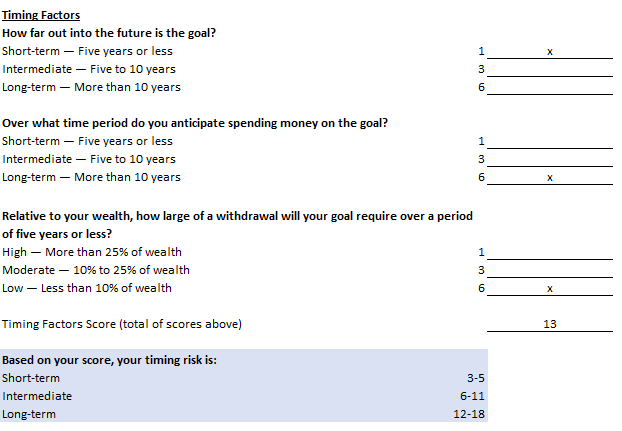
The timing of their goal is “now” because they’re retired. Given that they are in their mid-60s, their spending time horizon is long. Bob and Jane’s wealth allows them to take proportionately small withdrawals relative to their savings. Combined, these factors result in a long-term timing risk score.
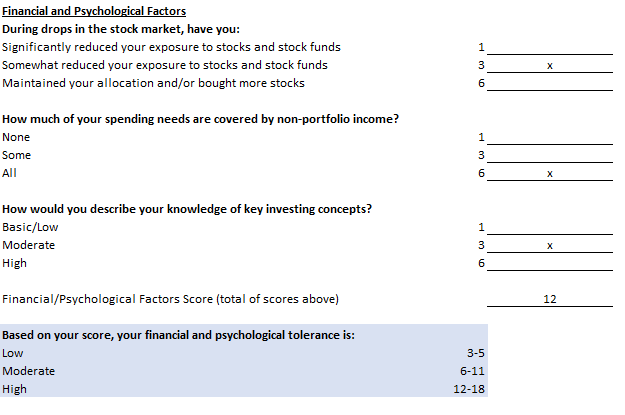
Bob and Jane are fairly disciplined investors but have gotten a bit nervous during past bear markets and pulled back a little bit on their equity allocations. They have a guaranteed stream of non-portfolio income. They have a good understanding of investing concepts but are not experts. These factors result in a high financial/psychological tolerance score, though albeit at the lower end of the range for this category. If they had less non-portfolio income, their tolerance score would be moderate.
The combination of their timing risk and financial/psychological tolerance suggests that they can use an aggressive allocation strategy (one designed to seek long-term growth). Their wealth and the presence of a pension are big reasons why.