The American Association of Individual Investors is an independent nonprofit corporation formed in 1978 for the purpose of assisting individuals in becoming effective managers of their own assets through programs of education, information and research.
With the right education and information, most individual investors are fully capable of becoming effective managers of their own assets.
No special talent is required to become a successful investor, only a bit of dedication and access to effective investment education that provides a framework for intelligent investment decisions.
You, the individual investor, have a distinct set of advantages that can help you outpace the market and most brokers, investment banks and institutional investors. You can move quickly (or slowly), invest in a wider range of opportunities and can tailor your portfolio more effectively. If you take investing seriously, you can do better than professional money managers. After all, no one takes your money more seriously than yourself.
By following the guidelines below, you can improve the likelihood of achieving good investment returns:
Large institutions cannot effectively invest in the stocks of smaller companies or in less liquid issues, and these are the stocks that have performed best over the long run.
Consider your time horizon when making investments. What is best for the short term may not be best for the long term.
Don't buy common stocks with money you feel you will need in less than five years. Markets go up and down and you don't want to be forced to sell in a down market.
Don't invest all of your wealth in the stock market. Unexpected events may require that you dip into your savings. Taking money out of the stock market at the wrong time can seriously impair your long-term strategy. Maintaining reserves in cash, cash equivalents (e.g., CDs) and short-term bonds can help you withstand most bear markets.
Maintain a diversified portfolio, with no fewer than 10 stocks in it. You are better off with 10 aggressive growth stocks than one blue-chip stock. If you have less than $15,000, diversify through mutual funds or exchange-traded funds (ETFs). If you don't have a diversified portfolio, you are either throwing away return or taking on risk that can be avoided.
Consider transaction costs when selecting your investment approach. Frequently buying and selling is costly and detrimental to your returns.
No single method of evaluating investment opportunities has proven to be successful all of the time.
Don't move a substantial portion of your wealth into or out of the market at one time. Ease in, ease out.
Adjust your portfolio periodically to ensure your allocations do not drift too far off target and no single stock accounts for too large a portion of your overall portfolio.
If you find yourself nervous, don't make any portfolio decisions. Rather, take a break and then revisit your portfolio. The times you may most feel like getting out of stocks are often the best times to be buying.
Planning is the secret to success, and starting early is key.
Dr. James B. Cloonan felt the need for an independent, nonprofit association that would help individuals control their own destinies. So in 1978, he launched the American Association of Individual Investors (AAII) with the mission of assisting individuals in becoming effective managers of their own assets through programs of education, information and research. The best investment advice for small investors is to do it yourself. Dr. Cloonan understood that you are going to do a better job of watching your own money than someone else.
Even then, many pundits expressed doubts that individuals stood any chance in succeeding, with big institutions controlling the market. However, AAII was founded with the belief that with the right education and information, most individual investors are fully capable of becoming effective managers of their own assets. The investment environment was very different when AAII began over 35 years ago. Investment information did not flow easily. Research involved a trip to the library to study a company's "tear sheet" and sending a letter to a company to request an annual report. Investor education for the individual investor was very limited. Fixed-brokerage commissions had just recently been stricken, freeing "mayday" brokers to compete on price and spurring the era of active individual investors.
Nowadays, investors are inundated with greater investment options as well as the faster flow of more data, often leading to paralysis. Today, more than ever, investors need basic education on developing a sound framework to manage their investments and build their wealth.
AAII has educated over two million investors and continues to help them develop their "investment philosophy" based on individual objectives. This is accomplished by illustrating how to evaluate different investment vehicles and opportunities, showing how to obtain necessary information for effective decision making, and even informing investors how various investments relate to each other within the economic climate.
The American Association of Individual Investors was created with the clear understanding that individual investors have unique investment needs and possess a number of advantages over institutions. Dr. Cloonan continues to believe that if you take investing seriously, you can do better than professional money managers. It is important for individual investors to play to their strengths, perform appropriate research, take a long-term perspective and not get caught up in the emotions of the market. The individual investor has a distinct advantage over the institution in terms of flexibility. They can move quickly, have wider range of opportunities and can tailor their portfolio more effectively. The size of institutions prevents them from investing a large proportion of the stocks available to the individual investor. Individual investors have only themselves to answer to. It must be noted that these are potential advantages for the individual. Many investors use their freedom to engage in investment activities that are not sound. Since its inception, AAII has been providing its members with education, information and research so they can realize their full potential and not get ensnared by Wall Street's traps.
The American Association of Individual Investors publishes the premier issue of the AAII Journal. The AAII Journal continues to provide a solid base of knowledge and information to individual investors, combining the best theoretical and practical approaches, all from unbiased sources. The focus is on real-world articles geared toward investors making important financial decisions. Topics include how to build and manage your investment portfolio; reading and understanding financial data; how to analyze and select stocks, bonds, mutual funds and exchange-traded funds (ETFs); setting up financial and retirement plans; managing your portfolio while retired; the top investment websites.
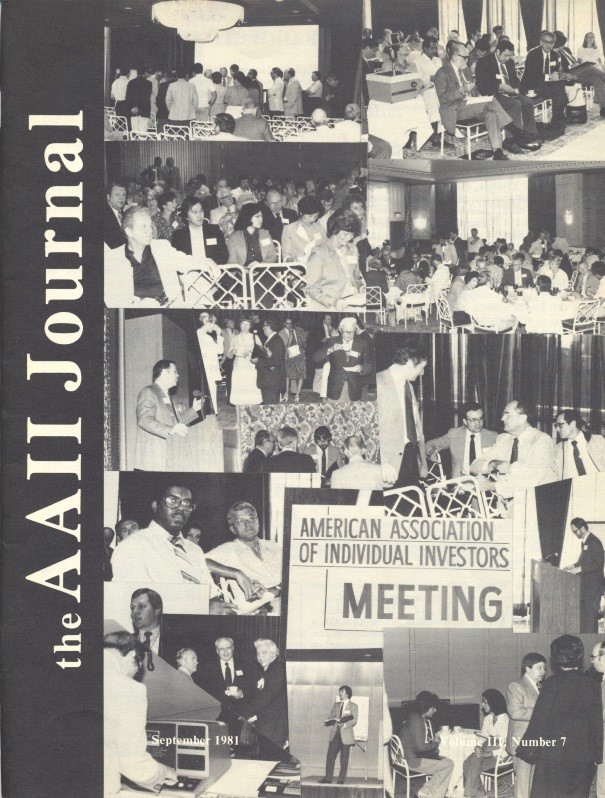
AAII holds its first national investor conference in Chicago. The conference brings together individual investors looking for hands-on education and the opportunity to interact with each other. The meeting had separate tracks for the beginning and the more sophisticated investor. Topics covered during the first conference included computer-assisted investing, the mathematics of investing, fundamental stock evaluation, estate planning, commodity trading, metals and collectibles, real estate investing, stock options and market outlook and evaluation.

James Cloonan finishes the first release of "A Lifetime Strategy for Investing in Common Stocks." Cloonan has expanded and updated this guide over the years and it remains a cornerstone publication of AAII. The guide advances the argument for a well-diversified, long-term, buy-and-hold portfolio that is principally invested in common stocks or common stock mutual funds. This is a must for beginning investors and can help re-establish priorities for practiced investors.
Initial group of AAII Local Chapters is formed with chapters in Boston, Chicago, Cincinnati, Los Angeles, Miami, Milwaukee, New York, San Francisco and Tampa.
Local chapters allow AAII to extend its mission of investment education "person to person" to individual investors in their own communities. Chapters are grassroots organizations, administered locally by volunteer AAII members. These elected leaders develop the local organization with guidance from AAII. This "bottom up" structure helps ensure that local organizations are in tune with the financial climate of a chapter's area and are responsive to the interests of the AAII members who live there.
Chapter meetings are informative gatherings that complement the educational publications, products and services offered by AAII. A typical chapter meeting features an investment professional's view of a timely financial topic. Following the presentation, members participate in the meeting through a question-and-answer session with the speaker, which helps them to evaluate the speaker's information in the context of their own financial situations. The opportunity to meet new friends and exchange ideas routinely tops the list of members' answers to the question, "Why do you come to chapter meetings?"
The AAII expands its investment research program to include a guide book on the performance of no-load mutual funds. This mutual fund guide book is provided free to all members, sold to the public, and has been updated annually.
AAII begins its Computerized Investing publication, targeted at individual investors wanting to learn how to utilize computers, investment software and databases to assist in their personal investing.
James Cloonan, in his AAII Journal opinion column, coins the phrase "shadow stocks" to refer to micro-cap stocks that are not well researched by professional analysts and may be mispriced due to market inefficiencies. Shadow stocks illustrate just one way that AAII turns academic research into actionable strategies suitable for individual investors.
AAII starts sponsorship of annual research awards presented to academic research papers that furthers the understanding of investments.
The AAII Journal begins offering investors how-to education articles that explain an investing technique accompanied with the creation of a quantitative stock screen. John Markese authored the Investor Workshop article series on how the screens were created and run. The Apple IIe computer and S&P's Stockpak II system were first used to illustrate the screening process.
AAII begins polling a random sample of its members to measure the sentiment of the individual investor on a weekly basis. The AAII Investor Sentiment Survey measures the percentage of individual investors who are bullish, bearish, and neutral on the stock market for the next six months.
AAII begins polling a random sample of its members to obtain a snapshot of how individual investors are dividing their investments among stocks, bonds and cash. The AAII Asset Allocation Survey polls members monthly on their current holdings.
AAII introduces the Quarterly Low-Load Mutual Fund Update that allows investors to easily keep tabs on the funds they own or are considering. The publication, website and downloads allows investors to see if a fund has done better or worse than its peer group for the most recent quarter, year-to-date, three years and five years. Over 1,000 no-load and low-load mutual funds are covered. Funds are grouped by category for easy evaluation and comparison. The major stock and bond index returns are reported so investors can judge funds by an appropriate market benchmark. The Quarterly Update also informs investors of any recent changes, such as a new portfolio manager, a fund name change or fee levied.
AAII introduces Stock Investor, a software program and database that allows users to screen through a universe of 7,000 stocks listed on the New York Stock Exchange, the NASDAQ, and the American Stock Exchange. The program brings sophisticated stock research, analysis and screening on the full range of U.S. publicly traded companies into the hands of the individual investor.
Stock Investor allows individual investors to research individual stocks and provides industry figures for comparison. Users can combine data fields into custom data fields and reference data fields when building stock filters. Users are also able to export data for further analysis in spreadsheet programs. Stock Investor was offered through a quarterly subscription that was priced at $99 for AAII members and $150 for non-members, making sophisticated analysis possible for the individual investor.
AAII launches its first website. AAII.com is created with a goal of providing a dynamic site that offers investors an educational resource, on on-line investment community to exchange knowledge, and a software library. The site offers a complete archive of AAII Journal articles dating back to 1991. Articles are grouped into eight educational areas:
| ·Investing Basics ·Investing Basics ·Financial Planning ·Stocks ·Mutual Funds |
·Fixed-Income ·Other Investments ·Broker Issues ·Portfolio Management |
The website included a message board, collections of frequently asked questions, and glossaries of investment terms.
A Computerized Investing section of the website offered current and past issues, news on developments in investment software and services, a software demo download library and a directory of computer-assisted products and services. A local chapter area of the AAII website included a chapter map with links to information such as meeting notices and chapter contact information.
AAII launches the Stock Investor Pro version of Stock Investor. The enhanced version of the stock analysis and screening database and program features a deeper dataset and more frequent monthly data updates. The Stock Investor series of programs offer investors both an educational background on a wide range of stock analysis and screening techniques along with the research tools to screen stocks and perform analysis of companies passing filters.
AAII offers a new Stock Screens section on AAII.com. The stock screens is an educational and informational tool that contains a series of fundamental stock screening approaches featured in the AAII Journal and Computerized Investing. The stock screens illustrate both the investment principles and stock selection strategies of some of the best-known investment names including:
·Benjamin Graham
·Warren Buffett
·Peter Lynch
·Ralph Wanger
·And more …
The presentation of each approach includes an article that helps investors understand the investment theory behind each approach while a list of passing companies illustrates the types of companies that pass a given approach over various market and economic conditions.
AAII launches an opt-in email — AAII Update Newsletter. The email was set up to improve the financial IQ of our Web users. The AAII Update highlights investment articles, special reports, online investment tools, and research available through AAII.com. Initially offered to members only, the email newsletter was expanded to the general public after a few months of operation.
AAII starts the Stock Superstars Report (SSR). The objective of the Stock Superstars Report is to educate readers on how to build a portfolio of stocks based on time-tested investment research and risk-reduction strategies that combine four unique approaches.
When building a stock portfolio, the overall objective should be to choose a mix of stocks that will appreciate at a greater pace than the market, both absolutely and on a risk-adjusted basis. While, for many, this is easier said than done, there are a group of well-known investment "superstars" whose approaches have beaten the market over very long time periods. It was the work of these investors— such as Benjamin Graham, William O'Neil, Peter Lynch, John Neff, Martin Zweig, Warren Buffett, David Dreman, John Templeton, etc.—that served as the starting point for the creation of the Stock Superstars Report concept.
The Stock Superstars Report illustrates how to build on the work of these superstars to develop a complete portfolio management system.
AAII.com is retooled with enhanced educational areas devoted to investing basics, stocks, bonds, mutual funds and personal finance. All of AAII's investor guides are placed within the Investing basics area for easy access: Discount Broker Guide, Guide to Exchange-Traded Funds, Top Mutual Funds Guide, Guide to Top Websites, AAII Tax Guide, Investment Information Guide, Guide to Dividend Reinvestment Plans, Lifetime Investment Strategy, Computerized Investing Guidebook, and Computer Hardware Guide. Free Investor Classrooms are added with mini-courses in investing basics, mutual fund investing, investing in stocks, and investing in bonds.
AAII.com receives a makeover, with a new design and updated navigation. Articles of current interest are highlighted on a rotating basis on the home page, and main topic areas from getting started and financial planning to mutual funds, stock selection, and bonds are strengthened. The website's Stock Screens area has grown to include over 60 investment strategies with updated data, performance and passing companies each month. The Asset Allocation area shows the performance of popular investment benchmarks and gives sample asset allocation models. AAII.com's popular Model Portfolios area is expanded to provide more stock and fund research and analysis. An AAII Blog keeps members abreast of ideas from AAII. Free opt-in emails are initiated for members who want to be informed when updates are posted to various areas of AAII.com.
AAII starts the special interest publication called Dividend Investing (DI). A DI website and publication are devoted to teaching investors the ins and outs of investing in dividend-paying stocks. The DI monthly newsletter keeps abreast of research in the area of equity-income investing with an eye toward sound strategies that can be used manage a stock portfolio of with an equity-income approach. Dividend Investing maintains a model tracking portfolio of 24 stocks and provides investment information and research on construction and management of the portfolio.
Stock Investor Pro 4.0 launches with several new features and enhancements. An automatic update feature downloads and automatically installs new data when it becomes available. The Crosstab Report allows users to select a number of predefined and custom screens and then see which stocks pass a specified number of those screens. In addition, nearly 200 new data fields are added to the database.
The book “Investing at Level3: Higher Returns With Minimal Risk for the Long-Term Individual Investor” by James B. Cloonan is published. AAII’s founder distills a lifetime of research, insight and history into a practical framework suited for individuals that helps investors overcome short-term, emotional decisions that hurt long-term performance. Level3 Investing is his strategy specifically geared to the individual investor that looks to maximize long-term wealth. It is reality-based rather than mathematically based in that return and risk are derived directly from actual historical data and commonsense without attempting to force them into a mathematical distribution or model first.
AAII uses well-established academic and industry research to both construct a portfolio of stocks and power a new, specialized grading system to identify stocks with more upside potential than downside risk. VMQ Stocks is rooted in three traits associated with higher returns and lower risk—value, momentum and quality. A to F grades for each trait are based on composite scores built on measurable data points. A 20-stock model portfolio allows subscribers to implement their own VMQ strategy.
AAII launches a suite of tools at AAII.com called A+ Investor that helps investors more easily find and track investment ideas and make decisions. The tools include portfolio tracking and analysis; a diversification analyzer and insights; stock, mutual fund and ETF evaluators; over 60 guru, quant and factor stock screens updated daily; customizable stock and fund screens; interactive asset allocation views of investor-built portfolios; and A—F grades for a universe of over 30,000 stocks, funds and ETFs. Investment data is parsed out in a way that allows an individual to apply it to their current holdings and almost any stock or fund they may be considering.
AAII launches a series of live video events to keep members informed during the coronavirus pandemic. AAII analysts and outside experts discuss investing strategies of interest and answer member questions during weekly hour-long webinars.
Assisting the unique needs of individual investors like you for over 35 years.

Wayne A. Thorp, CFA
VP, Sr. Financial Analyst

Jean Henrich
Managing Editor

John Bajkowski
President, CEO

Derek Hageman
Financial Analyst/Editor

James B. Cloonan
Founder

Nick Powell
IT Director

Pete Nguyen
Director of Marketing

Donna Carone
Controller

Gianni Calvopina
Member Services

Annie Prada
Art Director

Harry Madorin
Sr. VP of Operations

Iris Serrano
Data Entry

Remy Smith
Digital Marketing Manager

Trishell Harper
Member Services

Robert Perez
Web Developer

Mohan Perera
Web Devloper

Matt Bajkowski
Finance Writer

Anine Sus
Assistant Editor

Kimberly Clady
Staff Accountant

Ahriyan Harper
Member Services Rep

Osvaldo Guzman Ayala
Front End Developer

Sania Irfan
Software Developer Intern

Brian Danzy
Member Services Rep

Jack Gilleland
Finance Intern

Dylan Dease
Finance Intern

Adam Scheg
Finance Intern

Kyler Wurf
Video Production Intern

Angel Rodriguez
Membership Services Rep

Valerie Muhammad
Manager, Member Services

Atishay Saraogi
Marketing Intern
Raise your investment IQ by getting free access to
our special report: A Lifetime Strategy for Investing.

