Considering the variety of strategies that funds follow and the variety of assets that funds invest in, investors should have a variety of points from which they can compare funds to their category peers. One such point of comparison is a fund’s assets under management (AUM).
For large stock index funds, U.S. government bond funds or money market funds, the larger the AUM the better. These passive funds benefit from their large AUM figures because they invest in liquid segments of the market in which they can efficiently carry out large transactions. The benefits of these funds’ economies of scale should also be passed down to investors through lower fund expense ratios since the expense ratio is calculated as a percent of total assets. The larger the AUM, the more invested dollars there are to spread out the cost of fund management.
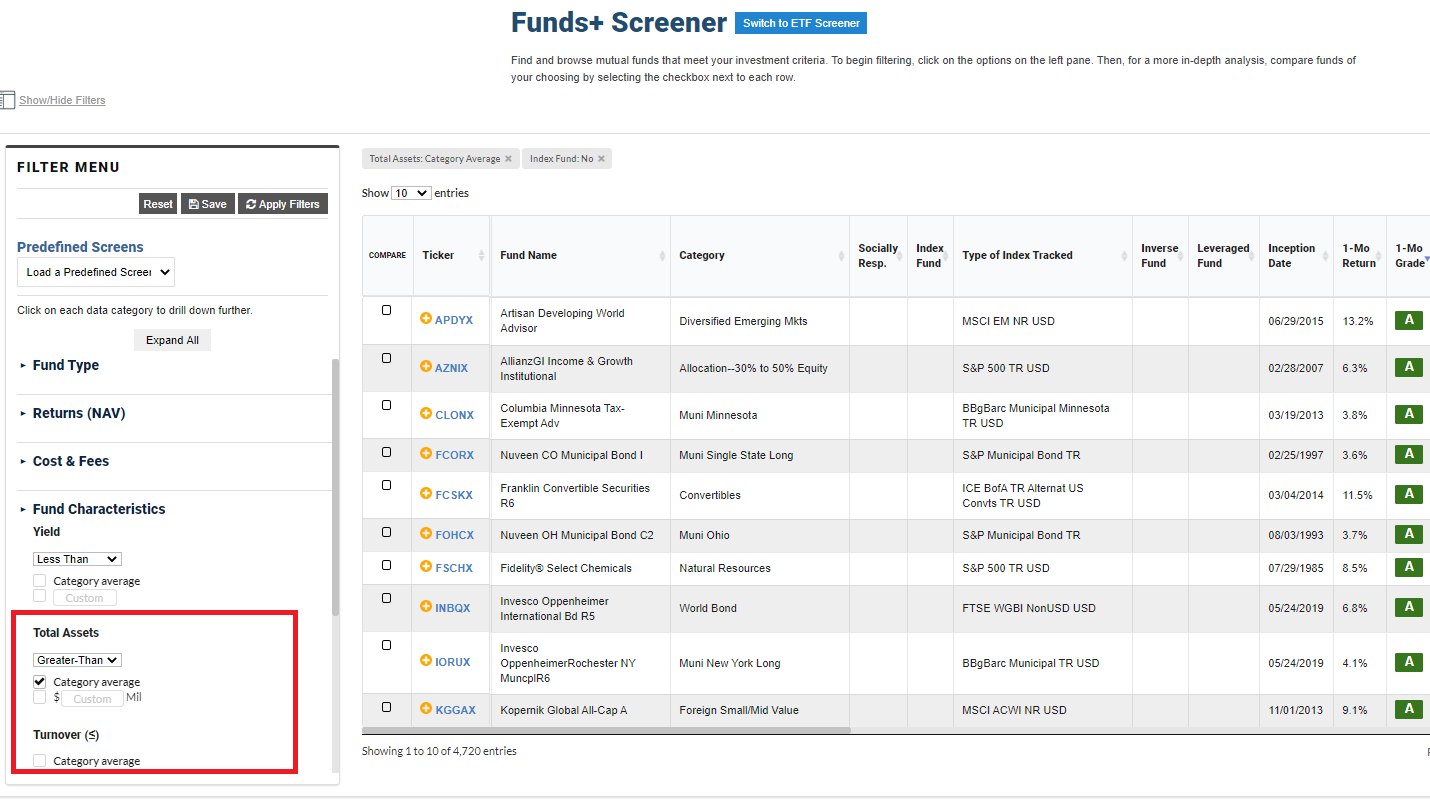
With the Funds+ Screener available to A+ Investor subscribers, you can filter for funds based on whether or not their total assets are greater or less than a fund’s category average or a custom-set figure. Subscribers can also filter for funds that have portfolio turnover that is less than the category average. These filters are available under Fund Characteristics within the Filter Menu.
Funds that cover small stocks or emerging markets, though still passive funds, shouldn’t be swelling with the same AUM that a fund invested in large stocks might be. These funds invest in assets that naturally belong to less liquid market segments, so transactions should be kept smaller as well. A fund trying to execute a large transaction in an illiquid market may suffer a loss of efficiency in trading due to a wide bid-ask spread. This can also make portfolio changes harder for management to accomplish, stifling their ability to execute a fund’s investment objective.
A large AUM can be especially stifling to actively managed funds. Active funds carry higher expense ratios to compensate management for their efforts to distinguish their performance from that of the market. A large AUM may dilute the nuance of a fund that is actively trying to be distinct through investments in less liquid assets. This follows the same logic as passive funds following less liquid markets.

