When choosing between funds for investment, a general rule is to favor funds with lower expense ratios. The expense ratio is a fund’s annual expense expressed as a percentage of its net asset value. A+ Investor subscribers can take advantage of their benefits to screen for low-cost funds.
Both the Funds Screener and the ETF Screener allow you to use the expense ratio grade to easily identify low-cost funds.
The A–F grade is assigned based on the percentile rank of a fund’s expense ratio compared to all the funds in the same category. An A is awarded for an expense ratio that is in the bottom 20% for all funds in the investment category (lowest expense ratios). B indicates below-average rank, C is average rank, D is above-average rank and F is the highest 20% rank.
Consisting of the management advisory fee and basic operating expenses, the expense ratio is the cost of owning a fund. Your return from a fund is inherently reduced by these expenses because its performance must make up their cost from the get-go. A difference between two funds may seem innocuous, but fees will add up significantly as a drag on long-term performance.
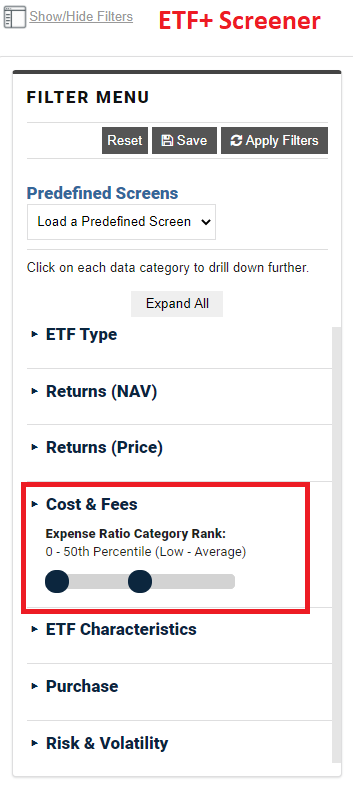
In the Filter Menu of the fund screeners, look for the expense ratio category rank slider under Costs & Fees. Sliding the scale will allow you to look for funds within specific grade ranges. The range noted in the parentheses will change as the slider does.
The only way to overcome a higher expense ratio is to realize a higher return. That can be an impossible task for a fund with lower risk or less aggressive investment objectives, which makes high relative expense ratios hard for management to hurdle. A high relative expense ratio should be of note when screening for funds.
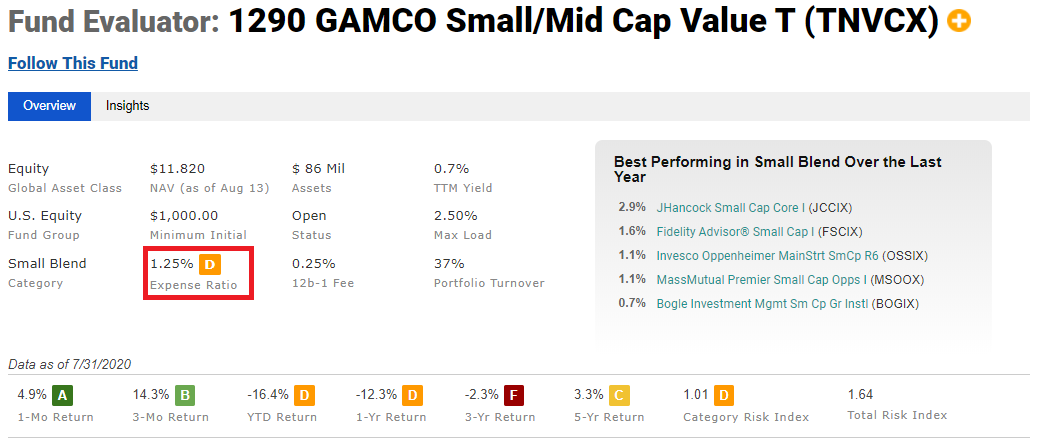
At an individual fund’s Evaluator page on the Overview tab, you can find the expense ratio and its grade immediately at the top. Both the Fund Evaluator and the ETF Evaluator also offer a short description of a fund’s expense ratio and category comparison in the About write-up.
For mutual funds, the expense ratio and grade are also noted on the Evaluator page in the Purchase Information section. For ETFs, the expense ratio and grade can be found on the Evaluator page in both the Portfolio Statistics and Expenses and Fees sections.

