A mutual fund’s performance is determined foremost by the objective of its investment strategy. Unlike most exchange-traded funds (ETFs) that are passively managed to follow a particular market index, most mutual funds are actively managed to represent a specific segment of the market, whether that be an industry, sector, market capitalization or an analyzable investment factor trend such as value or growth.
In practice, this means that some funds will outperform others for a given period depending on what is happening in the overall market, not based on the decisions of that fund’s management team. Although some indicative patterns emerge in the long-term performance of the market, short-term patterns are hard to replicate. Because the equity market is speculative, the past doesn’t dictate the future.
When comparing the performance of two or more funds, always start by matching those in similar categories. The return patterns of different categories may not be comparable, especially over longer periods. The correlations between stock, bond, real estate and commodity funds all decrease over time.
Look at returns over several time periods (as opposed to simply one year or even shorter time periods), the level of risk relative to peers and the expense ratio. Ask if one fund has consistently been better than the other. Has either fund been volatile, with big gains and big losses? Has either fund had a single year with a large gain or a loss that could skew its annualized returns?
The answers to these questions explain why it is important to look for funds with consistent year-to-year performance and why you shouldn’t chase recent best-performing funds. Investing in a fund because it is “hot” may waste valuable portions of your portfolio’s investment horizon; one of the primary advantages individual investors have is the extended length of their investing horizon compared to that of institutional investment managers. The longer your investment horizon, the longer your portfolio has to capture your equity’s growth prospects. Choosing funds for the wrong reasons from the outset is a serious opportunity cost.
The Funds+ Screener, available exclusively to A+ Investor subscribers, makes finding consistent funds easy. It comes with over 20 predefined screens that lay the groundwork for you to select a fund or that you can tweak to better locate funds that fit your portfolio’s profile.
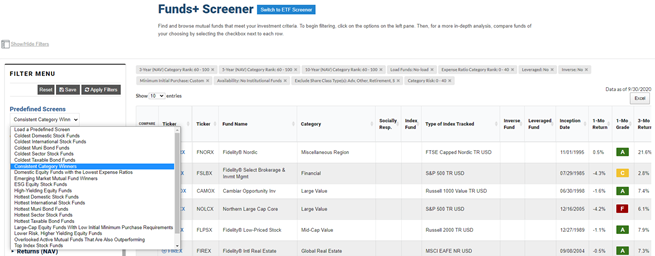
The Consistent Category Winners screen highlights no-load funds with three-year, five-year and 10-year performances that outrank at least half of their category peers and that also have expense ratios that rank in the bottom half of their categories. There are predefined screens for the top index stock funds, municipal bond funds and taxable bond funds, too, that look at performance over the same three-year, five-year and 10-year periods.
If you are still intrigued by the idea of “hot” and “cold” funds, there are predefined screens that filter based on these attributes. They look at the top 20% or bottom 20% of funds relative to their category peers based on one-month performance.

