Loads are commission fees that may be charged to investors when they buy into a mutual fund or when they redeem fund shares. They are expressed as a percentage of a fund’s net asset value. Subscribers to A+ Investor can specifically screen for funds based on the status of whether they carry loads using the Funds+ Screener.
Loads are paid to brokers, agents or investment advisers who act as intermediaries between the individual and the fund’s management company. In theory, loads are compensation for the intermediary’s time and expertise in distributing and recommending shares of a fund to investors.
However, loads are not included in a fund’s operating expenses and, therefore, they are not reflected in a fund’s expense ratio. This is problematic since investors are driven to favor funds with lower expense ratios, which already eat into investment returns. No-load funds have grown in popularity because of this concern.
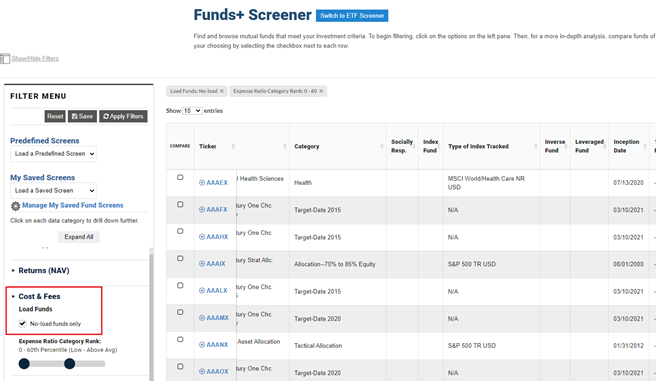
To filter out load funds using the Funds+ Screener, click Cost & Fees in the Filter Menu, and then check the box next to “No-load funds only.” Then select Apply Filters at the top of the Filter Menu to see the results. The majority of the funds in the 25,000-fund universe available to A+ Investor subscribers are no-load funds. As of the end of November 2021, there are about 15,000 no-load funds and about 10,000 load funds.
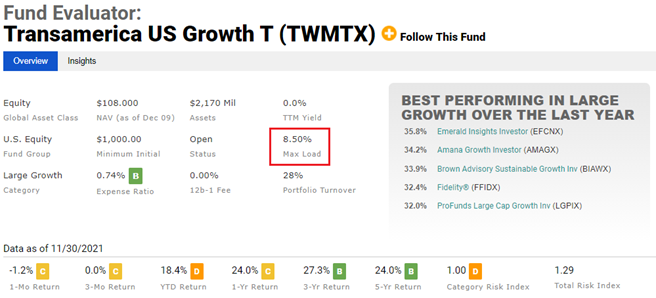
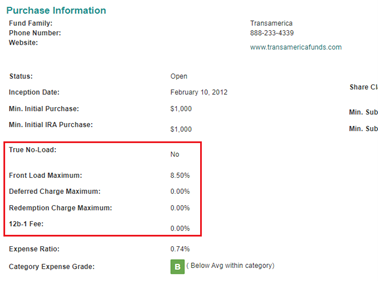
To check any individual fund for the presence of a load, type the fund ticker or name in the Search box at the top of any AAII.com webpage. Select the fund from the drop-down list to open the Fund Evaluator page. (You can also click on any fund ticker to open the Evaluator.) The maximum load, expressed as a percentage in relation to a fund’s net asset value, is among the summary figures at the top of a fund’s Overview page. Load information is also available in more detail at the bottom of the Overview page, under Purchase Information.
The fund’s management company determines the type of load that a fund will carry, which varies by the fund’s classes of shares. Class A shares of a fund typically follow a traditional model for loads, charging a commission for the purchase of shares. These are called front-end loads because investors pay them at the gate to get into a fund. Class B shares typically carry a load on the back end of owning the fund, i.e., paid when investors choose to sell, or redeem, their shares. Back-end loads are also called contingent deferred sales charges. Class C shares carry a back-end load that is usually lower than that of class B shares; however, they also tend to carry a 12b-1 fee, which is a recurring fee that is charged on an annual basis to compensate advisers but is included in a fund’s expense ratio.
Class A shares and their front-end loads are usually considered to be the most cost-effective—among loads—for investors with a long-term horizon and enough cash to hit breakpoint discounts, which reduce the front-end load for purchasing a higher number of shares. The back-end loads carried by class B shares are intended to penalize investors for holding shares for a shorter holding period. Back-end loads normally start to decrease after an investor has held the fund for five years.

