

How often are the stock lists updated?
The lists of companies that pass the strategies are updated each morning, using data as of the previous trading day’s close. At the same time, the data shown for each stock on the lists is also updated daily. Performance numbers for each screen are calculated monthly.
Do the results of the screens represent actual stocks picked by a strategist?
No. The criteria for each screen are defined by our own interpretations of the investment approaches. A strategist may or may not actually invest in a passing stock.
When tracking the screens, do you take sell rules that are different from buy rules into account?
For tracking purposes, the screens are simply rerun using end-of-month data for gain/loss calculations. A stock is “sold” (no longer included in the portfolio) if it ceases to meet the initial criteria, and new stocks are added if they qualify. Stocks that no longer qualify are dropped even if the guru behind a particular approach suggests different sell rules versus buy rules. No additional screens or tests are applied in constructing the hypothetical portfolios.
Are the portfolios rebalanced periodically?
For tracking purposes, stocks are purchased in equal dollar amounts at the start of the month and sold/rebalanced at the end of the month. This, in effect, rebalances the portfolios each month.
Do the performance charts show what I could have done using the screen?
The charts reflect buying and selling every month at the month-end closing. The price gains only (dividends excluded) for the portfolios are tracked. The impact of factors such as commissions, bid-ask spread, dividends, and time-slippage (time between deciding to buy a stock and the actual purchase) are ignored. While this makes the reported performance unachievable even in a best-case scenario, all approaches are subject to the same conditions and procedures. High turnover approaches would tend to benefit from our simplifications. The goal of tracking the performance of the screens is to help gain an understanding of how each approach reacts in different market conditions.
|

How are the total returns calculated?
The figure to the right shows the necessary math. The key item to keep in mind is that you cannot simply sum up a string of annual returns and divide by the number of years to calculate the annual compound rate of return.
If I like an approach, can I simply invest in the list of passing companies?
AAII provides these stock screens as a learning tool. The screens are not meant as investment recommendations, only as examples of the companies you would find when applying a specific investment technique. Each screen attempts to identify a different type of company for a different type of investment style. The companies that match each screen are only a first step in the investment process and further analysis should always be done before actually investing in a company’s stock.
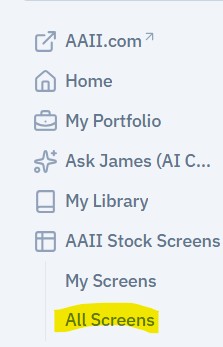
To browse the archive of screening approaches, go to the Investor Hub and choose All Screens from the AAII Stock Screens drop-down in the left-side navigation bar. These stock approaches are also included as predefined screens in AAII’s Stock Investor Pro software program.
Can I see past screen results?
Yes. Look for the calendar above the list of passing companies and choose the date you are interested in.
Do you post the actual formulas used in Stock Investor Pro for each screen?
We don’t have the Stock Investor Pro formulas on the website for the screens since they are included in the software program, but you should be able to easily construct the screen with any program using the criteria described at the bottom of each strategies webpage.
How do I select or build a stock screen that makes sense for me?
It is best to look at screening as a multi-stage process:
- You must first clearly define the objective of your screen.
- Next, you must construct primary criteria that locate the stocks that match your desired characteristics.
- Then, you will need to construct a set of secondary criteria that ensure the companies passing the primary screen did so because they truly meet your objective and not by coincidence.
- Keep in mind that even the best screen represents a starting point for in-depth analysis.
- And last, you may wish to construct a set of criteria to highlight companies in your portfolio that no longer match the objective of your screen.
The article “Constructing Winning Stock Screens” provides an overview of the stock screening process and illustrates how to design or select a stock screen that makes practical sense.