


This week, we cover a strategy that focuses exclusively on purchasing blue-chip companies when they become undervalued relative to each other. Dogs of the Dow is a disciplined approach for individuals seeking value-oriented, large-cap stocks and a steady source of dividend income. Read on to learn how to use AAII’s Dogs of the Dow screen and see lists of companies meeting the criteria.
The Dogs of the Dow approach was popularized in the book “Beating the Dow” (Collins Business, 1992) by Michael O’Higgins and John Downes. The book provides a basic outline of the approach, along with descriptions of each of the Dow stocks. AAII’s screen is based primarily on the book.
A Contrarian High-Yield Approach
Dogs of the Dow is a simple and purely mechanical approach that calls for an investor to buy the 10 highest-yielding stocks in the Dow Jones industrial average at the start of every calendar year. An equal dollar amount is allocated to each of those 10 stocks, and the portfolio is held for 12 months. On the first trading day of the next calendar year, the process is repeated and the portfolio is reconstructed with the new highest yielders.
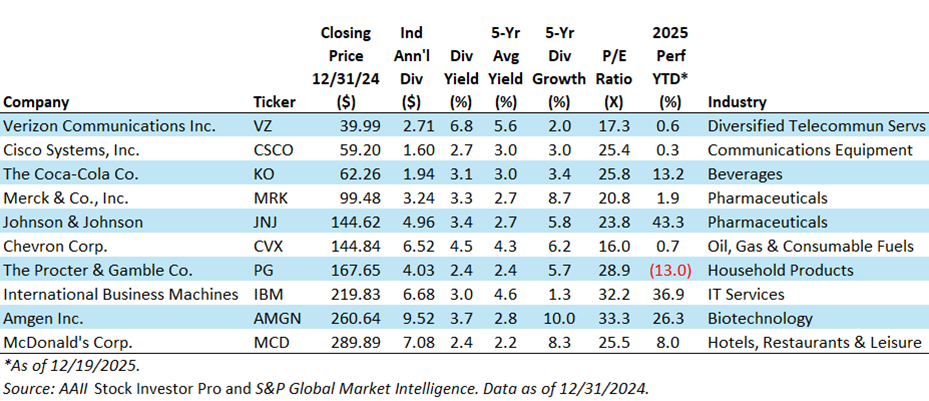
Table 1 highlights the 10 companies that passed the Dogs of the Dow screen as of December 31, 2024. To conduct a year-end checkup, AAII looked at these 10 companies passing the screen at the end of 2025 and updated the performance through December 19, 2025.
Table 1. Companies Passing Dogs of the Dow on 12/31/2024: 10 Highest Yielders and Low Priced 5 Screen (Ranked by Stock Price)
The theory behind Dogs of the Dow is that a high yield implies that a stock is undervalued relative to the other Dow stocks. Investors often seek to purchase supposedly out-of-favor, high-yielding stocks whose relative yields suggest that their valuations are underpriced. This is not always the case, as a stock could have a high yield and trade at high multiples of both earnings and book value.
According to the Dogs of the Dow approach, identifying undervalued Dow stocks is most effectively done by examining the dividend yield—a company’s total dividends expected to be paid over the next 12 months divided by current share price.
If a stock’s price rises faster than its dividend, the yield may be low, indicating that the price may have been bid up too far and may be ready for a decline. Conversely, if the dividend yield is too high, the stock may be poised for an increase in price if the dividend can be sustained. The dividend yield can increase if either the stock price falls or the company raises its dividend payment. Obviously, the latter is always preferable.
While stocks pass the Dogs of the Dow screen because of their high current dividend yield relative to other Dow stocks, a study of the companies’ historical dividend yield can be equally revealing. A current dividend yield that is higher than its historical average would be a sign that a stock is potentially undervalued.
Members are looking for your input. Can you help with this question from the Stock Screening & Analysis Community?
“When using the Dogs of the Dow screen, do you rely solely on the Dow Jones industrial average’s built-in quality filter, or do you also check dividend sustainability metrics like payout ratios, cash flow or recent dividend changes before investing?”
Click here and then choose the Join Community button on the right to answer this question or read other responses.
Johnson & Johnson  (JNJ) is involved in the research, development, manufacturing and sale of a broad range of health care products. The company operates through three main segments: pharmaceutical, medical devices and consumer health. Johnson & Johnson is a global leader in health care, known for developing innovative medicines, medical technologies and consumer health products that improve health outcomes and quality of life worldwide. The company was the top 2025 performer from the Dogs of the Dow 2024 list, up 43.3%.
Johnson & Johnson reported third-quarter 2025 revenue of $24.0 billion, up 6.8% year over year, driven by strong performance across its pharmaceutical and medical technology businesses. This prompted the company to raise its full-year 2025 sales outlook. Johnson & Johnson also delivered robust earnings, with net income and adjusted earnings per share showing significant growth compared to the prior year. During 2025, the company continued to sharpen its strategic focus on high-growth areas such as oncology, immunology, neuroscience and cardiovascular care. It also announced plans to spin off its orthopedics business to further enhance long-term growth and operational efficiency.
The worst 2025 performer from the Dogs of the Dow 2024 list was Procter & Gamble Co. (PG), down 13.0%. Procter & Gamble is a global consumer packaged goods company operating across five segments: beauty; grooming; health care; fabric and home care; and baby, feminine and family care. It markets a broad portfolio of well-known brands spanning personal care, health products, household cleaning and family care. Its brands include Tide, Pampers, Gillette, Olay, Crest, Oral-B, Dawn and Charmin. Procter & Gamble sells its products worldwide through a wide range of retail, e-commerce and direct-to-consumer channels.
Procter & Gamble reported revenues of $22.4 billion for its fiscal first-quarter 2026 ended September 30, 2025, up 3.0% year over year. The current consensus earnings estimate for fiscal second-quarter 2026 is $1.871 per share. Three months ago, it was $1.936 per share.
The Dogs of the Dow philosophy is a contrarian approach. Like all basic value-oriented techniques, this dividend-yield strategy attempts to identify investments that are out of favor. Contrarian techniques such as this are based on the premise that markets tend to overreact to news—both good and bad—and push the price of a security away from its intrinsic value.
The biggest challenge with the Dogs of the Dow strategy is that it limits its universe to a highly restrictive group of stocks—the 30 stocks comprising the Dow. These are large, well-known companies with long histories of profitability. Investors looking at high-yield stocks should always ensure that the company can continue to pay its dividend.
The stocks passing the Dogs of the Dow screen are sorted by price, from low to high. Doing so makes it easy to identify those also passing the Dogs of the Dow Low Priced 5 screen, which selects the five lowest-priced components from the 10 Dow stocks with the highest dividend yields. The latter approach is even more concentrated and thus more vulnerable to a major setback in one particular stock.
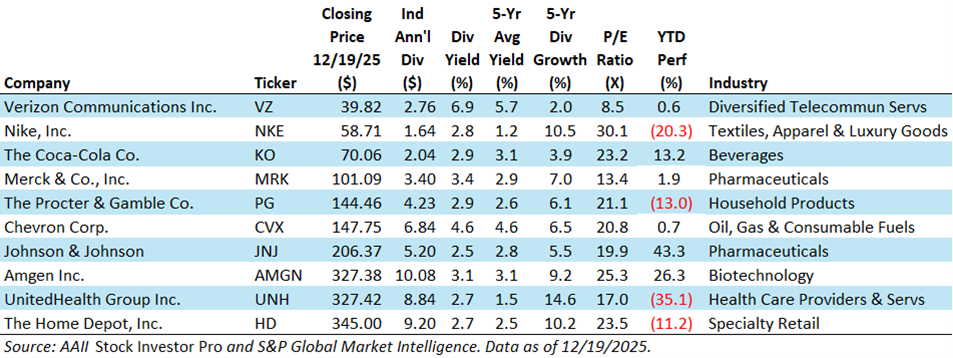
As mentioned above, the Dogs of the Dow approach requires an investor to buy the 10 highest-yielding stocks in the Dow at the start of every calendar year. As of December 19, 2025, the companies highlighted in Table 2 make up the new Dogs of the Dow list.
There are three deletions and three additions to the list of companies that currently pass the Dogs of the Dow screen compared to the end of 2024. Cisco Systems Inc. (CSCO) no longer passes the screen in 2025. It has been replaced by Nike Inc. (NKE), one of the largest retailers in the world. Also, International Business Machines Corp. (IBM) was removed and replaced with Home Depot Inc. (HD). Lastly, UnitedHealth Group Inc. (UNH) now passes the screen, replacing McDonald’s Corp. (MCD).
Comparing the passing company composition of the Dogs of the Dow 2024 and 2025 lists shows that the average yield remains at 3.5%. The total indicated annual dividends from the 10 companies rose from $48.28 to $54.23 per share.
Table 2. Companies Passing Dogs of the Dow on 12/19/2025: 10 Highest Yielders and Low Priced 5 Screen (Ranked by Stock Price)
___
Keep in mind that no matter how well a stock screening methodology has performed (or how badly it has underperformed) over the long term, stock screening is only the first step in the stock selection process. You will want to do your homework to see why these companies are at their current levels. Only then will you gain insight into those that will continue to languish and those that may eventually flourish.
The stocks meeting the criteria of the approach do not represent a “recommended” or “buy” list. It is important to perform due diligence to verify the financial strength of the passing companies and to identify those stocks that match your investing tolerances and constraints before committing your investment dollars. Keep in mind that the quantitative screens AAII has developed are based upon our interpretations of published works tied to the market gurus.
Discussion
FREE REPORT

No comments have been added yet. Add your thoughts to the discussion!
You need to log in as a registered AAII user before commenting.
Log InCreate an account