

AAII Survey: Lower Fees, Other Benefits Not Enough to Entice Investors to Provide More Personal Information
by Wayne A. Thorp | March 25, 2019
Wayne Thorp recently spoke at the AAII Investor Conference 360. Video replays of all sessions are available for purchase. Go to www.aaii.com/investorconference for more details.

Today, personal information is big business. Technically known as personally identifying information (PII), the National Institute of Standards and Technology defines personally identifying information as “any information about an individual maintained by an agency, including (1) any information that can be used to distinguish or trace an individual’s identity, such as name, social security number, date and place of birth, mother’s maiden name, or biometric records; and (2) any other information that is linked or linkable to an individual, such as medical, educational, financial, and employment information.”
Whether you like it or not, companies are profiting from your personally identifying information. Usually, this is money you never get a cut of. However, sometimes you are rewarded for providing personal information that companies can use to build better services or sell to other companies.
But how much information would you provide to a company, if it meant you would receive extra benefits or be charged lower fees?
A recent study by Accenture plc indicates that most consumers worldwide would share more personal data with banks and insurers in exchange for cheaper services despite privacy concerns. The survey showed that six in 10 consumers polled said they would share data such as lifestyle habits if they received benefits ranging from gym membership discounts to offers based on their location.
AAII Weekly Survey Question
After hearing about the Accenture study, we were curious to see if our readers held the same views. So, last week’s survey question asked:
Would you be willing to share more personal data—location data, lifestyle information, etc.—with financial institutions in exchange for lower pricing on products and services or other benefits?
Here are the results:
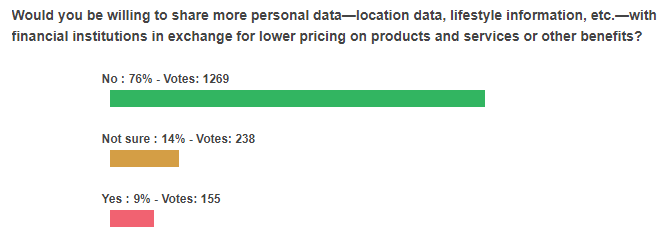
In all, 1,662 votes were cast.
What is immediately apparent is our readers don’t hold the same views as those polled by Accenture.
By an overwhelming count—76%—our readers would not be willing to share more personal data, even if they received some type of reward for doing so.
In fact, only 9% said they would be willing to share more personal information with financial institutions in return for lower fees or some benefit.
The remaining 14% are unsure whether they would be willing to provide more personal information to a financial institution for something in return.
Weekly Special Question
One of the biggest fears people have when it comes to their personal information is that it gets compromised. It seems like everything week there is a news story of a retailer or some other institution reporting a security breach where personal information is compromised.
For that reason, consumers are becoming more concerned about how they can protect their personal data. So last week’s special follow-up question asked:
What steps do you take to protect your personal data?
In all, we received 171 responses.
The number one way in which our readers protect their personal data is by not sharing it (17%).
Closely following in second place, our readers protect their personal data by not having social media accounts (16%).
Roughly 12% of readers say they protect their personal data by not using online services or by avoiding storing information on the cloud.
From there the responses became more varied. The fourth most popular way in which our readers protect their personal data is by regularly changing their passwords or by using “strong” passwords (9%).
Rounding out the top five responses, 6% of readers say they cute a credit monitoring/identify protection service.
Here is a sampling of the responses from our readers as to why they don’t use technical analysis:
- “I change my passwords regularly.”
- “I try not to access any online search engines or requests that require any personal information that I would not like made public.”
- “I do not put anything on the cloud. All info stays on my personal drives or computers which have a fair amount of protection.”
- “This is a problem, but most people don’t realize that they are already sharing personal data by just clicking on an offer. I buy only from a few vendors so as to not share my information more than necessary. I also delete cookies and use robust antivirus and firewall software.”
- “I am reluctant to do much banking with my iPhone. I do very little on Facebook. I am becoming more and more reluctant to do things online.”
Everybody has an opinion! Why not give us yours? Participate in our weekly member poll, updated every Monday, and see the results online at www.aaii.com/memberquestion.
Discussion
Bud from WA posted over 7 years ago:
I chuckle when I read some of these responses. To me, they show more naïveté than knowledge of security. They seem to be saying that they trust the post office more than they do their bank or broker. In regards to that I will simply ask the question: When was the last time you ever received a piece of your neighbor's mail, or vice versa? When was the last time your broker ever credited someone else's stock trade to your account, or vice versa.
You need to log in as a registered AAII user before commenting.
Create an account