


Related

Portfolio Strategies
A more conservative investment strategy might not do as well as a more aggressive strategy.
by Jerome Clark | July 2010

Retirement investors must balance two fundamental risks—the risk of not having enough growth in their portfolios to sustain income for many years in retirement versus the risk of a steep market decline that could substantially cut into assets at the worst time, such as retiring during a bear market.
Prior T. Rowe Price studies have noted that a lower equity exposure in a retirement portfolio has helped protect against short-term market setbacks, but provided less retirement income over the long run. A new analysis shows that even those who pursue a more conservative investment strategy to avoid large losses at retirement—with the intention of cashing out their assets soon after retiring to, say, buy an annuity—might not do as well as those with a more aggressive strategy. This was the case even for some risk-averse retirees who started withdrawing their retirement savings on the eve of the 2008 market crash.
The reason: Even with a sharp downturn in stocks at retirement, an investor who had a high allocation to equities for many years prior to retirement had the opportunity to accumulate more assets than an investor who had pursued a more conservative allocation. In other words, though many investors naturally focused on their losses in the 2008 market crash, those who had a sufficient exposure to stocks for years leading up to the crash may still have ended up better off than investors who had been much more conservatively invested all along.
The new T. Rowe Price study compared the outcomes for two hypothetical investors who each retired at the end of 2007 and planned to withdraw all of their savings in three installments: one-third in January 2008, one-third in January 2009, and one-third in January 2010. It then examined which of these investors would have been able to withdraw more savings if one had been invested with less equities and the other invested with higher equity exposure.
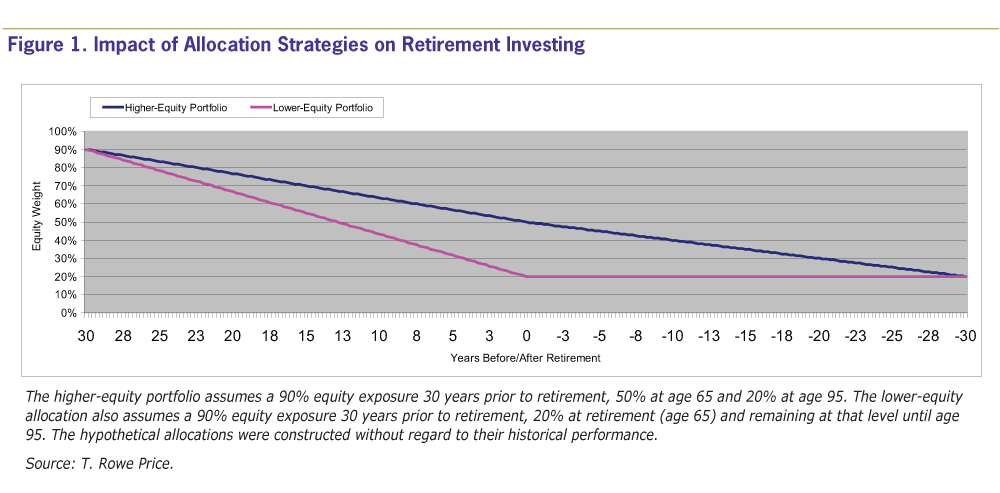
As shown in Figure 1, the higher-equity investor begins with a 90% allocation to stocks 30 years prior to retirement (which is assumed to start at age 65). His allocation is reduced by 1.32 percentage points a year for the next 30 years, so he has 50% of his portfolio in stocks at age 65. After retiring, the allocation to stocks is reduced one percentage point a year after that so the investor has 20% in equities at age 95.
Having experienced a good deal of such volatility the past few years, many investors who are about to retire—and particularly those who plan to withdraw their retirement savings soon after retiring—might find the idea of less market risk from less equity exposure more appealing. Indeed, the study shows that if the two investors each retired at the end of 2007 with $1 million retirement nest eggs and planned to withdraw their respective savings in three equal annual installments, the total withdrawals of the less-aggressive investor would have been more than that of the more-aggressive one: $1,002,680, versus $919,970.The more conservative investor—the one with a lower equity exposure—also begins with a 90% allocation to stocks 30 years prior to retirement (which is assumed to begin at age 65). His exposure to stocks is reduced by 2.32 percentage points a year, so that the stock allocation is 20% at retirement. His allocation to stocks then remains at that level to age 95. In contrast to focusing on the risks of inflation and longevity, this investor is focused on reducing the risks from short-term market volatility.
This result should not be surprising, as the portfolio with the higher equity allocation encountered greater short-term volatility. Over 2008 and 2009, this portfolio with greater equity exposure lost 4%—including a decline of 17.3% in the 2008 bear market. In contrast, the lower-equity portfolio gained 5.5% over the two-year period.
Looking at only the withdrawals from equal levels of retirement savings, however, ignores when the two investors started investing. Retirement savers do not just happen to arrive at their retirement dates with nest eggs that are independent of asset-allocation decisions made over years of saving.
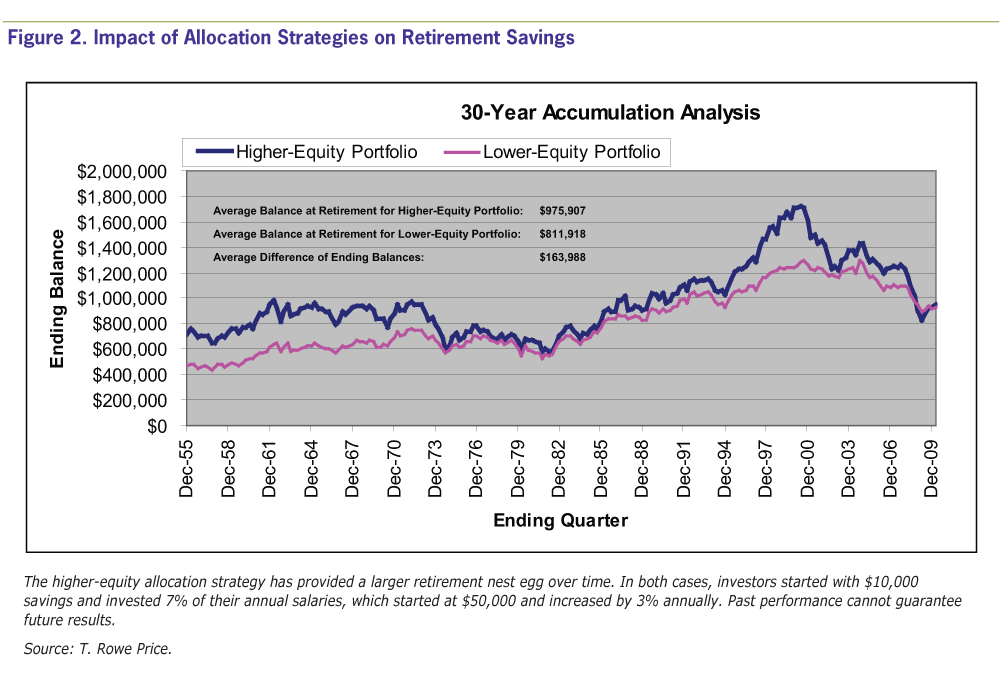
That is where the higher returns of the more aggressive portfolio—because of the historically higher returns of stocks over bonds—added up to a big difference in withdrawals, as shown in Figure 2. This part of the study examined two savers following these same strategies for 30 years, both starting with $10,000 initial savings, $50,000 salaries that increase 3% a year and saving 7% of their annual salaries.
Comparing WithdrawalsThe study found that in rolling, 30-year time periods from the end of 1925 to the end of 2009 (218 periods in all, measured quarterly), there were only four time periods in which the more conservative investor ended up with a larger ending balance than the more aggressive one. Over these rolling 30-year time periods, the higher-equity portfolio accumulated, on average, $163,988 more than the more conservative portfolio.
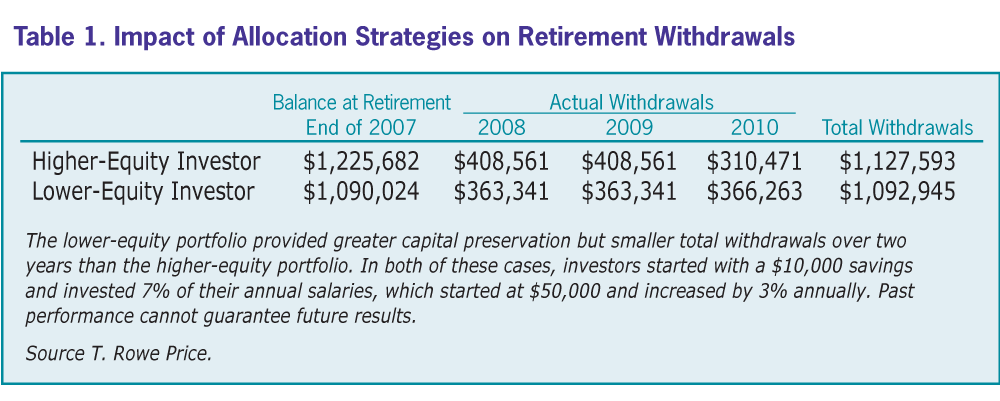
Taking into account the difference in potential balances at retirement between these two investment approaches, the study took a second look at how investors who planned to withdraw their nest eggs over two years starting in 2008 fared. This time, the study assumed these investors started saving 30 years before retiring at the end of 2007. As shown in Table 1, in this case, the more aggressive investor arrived at retirement with approximately $135,000 more than the conservative investor.
Although the more aggressive investor still lost more money than the relatively conservative investor in the market crash of 2008, his initially greater nest egg at retirement enabled him to withdraw about $35,000 more over the two years—even though he experienced more market volatility in that time. In other words, the more conservative approach to investing—perhaps more attractive to an investor intending to withdraw his nest egg shortly after retirement—did not turn out to be better in this case.
This is a particularly notable outcome given that the decade before the final withdrawal in this study (made in January 2010) was such a poor one for stocks, posing a big handicap for the strategy with higher equity exposure.
What if these investors, rather than withdrawing all of their assets over a three-year period, decided to gradually withdraw them over a 30-year retirement period?
We don’t know, of course, what the next 30 years will bring, and past performance cannot predict future results. However, the study also examined how the two strategies performed over all the historical rolling 30-year withdrawal periods from 1925 to 2009.
This analysis assumed that the investors entered retirement with the total assets each had accumulated after 30 years of saving cited in the example above; they continued with their respective investment strategies throughout retirement; and they withdrew about $39,000 (4% of the larger portfolio assets) in the first year, increasing that amount by the Consumer Price Index (CPI) inflation rate each subsequent year.
In this case, the more aggressive strategy was able to provide all the withdrawals and still have money left over after 30 years in 88% of the periods examined. The more conservative strategy was able to provide all the withdrawals in only 12% of the periods. In other words, it ran out of money before 30 years in 88% of the periods.
The portfolio with greater equity exposure is more appropriate for an investor who plans to withdraw his savings gradually throughout retirement, not quickly. Even so, a more aggressive strategy could potentially benefit the investor who expects to take out all or most of his money soon after retiring—even in a down market—if he had pursued the higher-equity approach for a number of years in advance.
Portfolio Strategies

Investor Professor

Bob from IL posted over 16 years ago:
Michael from CA posted over 16 years ago:
Jon from AZ posted over 16 years ago:
William from KS posted over 16 years ago:
Tom from NM posted over 16 years ago:
S from VA posted over 16 years ago:
B Wildfeir from NY posted over 8 years ago:
John Greer from MI posted over 8 years ago:
James Joslin from NC posted over 8 years ago:
cept4Grace from Washington posted over 7 years ago:
reality from NY posted over 7 years ago:
Neil from PA posted over 7 years ago:
KENDRICK MILLER from N CAROLINA posted over 6 years ago:
charlie bird from Washington posted over 6 years ago:
DEM from Arizona posted over 6 years ago:
Craig from California posted over 6 years ago:
Steve Peterson from OR posted over 6 years ago:
Kurt from ID posted over 6 years ago:
Mike from Kentucky posted over 6 years ago:
Pat from IL posted over 6 years ago:
Jon from Texas posted over 6 years ago:
You need to log in as a registered AAII user before commenting.
Log InCreate an account