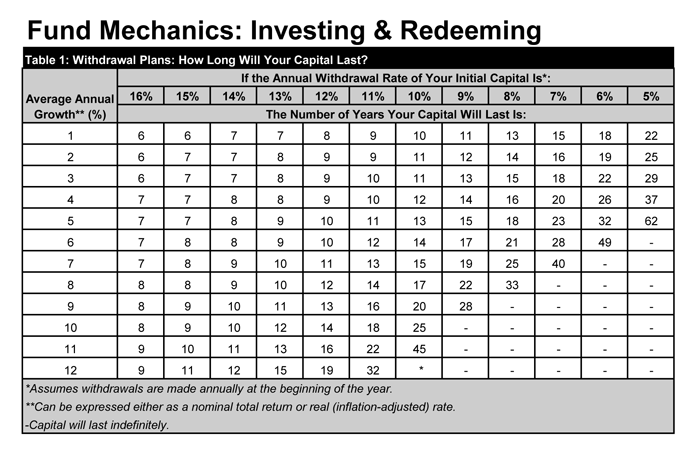
If the rate at which you withdraw is too close to or exceeds your fund's total return (or growth rate), you will eventually deplete your capital. Table 1 shows approximately how long, in years, your principal will last given the return generated by your fund and your withdrawal rate on your starting investment amount. The numbers in the body of the table are conservative estimates since they assume withdrawals are made at the beginning of the year. Thus, the first annual redemption would occur immediately. When the portfolio's growth exceeds the withdrawal percentage by a sufficient amount, you could continue withdrawing for an indefinite period; asterisks appear in these instances.
Table 1 can help you determine the best redemption rate. For example, if you assume your fund will grow at 9% per year in nominal terms, you could withdraw 10% of your initial investment amount annually for 20 years. If you trim your withdrawal rate back to 8%, or less, your capital would last indefinitely.
What about inflation? Suppose you expect the price level to increase by 4% per year, on average, and want to withdraw 10% in constant dollars. This means the amount you withdraw each year would need to increase by 4%. In this more realistic case, your capital would be growing at a real, or inflation-adjusted, rate of 5% (9% — 4%). You've simply reduced your 9% nominal return by the anticipated inflation percentage.
Now look in the 5% "average annual growth" row in Table 1. Your nest egg would last only 13 years, when inflation is factored in, with a 10% withdrawal rate. If you want the capital to last longer, you have to reduce your withdrawals. For instance, at an 8% redemption rate your capital would last 18 years; at 6% it would stretch for 32 years.
Taxes are another consideration. In addition to reducing an expected return for inflation, the careful planner can scale it back further based on an estimate of the impact of taxes on his or her results. Depending on your tax bracket and the fund you're using, your expected return after inflation and taxes could be as low as 2% to 1%, or less.
Table 1 can also help you determine an appropriate withdrawal rate, based on how long your capital must last. Suppose your capital must last at least 20 years, during which you expect 4% inflation yearly. How much can you safely withdraw? If you estimate that your stock fund can return at least 9% annually in nominal terms (5% in real terms), you could withdraw up to 7%—in which case your principal should hold out for 23 years. It would be safer to withdraw a bit less than 7% to provide some margin for error. In fact, in a world with taxes and inflation you risk eventually depleting your capital with a withdrawal rate that exceeds 6% or so, especially if your returns don't live up to your expectations.
Continue to Step 4 »